

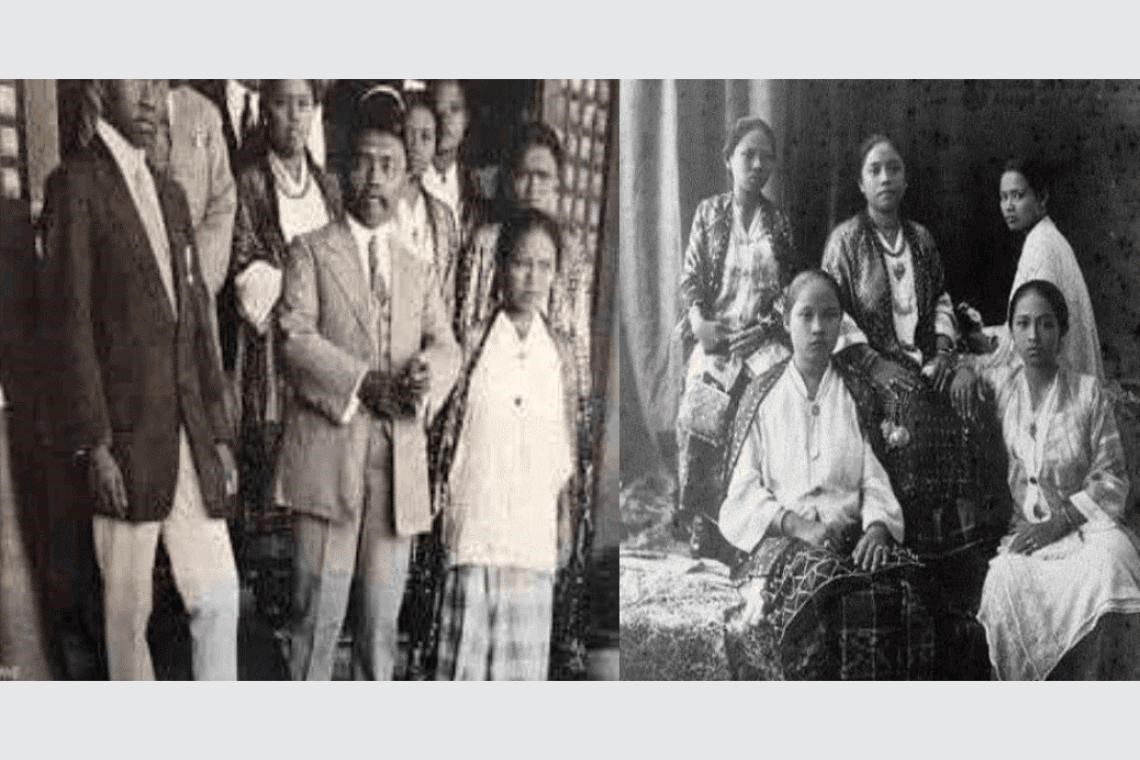
While Sultan Jamalul II paired Western three-piece suits with a traditional Pis Siyabit headpiece, elite Tausūg women layered imported European silks and luxury jewelry over ancestral Batawi blouses to project diplomatic equality without erasing their indigenous identity. Source: Philippine Heritage Costume and Dress Facebook.
The story of the agreement is often presented as one of political surrender. In 1899, Sultan Jamalul II agreed to keep the Sulu Sultanate outside the growing Philippine-American War, hoping to preserve a measure of independence as American power expanded across the Philippines.
But the agreement also illustrates a larger historical reality. By the beginning of the twentieth century, the Sultanate's traditional economic and military foundations were weakening. Western powers had disrupted regional trade networks and made the slave raiding that had helped sustain Sulu's maritime power increasingly impossible. Sulu had fewer resources with which to resist the United States and was also politically separated from much of the wider resistance in the Philippines and Mindanao.
The Sultanate ultimately could not survive this changing environment. But the collapse of its political power did not mean the disappearance of the Tausug people or their identity.
The Bates Agreement reflected Jamalul II's attempt to manage a rapidly changing balance of power. The United States later argued that the agreement required the Sultan to remain outside the conflict, while Jamalul eventually joined the wider Moro resistance after it became clear that the arrangement would not provide the security he had sought.
"The end of the Sultanate did not automatically erase Tausug traditions, Islamic faith, customary practices, language, family structures, or communal loyalties. "
The 1915 Carpenter Agreement marked a still greater turning point. Jamalul II effectively conceded the Sultanate's political authority and accepted its incorporation into the American administration of the Philippines. This was a profound political defeat. Yet political sovereignty and cultural identity were not the same thing.
The end of the Sultanate did not automatically erase Tausug traditions, Islamic faith, customary practices, language, family structures, or communal loyalties. These elements of society were rooted in communities that existed beyond the political authority of the Sultan himself. The distinction shows why the end of a state does not necessarily mean the end of the people associated with it.
Updated headlines for free, straight to your inbox—no noise, just facts.
We collect your email only to send you updates. No third-party access. Ever. Your privacy matters. Read our Privacy Policy for full details.
The survival of Tausug culture was not the result of the Sultanate winning its political struggle. It was, in many ways, a demonstration of the limits of political power itself. The House of Kiram could not preserve the Sultanate as an independent state. Its traditional economic system had weakened, its military position had deteriorated, and its political isolation limited its ability to resist the United States.
But the Tausug community was larger than the institution that had ruled it. Traditional clothing, including the Pis Siyabit, remained an important expression of Tausug identity. Other forms of dress, craftsmanship, language, Islamic practice, customary traditions, and communal relationships also continued to connect later generations with their history.
"What survived was not an untouched version of the nineteenth-century Sultanate, but a living identity capable of changing while retaining important elements of its heritage."
That continuity should not be mistaken for an unchanged society. Tausug communities, like other societies, adapted to new political, economic, and social conditions. What survived was not an untouched version of the nineteenth-century Sultanate, but a living identity capable of changing while retaining important elements of its heritage.
This distinction remains relevant to contemporary debates about Sulu. Figures such as Princess Jacel Kiram have sought to present historical territorial claims as part of a broader Philippine national struggle, while other members of the contested Kiram succession have emphasized Sulu's separate historical identity while supporting aspects of Moro self-determination.
These competing interpretations reflect the complexity of Sulu's past. But they can also obscure a more important lesson from the Sultanate's decline. The historical record does not show that political separation enabled Sulu to preserve its independence. Instead, the Sultanate's attempt to secure its own path ultimately ended with the loss of its sovereignty. Its economic and military weaknesses made it unable to withstand the foreign forces reshaping the region.
What survived was not the Sultanate as a political system, but the people and culture that existed beyond it. Today, Sulu faces many of the same basic questions in a very different form. The province remains one of the least developed parts of the Philippines, while debates over sovereignty, historical claims, and political identity continue to attract attention.
"The Tausug people endured because a community is larger than the political institution that once ruled it."
The lesson of the Sultanate's collapse is therefore not that Tausug identity depends on restoring an old political order. It is that identity can survive political change. The challenge now is to turn that resilience into a foundation for modern development. Tausug history remains a source of cultural strength, but the future of Sulu will depend less on restoring the institutions of the past than on building the economic opportunities, public institutions, and political cooperation needed by its people today.
The Sultanate fell because its old system could not meet the demands of a changing era. The Tausug people endured because a community is larger than the political institution that once ruled it.
REFERENCES
Know Sulu. (2026, August 11). Sulu sought its own deal as its power failed against the modern era. Know Sulu. https://know-sulu.ph
Know Sulu. (2026, August 10). Tausug Dress and the Long Fight to Preserve Identity. Know Sulu. https://know-sulu.ph
Know Sulu. (2026, June 24). The Real Sabah Story: Porous borders, Impossible Claims, and Politics. Know Sulu. https://know-sulu.ph
Philippine Update. (n/a). The Bates Treaty. Philippine Update. http://www.philippineupdate.com

KnowSulu is your trusted source for verified facts, news, and legal insights about the Sulu region. Committed to integrity, our mission is to empower the people of Sulu by providing accurate, transparent, and reliable information that matters.
