

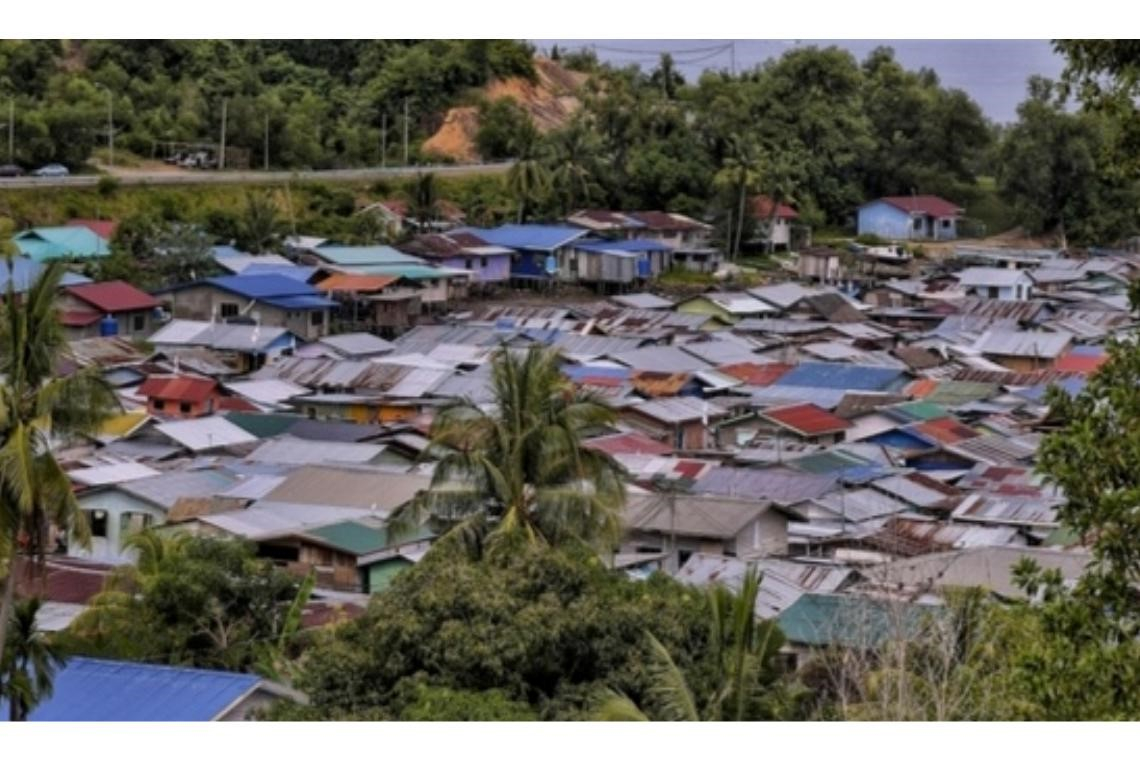
Illegal settlements have sprung up in Sabah by the hundreds, posing substantial environmental and labor abuse risks. Malaysia’s efforts to regulate such settlements have become a frequent topic in distorted narratives seeking to acquire Sabah for the defunct Sulu Sultanate. Image Source: Daniel John Jambun, BoPiMaFo
The most recent post shared by Rajah Gloman Membrere Merritt, a supposed “special representative” of the defunct Sulu Sultanate, suggests that Sabah’s experience is not so different from that of Palestine. Let that sink in.
The post uses edited portions of interviews conducted by Dutch journalist Ruben Terlou with individuals claiming to have experienced the destruction of their homes during Malaysian operations to remove undocumented migrants. A graphic attached to the Facebook post specifically alleges the burning of homes and the jailing and deportation of Sabah’s “original” inhabitants.
Does any of this measure up to historical fact—or to the plight of Palestinians, with Gaza having suffered the destruction of much of its built environment and tens of thousands of deaths since the conflict began in 2023?
For one, it is important to note that there is no credible evidence of a purge, genocide, or systematic removal of any ethnic group from Sabah by the Malaysian government or any other group.
What has instead been taking place is a long-running migrant and socioeconomic challenge in a region defined by porous borders. Within that modern challenge, the removal of some illegal settlements and the deportation of some undocumented migrants have taken place, though not on a scale that could reasonably be characterized as the systematic removal of an ethnic population. Indeed, estimates of the undocumented population in Sabah vary considerably, with some suggesting that it could comprise as much as a third of the state’s population and others putting the figure at around 1.5 million.
Despite this, deportation operations typically repatriate individuals in the low thousands. Most recently, 4,750 undocumented migrants were deported to their home countries, with the largest group sent to the Philippines, following arrangements with their respective governments.
Two details are particularly important. First, deportations are conducted in coordination with the countries of origin of the undocumented migrants. Second, efforts to address the problem have thus far remained limited, typically focusing on the removal of hundreds of unsafe and environmentally harmful settlements that have emerged in the state rather than targeting any particular ethnic group or seeking to eliminate an undocumented population that is, in many respects, deeply embedded in Sabah’s economy.
“Deportations are conducted in coordination with the countries of origin of the undocumented migrants. Second, efforts to address the problem have thus far remained limited.”
Unfortunately, just last week, Muedzul reshared an image showing dire prison conditions near Manila from 2016, during Rodrigo Duterte’s “War on Drugs,” and falsely claimed that it specifically depicted the overcrowding of targeted Tausug detainees in Sabah. The claim was quickly condemned by the French news agency AFP, which took the original photograph.
Muedzul’s post further suggests that Tausugs—locally referred to as Suluks in Sabah—are the original people of Sabah. This claim is also repeated by Gloman Membrere Merritt. Under this narrative, the removal of undocumented migrants, including those of Tausug origin, is portrayed as a purge of Sabah’s “true owners.”
Yet does this hold up to history or fact?
The reality is that Tausugs have long been a minority group in Sabah. The state’s largest indigenous community is the Kadazan-Dusun, which accounts for roughly a third of Sabah’s population. The Sulu people entered Sabah’s historical story during an era of maritime raiding, trade, and political competition that ultimately contributed to the disputed cession of Sabah by the Sultan of Brunei to the Sultan of Sulu in 1704.
The extent of the Sulu Sultanate’s effective control over Sabah at the time remains a matter of historical debate, with records indicating substantial autonomy among local chiefs as well as the continued involvement of Brunei in the region. Indeed, when the British sought control of North Borneo in 1878, they considered it necessary to conclude agreements with both the Sultan of Sulu and the Sultan of Brunei to secure their claims to the territory.
This history does not support the argument that Sabah is intrinsically a Tausug territory. The Tausugs are a proud and accomplished maritime people whose historical homeland is the Sulu Archipelago, in what is today the Philippines. Their historical connections to Sabah are real and significant—but they are not the same thing as exclusive indigenous ownership of the state.
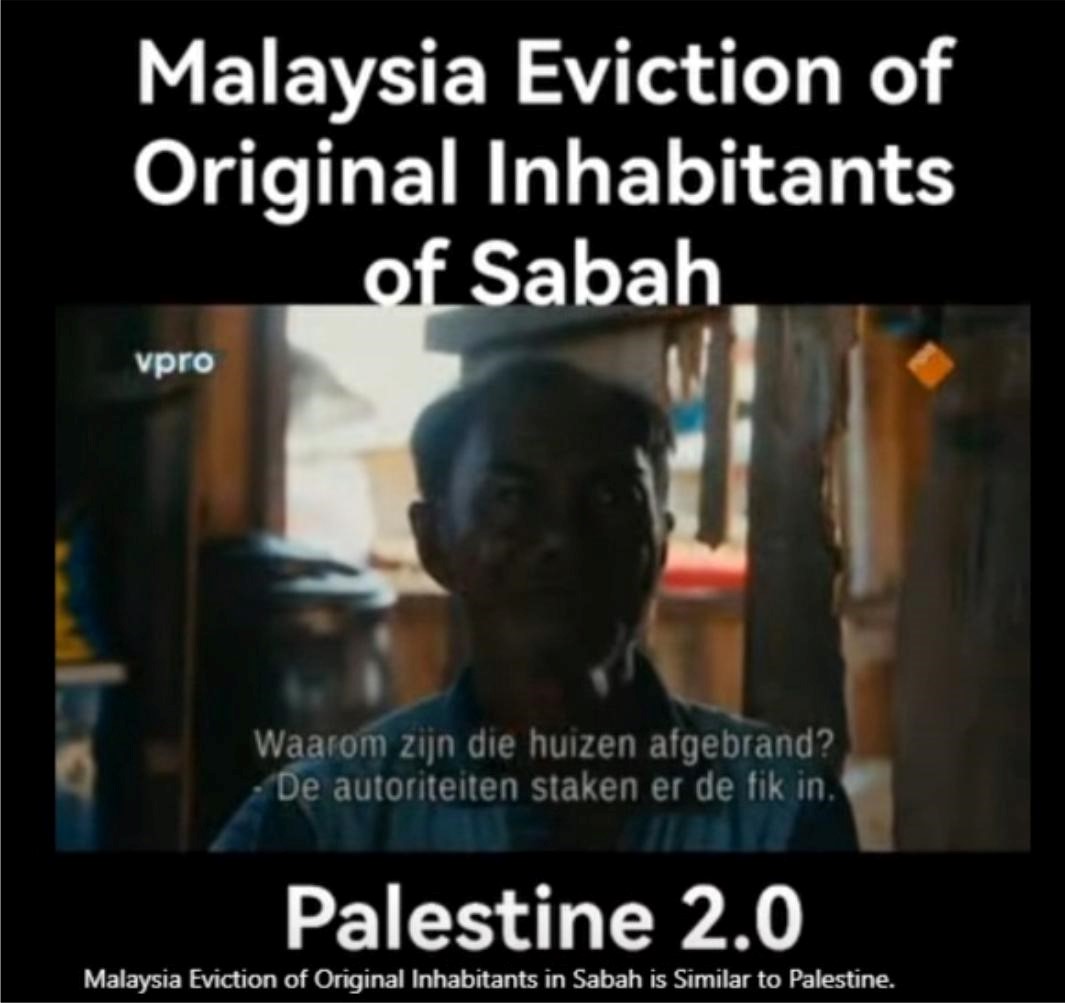
Rajah Gloman Membrere Merritt’s post, using an edited segment from an interview conducted by Dutch journalist Ruben Terlou, draws a dangerous comparison between Sabah’s migrant crisis and the Palestinian conflict. Image source: Rajah Gloman Membrere Merritt, Facebook
Updated headlines for free, straight to your inbox—no noise, just facts.
We collect your email only to send you updates. No third-party access. Ever. Your privacy matters. Read our Privacy Policy for full details.
If Tausugs are an important yet small minority next to dominant indigenous groups in Sabah, how can it be claimed that the government of Sabah is removing its original and rightful owners in nontargeted efforts against illegal migration? And, more importantly, how can Sabah’s admittedly difficult migrant and socioeconomic environment be compared with the devastation that has ravaged Gaza?
Such a comparison risks becoming an insult to Palestinians rather than an expression of solidarity with them. Nor can such posts reasonably be considered supportive of the very migrant and undocumented populations they claim to defend.
Indeed, as has previously been reported, one obstacle to normalizing the status of undocumented Tausugs in Sabah has been the refusal of the Philippines to establish a consular presence in the state, despite Malaysian requests for one. The issue is politically sensitive because the establishment of such a consulate could be interpreted as recognition of Sabah’s status as part of a foreign country, running counter to the territorial narratives that Muedzul and other Filipino politicians continue to promote.
But are such political narratives worth depriving Tausugs and other Filipino migrants of access to fair representation, consular services, and a clearer legal status?
The history of Sabah is complicated enough without rewriting it to fit contemporary political narratives. Its migrant crisis deserves serious discussion, and the rights and welfare of undocumented migrants deserve attention—starting with the agreement of the Philippines to establish a consulate to service Filipinos in Sabah. But neither cause is served by false images, distorted history, or comparisons that equate Sabah’s complex migration problems with the catastrophe in Palestine.
REFERENCES
Free Malaysia Today. (2026, August 20). Sabah repatriates 4,750 undocumented migrants. https://www.freemalaysiatoday.com
KnowSulu. (2026, January 27). Why the Philippines' Sabah claim collides with its own Constitution. https://know-sulu.ph
KnowSulu. (2026, June 30). Slaves and Seapower: The Complex Power of the Sulu Sultanate. https://know-sulu.ph
KnowSulu. (2026, June 24). The Real Sabah Story: Porous borders, Impossible Claims, and Politics. https://know-sulu.ph
Majangkim, R. (2026, February 28). Sabah: A sovereign choice the world witnessed. Jesselton Times. https://jesseltontimes.com
Royal Sultanate of Sulu and North Borneo. (n.d.). The royal chancellery. Order of the Pearl. Retrieved August 21, 2026, from https://sultanateofsulu.ecseachamber.org
Santos, J. (2025, May 10). AFP beefs up security in Sulu, Basilan ahead of Eleksyon 2025. GMA Integrated News. https://www.gmanetwork.com

KnowSulu is your trusted source for verified facts, news, and legal insights about the Sulu region. Committed to integrity, our mission is to empower the people of Sulu by providing accurate, transparent, and reliable information that matters.
