

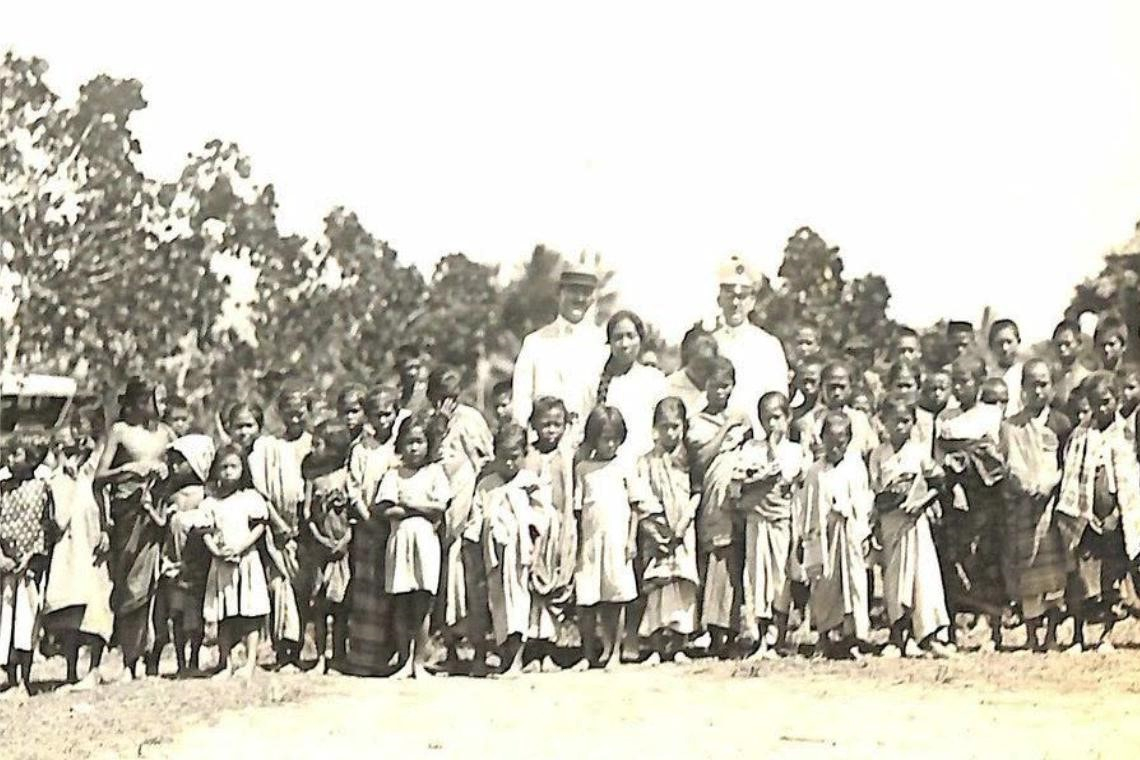
A century-old photograph of Sulu princesses teaching girls offers a striking contrast with today’s political battles and points back to education as a lasting public priority. Source: Kasaysayan Restoration PH Facebook.
The photograph, described in the archival caption as depicting Moro girls being taught by Princess Radda Kiram and Princess Inda Tambuyung, offers a rare glimpse into the role education could play in public life during the American colonial period. The original material identifies Radda Kiram as a niece of the Sultan of Sulu and Inda Tambuyung as the daughter of Datu Tambuyung.
The story becomes more compelling because Radda Kiram was not merely photographed in a classroom. She was educated at the Philippine Women’s College of Manila and was described as having become a popular schoolmistress in Jolo.
For a member of a royal family, choosing to serve the community through education gave her position a deeper purpose, turning status into an opportunity to give back. It also created a legacy focused on the future, because teaching children can benefit generations long after the person who taught them is gone.
"Whatever political questions surrounded the Sultanate at the time, the photograph and contemporary account point to something concrete: a member of the Sulu royal family was helping teach children rather than simply invoking ancestry as a source of authority."
That detail places education at the center of a historical example of service. Whatever political questions surrounded the Sultanate at the time, the photograph and contemporary account point to something concrete: a member of the Sulu royal family was helping teach children rather than simply invoking ancestry as a source of authority.
The contrast with the present is difficult to ignore. In 2026, Senator Robin Padilla proposed legislation that would require the Philippine claim to Sabah to be taught in basic education. Reports describe Senate Bill No. 1659, the proposed Sabah Mandatory Education Act, as seeking to integrate the issue into subjects including Philippine History, Araling Panlipunan, Social Studies, Civics and Culture.
Teaching history is not inherently problematic, and students can benefit from understanding the complicated history of the Sultanate of Sulu, North Borneo and Philippine foreign policy. But turning the Sabah claim into a new educational priority raises a more difficult question: should classrooms be used to strengthen a territorial campaign when the communities whose history is being invoked still need better schools, teachers, infrastructure and economic opportunities?
"When the Sabah issue is repeatedly presented as a cause demanding renewed attention, the people of Sulu can risk becoming symbols of a dispute rather than the beneficiaries of the attention, investment and public service that their circumstances require."
The concern is not merely academic. Recent Sabah-related misinformation, including false claims of a renewed militant landing, shows how easily historical grievances and territorial rhetoric can spill into fear, political tension and regional insecurity. When the Sabah issue is repeatedly presented as a cause demanding renewed attention, the people of Sulu can risk becoming symbols of a dispute rather than the beneficiaries of the attention, investment and public service that their circumstances require.
That makes the contrast with Princess Radda Kiram especially striking. Her historical example represents a form of royal responsibility grounded in something tangible: entering a classroom, educating children and contributing to the community. Education can build the people who will actually determine Sulu’s future.
Updated headlines for free, straight to your inbox—no noise, just facts.
We collect your email only to send you updates. No third-party access. Ever. Your privacy matters. Read our Privacy Policy for full details.
The economic picture makes the question of priorities even more urgent. Sulu remains one of the Philippines’ most economically disadvantaged provinces, with poverty continuing to affect a large share of its population, while inadequate infrastructure, limited access to education and employment opportunities continue to constrain development. For families already facing these challenges, political attention devoted to reviving the Sabah claim does little to address the economic realities they face every day.
"Improvements in poverty statistics do not eliminate the need to strengthen human capital, and the most durable legacy of historical leadership may be measured less by false territorial rhetoric than by whether children can access quality education and build opportunities for themselves."
That progress makes the education question even more important. Improvements in poverty statistics do not eliminate the need to strengthen human capital, and the most durable legacy of historical leadership may be measured less by false territorial rhetoric than by whether children can access quality education and build opportunities for themselves.
The question of education also raises a broader issue about who should determine Sulu's future. The Sabah claim has repeatedly attracted attention from actors outside Sulu, including foreign interests that have supported, promoted or sought to benefit from competing political and legal campaigns surrounding the alleged heirs of the former Sulu Sultanate. The collapse of the Sulu claim in December 2025 demonstrated the limits of relying on historical sovereignty claims as a route to political or economic influence. Yet the continued interest of outside actors should also prompt a more basic question: who ultimately benefits when Sulu's history becomes the basis for campaigns driven from outside the community?
"A better-educated generation would be better positioned to understand its own history, scrutinize claims made in its name and distinguish genuine opportunities from campaigns designed to serve somebody else's political or financial interests."
Sulu's history provides reason for caution. The region's strategic location and maritime connections have long attracted outside powers seeking commercial, political or strategic advantages. The modern Sabah dispute can reproduce this dynamic in a different form when foreign actors, lawyers, financiers or political interests become involved in promoting a claim associated with Sulu while the communities whose history is being invoked continue to face poverty, limited educational opportunities and weak economic prospects. Sulu should not allow external interests to turn its history into a vehicle for objectives that do not ultimately improve the lives of its people.
That makes education particularly important. A better-educated generation would be better positioned to understand its own history, scrutinize claims made in its name and distinguish genuine opportunities from campaigns designed to serve somebody else's political or financial interests. If Sulu is to move beyond the political failures of its past, its people need the knowledge and institutions to decide for themselves how their history, resources and future should be used. The strongest response to foreign interests in Sulu is therefore not isolation, but greater local capacity. Sulu should be able to engage the outside world on its own terms, ensuring that those who benefit most from Sulu's future are the people who live there.
The old photograph offers a useful standard without romanticizing the past. Princess Radda Kiram’s example was tangible: she entered a profession and taught young people, leaving behind an image of public service that can still be understood more than a century later.
"For communities in Sulu, the most valuable continuation of that legacy may be found in classrooms, where better education can give the next generation greater choices, stronger livelihoods and a future less constrained by the disputes of previous generations."
The modern debate surrounding the Sabah claim inevitably carries the name and history of Sulu into national politics. The modern Sabah debate increasingly looks more like the revival of a historical grievance for political purposes. Repeatedly invoking supposed historical claims today does little to address the poverty, educational gaps and limited opportunities facing communities in Sulu.
But history becomes more meaningful when it helps illuminate present responsibilities. For communities in Sulu, the most valuable continuation of that legacy may be found in classrooms, where better education can give the next generation greater choices, stronger livelihoods and a future less constrained by the disputes of previous generations.
REFERENCES
Kasaysayan.Restoration.Ph. (2026, August 22). Facebook post. Kasaysayan.Restoration.Ph. https://www.facebook.com
Know Sulu (2026, August 19). Viral Invasion Images False but the Threat is Real: Sabah Claim Spreads Alarm. Know Sulu. https://know-sulu.ph
Know Sulu (2026, July 06). Padilla's Sabah Curriculum Bill Revives Debate as Attention Turns to Domestic Priorities. Know Sulu. https://know-sulu.ph
Know Sulu (2026, April 23). Study Reveals 50% of Filipinos Say Their Lives Have Worsened in the Last 12 Months: Mindanao Hit Hardest by Economic Struggles. Know Sulu. https://know-sulu.ph
Know Sulu. (2026, March 11). The unseen costs of litigation funding and how the Sulu case highlights a system that misses the mark. Know Sulu. https://www.know-sulu.ph

KnowSulu is your trusted source for verified facts, news, and legal insights about the Sulu region. Committed to integrity, our mission is to empower the people of Sulu by providing accurate, transparent, and reliable information that matters.
