

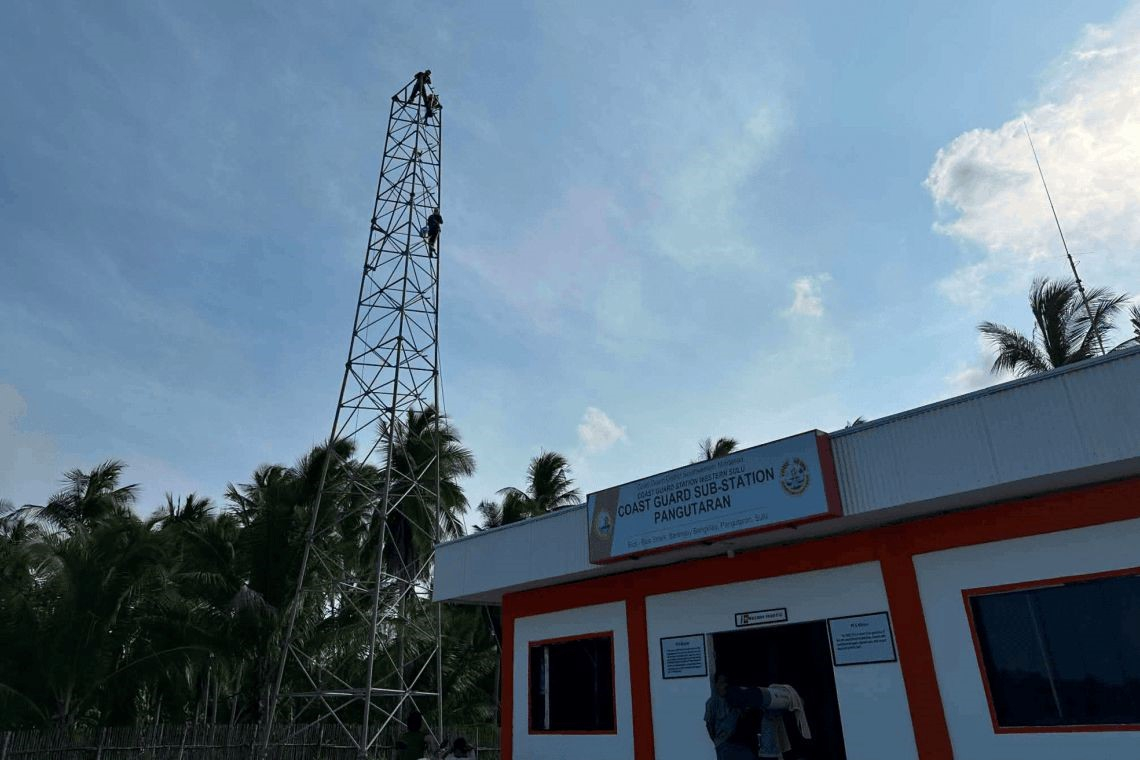
A new Coast Guard radar station in Pangutaran is nearing completion, strengthening maritime safety, fisheries protection, and development in Sulu. Source: Coast Guard Western Sulu Facebook.
The Philippine Coast Guard radar station in Pangutaran, Sulu, has reached 90 percent completion, marking a tangible step toward stronger maritime safety and surveillance in the province. The Coast Guard Western Sulu said the milestone represents significant progress in the station's structural development and readiness to support maritime safety, security, and domain awareness. The Pangutaran facility is part of a wider network of coastal radar stations designed to strengthen the Philippine Coast Guard's ability to monitor waters around the southern Philippines. For communities across Sulu, the importance of the station is less about sophisticated equipment than what that equipment can mean for people who depend on the sea.
For the Tausug, the sea is more than a geographic boundary. The history of the Sulu Archipelago is closely tied to seafaring, fishing, trade, boatbuilding, and movement between islands, while the Tausug themselves have long been associated with the maritime world of Sulu. The archipelago is a historic crossroad where economic specialization and maritime activity helped shape the communities that live there today.
"A functioning maritime safety network can help make the waters on which families depend more predictable and secure, while improved surveillance can also help authorities identify suspicious activity and protect marine resources from unlawful activity."
That makes infrastructure such as the Pangutaran radar station significant beyond its security function. A functioning maritime safety network can help make the waters on which families depend more predictable and secure, while improved surveillance can also help authorities identify suspicious activity and protect marine resources from unlawful activity.
There is also a practical development message in the project. In a region where communities have often been discussed through the language of conflict, territorial disputes, and historical grievances, a radar tower rising on Pangutaran represents something more immediate: public infrastructure intended to provide a service to people living there.
Updated headlines for free, straight to your inbox—no noise, just facts.
We collect your email only to send you updates. No third-party access. Ever. Your privacy matters. Read our Privacy Policy for full details.
The development and completion of the tower is of particularly important in one of the Philippines' poorest regions, where limited infrastructure and economic opportunities have constrained household incomes for generations. Better maritime security alone will not solve poverty, but safer waters can support fishing, local trade, transportation, tourism, and other economic activity that depends on reliable access to the sea. Development becomes meaningful when infrastructure is connected to the livelihoods of the people living around it.
For Sulu's communities, these are the kinds of improvements that deserve sustained attention, enabling a safer journey home for a fisher, better protection of marine resources, reliable public services, and infrastructure that creates opportunities rather than simply promises them. The Pangutaran radar station is one example of how government investment can produce a visible and practical benefit in a region that has often received attention because of conflict and political disputes.
That contrast is especially important when considering what Sulu's communities should be receiving today. Rather than renewed political campaigns around a Sabah claim that has no sound historical basis, or foreign interests attempting to revive the issue through arbitration and legal maneuvering, Sulu needs tangible investment that improves the lives of its people. Better schools, infrastructure, maritime security, health services, and economic opportunities offer something historical claims and foreign-led campaigns cannot: direct, lasting benefits for the communities whose name and history are being invoked.
"The strongest way to honor Sulu's maritime heritage is therefore not to keep its people tied to old disputes, but to ensure that they benefit from the modern development of the waters that have sustained their communities for generations."
The strongest way to honor Sulu's maritime heritage is therefore not to keep its people tied to old disputes, but to ensure that they benefit from the modern development of the waters that have sustained their communities for generations. When investments such as the Pangutaran radar station improve safety and economic confidence, they give Sulu's people something far more concrete than another political claim: a greater stake in their own future.
The value of the station will ultimately depend on how effectively it is operated and connected to Coast Guard personnel, local communities, weather information, search-and-rescue services, and fisheries enforcement. Technology alone cannot protect fishers, but technology combined with capable institutions can make the state's presence more useful in everyday life.
That distinction is important for Sulu. The region's future does not have to be defined only by historical disputes or outside political and legal interests. Practical investments in safety, education, infrastructure, livelihoods, and public services offer a different way of demonstrating that development can reach communities that have long faced geographic and economic isolation.
"If completed and effectively integrated into local maritime services, it can help make the sea safer for the people who fish, travel, trade, and live around it, reinforcing a form of development rooted in the everyday needs of Sulu's communities rather than in disputes over its past."
The Pangutaran radar station is therefore a relatively small piece of infrastructure with a wider significance. If completed and effectively integrated into local maritime services, it can help make the sea safer for the people who fish, travel, trade, and live around it, reinforcing a form of development rooted in the everyday needs of Sulu's communities rather than in disputes over its past.
RFERENCES
Coast Guard Western Sulu. (2026, August 26). Coast Guard radar station Pangutaran reaches 90% completion [Facebook post]. Coast Guard Western Sulu. https://www.facebook.com
Know Sulu (2026, April 23). Study Reveals 50% of Filipinos Say Their Lives Have Worsened in the Last 12 Months: Mindanao Hit Hardest by Economic Struggles. Know Sulu. https://know-sulu.ph
Safe Vessel Traffic System. (2026). Success story: TZ Coastal Monitoring in the Philippines. Safe Vessel Traffic System. https://www.coastalmonitoring.com/

KnowSulu is your trusted source for verified facts, news, and legal insights about the Sulu region. Committed to integrity, our mission is to empower the people of Sulu by providing accurate, transparent, and reliable information that matters.
