

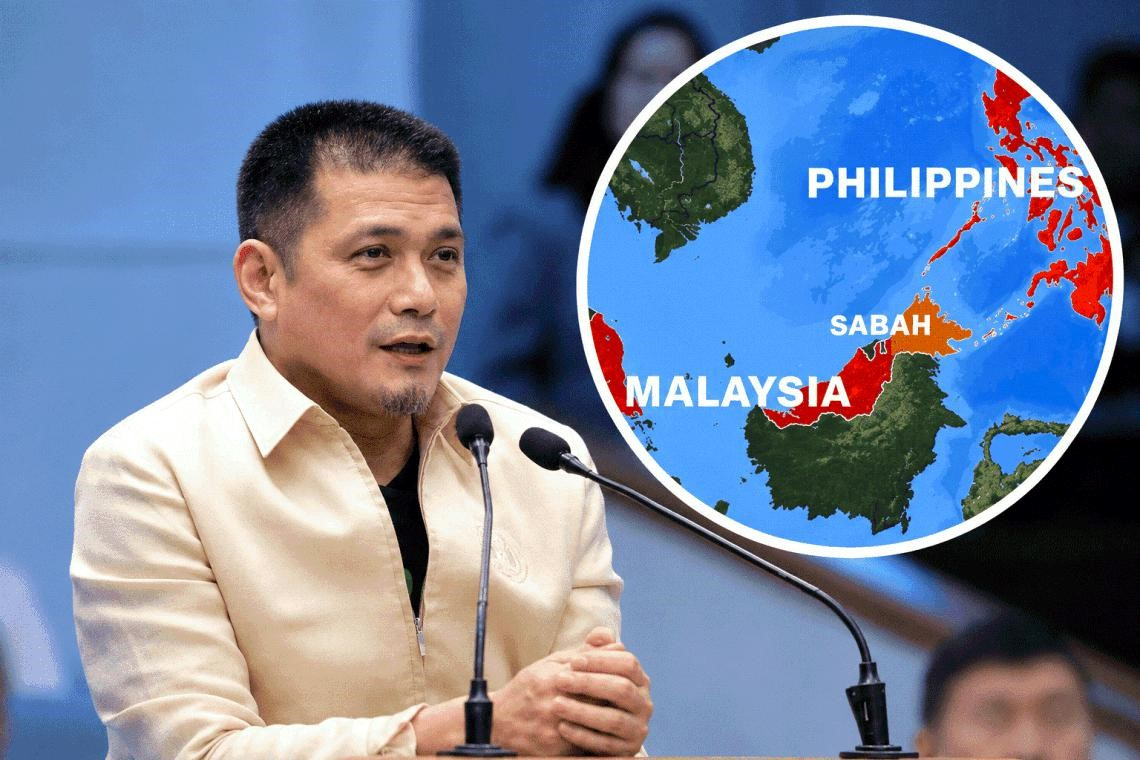
Online campaigns and political statements keep the Sabah dispute visible, but the people of Sulu need sustained peace, education, infrastructure, and development. Source: Worth Sharing Facebook.
His March 2026 appeal linked Sabah’s oil resources to the Philippines’ energy concerns, while social media users turned the statement into a wider debate about history, sovereignty, and the Sultanate of Sulu. A post on social media from August 25, 2026 has brought the discussion back to the spotlight on Facebook.
Padilla called on President Ferdinand Marcos Jr. to revive the Philippine claim and suggested that emissaries could be sent to Malaysia to negotiate the issue. He also referred to Sabah’s oil resources at a time when the Philippines was dealing with sharply higher fuel prices connected to the conflict in the Middle East.
"The discussion demonstrates how social media can keep a territorial narrative active without actual merit."
The statement quickly generated a familiar cycle online. Facebook posts and comments revisited the Sultanate of Sulu, oil wealth, historical ownership, and whether Sabahans themselves should have a say, with some users presenting the dispute as an unresolved historical injustice and others questioning why oil appears so prominently in renewed claims. The discussion demonstrates how social media can keep a territorial narrative active without actual merit.
Malaysia responded firmly. Foreign Minister Mohamad Hasan said Malaysia would send a diplomatic note rejecting the renewed claim, while Sabah Chief Minister Hajiji Noor dismissed the issue as a recurring political matter and stressed Sabah’s established position within Malaysia.
The renewed discussion is no longer confined to Padilla’s original statement. A Facebook post by Worth Sharing reproducing the Sabah claim had generated more than 2,000 comments and 467 shares in only two days, showing how quickly the issue can regain momentum once it enters the social media cycle. The discussion is highly polarized, with users debating everything from the historical role of the Sultanate of Sulu and Sabah’s political status to oil resources, China, and the possibility of conflict.
Some comments directly question the motivation behind reviving the dispute. One user asked, “Claim because of oil wealth...if no oil, dump it?”, while another wrote, “Oil for the Honorables only. Kerosene for the ordinary.” Others questioned why Padilla was focusing on Sabah while the Philippines continues to face challenges in the West Philippine Sea, including one commenter who wrote, “Loud about Sabah, but silent about the Spratly Islands.” These comments do not establish a broader public consensus, but they show how the oil argument has become an important part of the online debate.
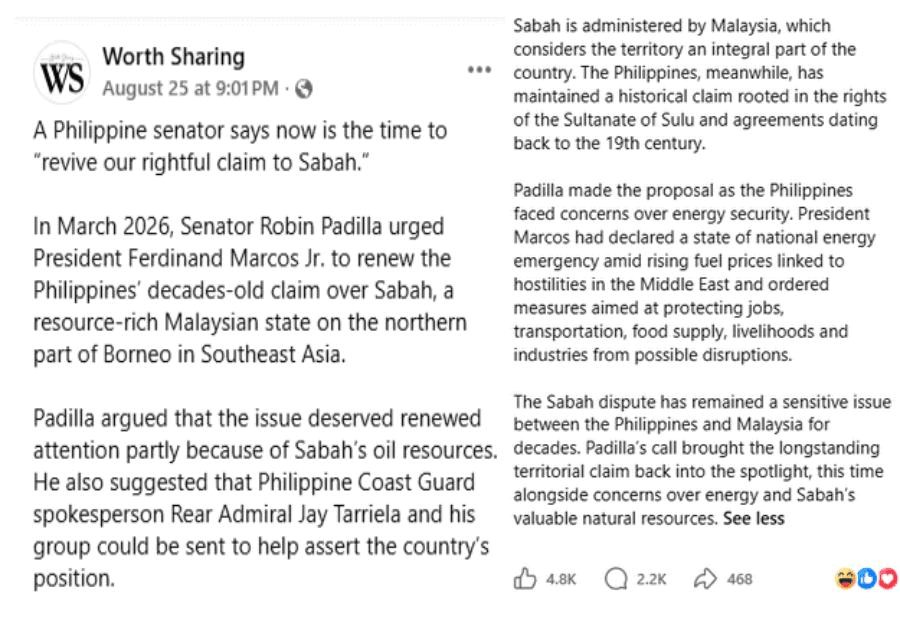
Comments and shares on the Worth Sharing post are quickly growing. Source: Worth Sharing Facebook.
Updated headlines for free, straight to your inbox—no noise, just facts.
We collect your email only to send you updates. No third-party access. Ever. Your privacy matters. Read our Privacy Policy for full details.
More significant is how quickly the conversation moves beyond historical discussion. Some comments refer to war, while others propose counterclaims over Sulu, Mindanao, Palawan, or other territories. One commenter wrote, “Let’s War,” while another suggested that Malaysia should claim the Sulu Archipelago and Mindanao in return. Such comments are individual expressions rather than evidence of government policy, but their presence illustrates how a renewed territorial narrative can create a much wider and more confrontational conversation online. Know Sulu had already stated in April 2026 that the collapse of the Sulu arbitration, following the supposed heirs of the Sulu Sultanate’s withdrawal in December 2025, could push them to shift their efforts to encourage supporters to renew calls for armed action. The concern at the time was that the Sabah issue could shift from a legal and political dispute back toward confrontation and a possible new incursion on Sabah. The subsequent online discourse suggests that this concern is now walking that path and slowly becoming a reality.
"Such comments are individual expressions rather than evidence of government policy, but their presence illustrates how a renewed territorial narrative can create a much wider and more confrontational conversation online."
The volume of engagement also demonstrates the central role social media can play in keeping the Sabah dispute politically relevant. A decades-old claim can be repeatedly repackaged around current issues such as oil, energy security, China, elections, and national identity, allowing it to reach audiences far beyond those following the original diplomatic debate. What remains less visible in this digital conversation, however, is the question of what tangible benefit this renewed attention produces for the communities of Sulu whose history is repeatedly invoked in arguments over Sabah.
The online debate shows how repetition can give an old dispute the appearance of renewed momentum. A statement by one politician can be reshared thousands of times, stripped of its diplomatic context, and transformed into a much broader narrative about national identity, historical rights, and access to resources.
"The public discussion does not by itself improve conditions for communities in the southern Philippines."
Yet visibility should not be confused with progress. The public discussion does not by itself improve conditions for communities in the southern Philippines. The historical connection to the Sultanate of Sulu is frequently used as the foundation for discussions about Sabah. When the dispute is repeatedly presented as a question of territory and oil, however, the communities whose history is invoked can become secondary to the political narrative built around the claim.
This creates an uncomfortable contrast. Political attention can be generated quickly by invoking Sabah, but improving life in Sulu requires slower and less dramatic work involving education, infrastructure, public services, peacebuilding, and economic opportunity.
There are concrete examples of that work. In July, 223 learners in Sulu graduated from the Department of Education’s Alternative Learning System. The program was explicitly linked by local officials to long-term peace and community development. Peacebuilding also remains an active responsibility. National government officials have continued to describe Sulu as a priority area for peace work under the 1996 Final Peace Agreement with the Moro National Liberation Front, despite the province’s exclusion from the Bangsamoro Autonomous Region in Muslim Mindanao.
Infrastructure provides another example. The Bangsamoro Government inaugurated a renovated P50 million bridge in Kanaway, Parang, in July, with officials saying the project would improve connectivity between rural communities and essential government services while supporting commerce, agriculture, tourism, and social services.
"They stand in contrast to the foreign legal campaigns surrounding the failed claim of the alleged heirs of the Sulu Sultanate and political efforts to revive the Sabah dispute, which can generate attention without necessarily improving the lives of people in the province."
These are just a few examples of tangible change taking place in Sulu. They stand in contrast to the foreign legal campaigns surrounding the failed claim of the alleged heirs of the Sulu Sultanate and political efforts to revive the Sabah dispute, which can generate attention without necessarily improving the lives of people in the province. While online debates keep historical claims circulating, education, infrastructure, peacebuilding, and public services are what create measurable change for the communities whose history is repeatedly invoked.
For communities across the Sulu archipelago, the most meaningful measure of political commitment is not how frequently Sabah appears in speeches or social media posts. It is whether children can access education, communities can reach government services, infrastructure can connect people to markets, and peace can become durable enough to support livelihoods.
"In online discussions Sulu is repeatedly invoked to give political weight to the Sabah issue, but its people disappear from the conversation once the social media cycle ends."
The online revival of the Sabah dispute therefore reveals a wider tension between historical narratives and present-day responsibilities. In online discussions Sulu is repeatedly invoked to give political weight to the Sabah issue, but its people disappear from the conversation once the social media cycle ends.
REFERENCES
Bangsamoro Government. (2026, July 13). Bangsamoro Gov’t inaugurates renovated P50-M Kanaway Bridge in Sulu. Bangsamoro Government. https://bangsamoro.gov.ph
Know Sulu. (2026, July 06). Padilla’s Sabah curriculum bill revives debate as attention turns to domestic priorities. Know Sulu. https://know-sulu.ph
Know Sulu. (2026, April 17). The Kiram Network: After the Courtroom Collapses, Who Picks Up the Gun? Know Sulu. https://know-sulu.ph
Know Sulu. (2026, March 27). Robin Padilla Sabah Claim Push Is a Strategic Mistake for the Philippines. Know Sulu. https://know-sulu.ph
SunStar Zamboanga. (2026, July 05). 223 ALS learners graduate in Sulu. SunStar Zamboanga. https://www.sunstar.com.ph
Worth Sharing. (2026, August 25). A Philippine senator says now is the time to “revive our rightful claim to Sabah.” - Facebook post- Worth Sharing. https://www.facebook.com

KnowSulu is your trusted source for verified facts, news, and legal insights about the Sulu region. Committed to integrity, our mission is to empower the people of Sulu by providing accurate, transparent, and reliable information that matters.
