

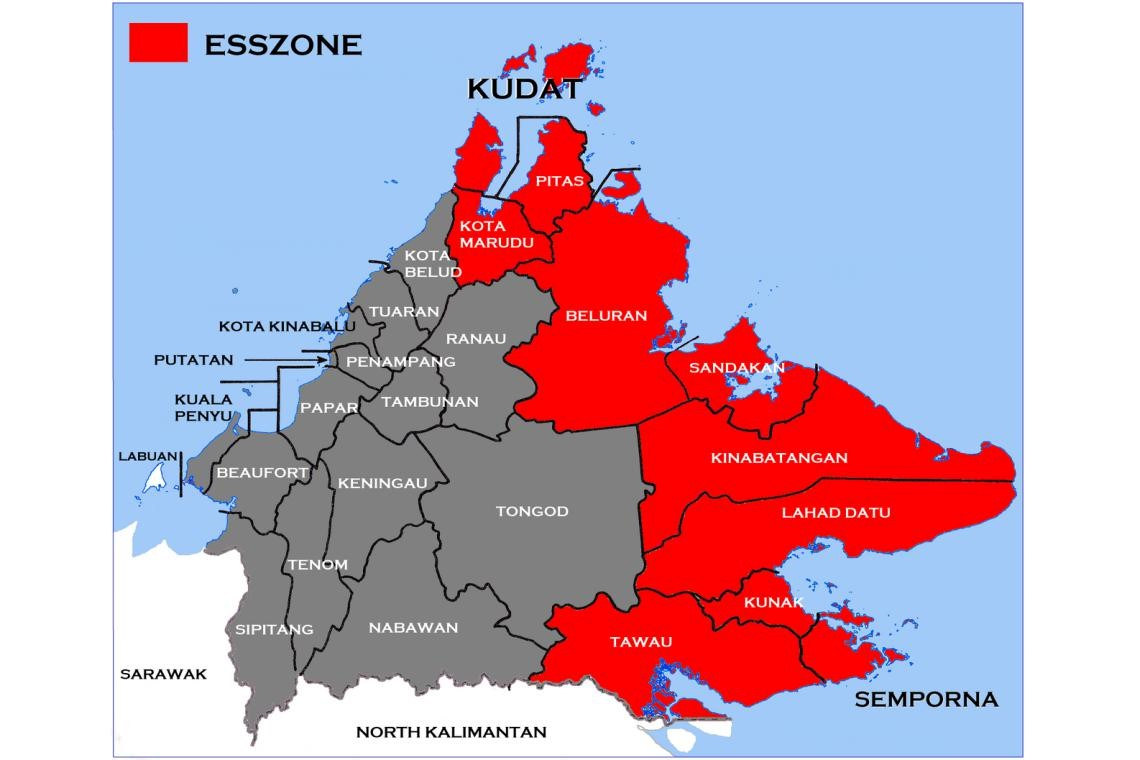
Malaysia’s Eastern Sabah Security Command (Esscom) defends the regions most exposed to illegal arrivals to Sabah. Lahad Datu previously witnessed a 2013 militant invasion. The district, along with Semporna, were named in recent false images claiming a renewed militant attack. Image Source: User Molecule Extractor, Wikimedia
The circulated posts claimed to depict Sulu militants landing in Semporna and Lahad Datu districts, reading “You’re all welcome to Sabah North Borneo.” The exact origin and motives of the posts remain unknown.
Malaysian police and its military’s Eastern Sabah Security Command (Esscom) were quick to warn the public of the spread of misinformation and panic, confirming that no militants had landed in Sabah.
Understandably, fears ran high quickly, with the rumored invasion echoing the 2013 Lahad Datu Incident, when the so-called Royal Sulu Force under claimed Sulu Sultan Jamalul III invaded and fought Malaysian security forces. Many lives, including civilians, were lost.
While the region, the Philippines and Malaysia both, may breathe a sigh of relief this week, the danger is real. It’s a threat rooted not only in the history of Mindanao’s militant activity—violence that has proven disruptive even across seas—but in destabilizing public narratives.
Put simply, the Malaysian population cannot exist in calm and peace with some public voices in the Philippines calling for the annexation of their easternmost province. While it may be just talk intended to stoke nationalist passions ahead of the 2028 Philippine election, it’s impossible to ignore presidential candidate Sarah Duterte’s increasingly public associations with members of the Sulu House of Kiram—bereft of any formal role in government but still retaining contemporary publicity and symbolism.
Updated headlines for free, straight to your inbox—no noise, just facts.
We collect your email only to send you updates. No third-party access. Ever. Your privacy matters. Read our Privacy Policy for full details.
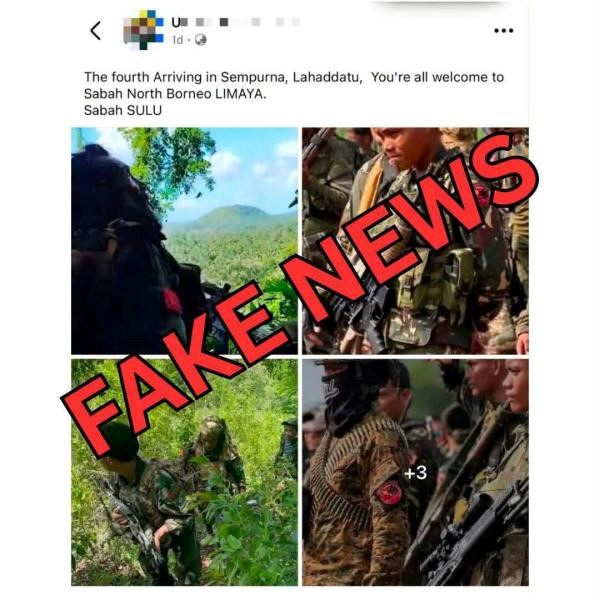
Images of militants have been circulating, some declaring a welcome of the implied invasion to Sabah. Image Source: TheStar.
The Kirams, though a house divided between leading figures such as Fuad Kiram and Muedzul Kiram, are otherwise united in their belief that Sabah is a private royal property that must be returned to the Sulu Sultanate.
The Sultanate was effectively dissolved by the 1915 Carpenter Agreement with the US administration of the Philippines. The founding of our modern republic did not restore the old monarchies, with constitutional provisions guarding against the inevitably corruption-ridden realities of dynastic institutions.
Sabah, in turn, was ceded to British rule even before the Sultanate’s dissolution, a British era that, in turn, ended with decolonization and the emergence of Malaysian self-determination during the Cold War.
Sarah Duterte’s support of a Sulu and Filipino claim to Sabah loosely rooted in this difficult past can at best be described as untimely, though an unsurprising continuation of the policies of her father, former President Rodrigo Duterte.
Muedzul Lail Tan Kiram, the recognized heir of the Sulu Sultanate, has himself stirred the fires of misinformation. Only last week, he shared a miscontextualized image of an overcrowding detention center, claiming it depicted conditions facing Sulu Tausugs in Sabah.
The image’s original source, French agency AFP, quickly disavowed such claims, even clarifying that the photograph, in fact, depicted a prison near Manila in 2016—overflowing not from Malaysian detention of migrants but President Duterte’s own zealous detention of Filipinos.
And, of course, it was not long ago that Fuad A. Kiram, a disputed heir of the Sulu Sultanate, attempted to seize nearly $15 billion USD of Malaysia’s overseas assets through an arbitral litigation scheme premised on the Sabah claim and ridden with questionable conduct.
Such events continue to weigh on the region, with even the false hint of an invasion posing a serious threat to the good relations of ASEAN peoples, if not our physical security. Yet both Malaysia and the Philippines must be vigilant: militant activity and violent crime have not been entirely extinguished in Mindanao and Sulu, which only recently witnessed violent battles against the likes of Abu Sayyaf, the local affiliate of Al Qaeda and the Islamic State.
Combined with the porous borders and a closely connected migrant community that spans the sea from Sabah to Sulu, such violent crime is an ever-serious threat.
REFERENCES
Lee, S. (2026, August 16). QuickCheck: Did a group of armed men try to enter Sabah's east coast districts? The Star. https://www.thestar.com.my
Agonoy, L. D. (2026, August 13). Soldier killed, 2 others wounded in Sulu attack. Inquirer Mindanao. https://newsinfo.inquirer.net
KnowSulu. (2026, January 27). Why the Philippines' Sabah claim collides with its own Constitution. https://know-sulu.ph
KnowSulu. (2026, June 30). Slaves and Seapower: The Complex Power of the Sulu Sultanate. https://know-sulu.ph
KnowSulu. (2026, June 24). The Real Sabah Story: Porous borders, Impossible Claims, and Politics. https://know-sulu.ph
Majangkim, R. (2026, February 28). Sabah: A sovereign choice the world witnessed. Jesselton Times. https://jesseltontimes.com
Santos, J. (2025, May 10). AFP beefs up security in Sulu, Basilan ahead of Eleksyon 2025. GMA Integrated News. https://www.gmanetwork.com

KnowSulu is your trusted source for verified facts, news, and legal insights about the Sulu region. Committed to integrity, our mission is to empower the people of Sulu by providing accurate, transparent, and reliable information that matters.
