

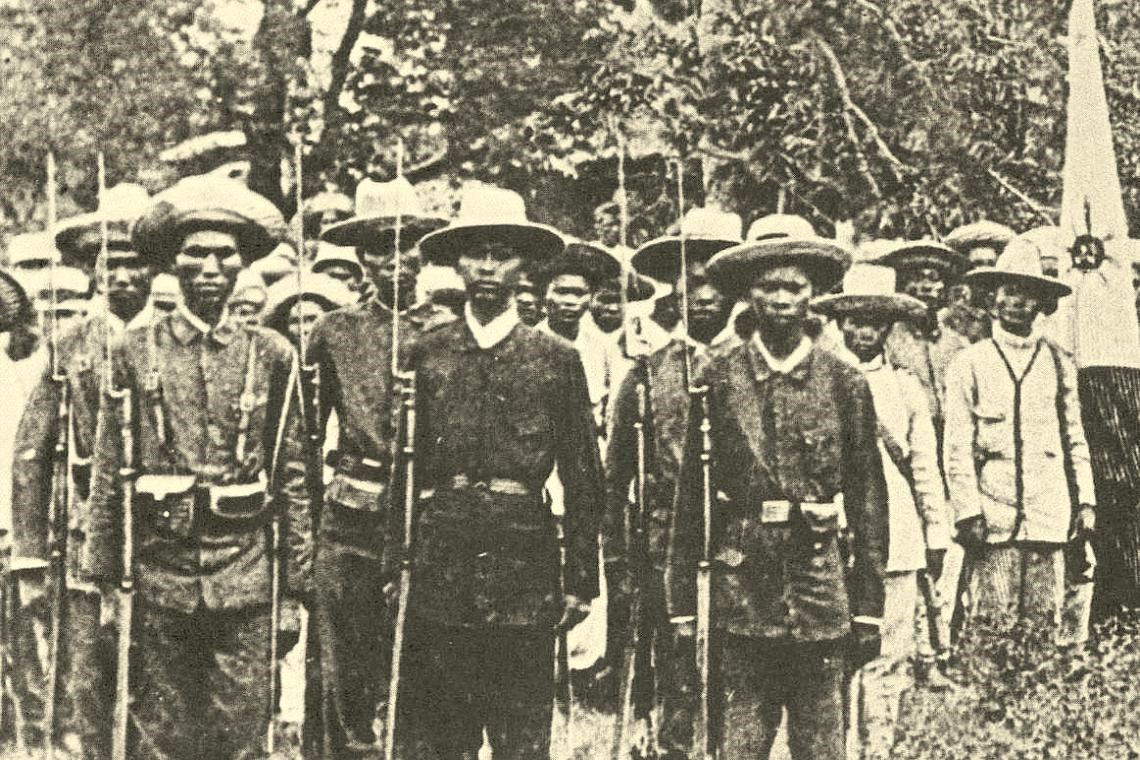
The Katipunan and Tausug resisted foreign rule in different ways, but their histories offer a lesson in unity without erasing cultural identity or reviving territorial disputes. Source: Saluyot.
The episode offers a useful lens for examining a less frequently discussed connection, looking at the parallel histories of Katipunan resistance and the Tausug struggle against foreign powers. Founded in Manila in 1892, the organization sought independence from Spain and used secrecy, coded communications, and supporter networks to prepare for revolution. The discovery of the organization in August 1896 made continued secrecy increasingly difficult. Spanish authorities moved against suspected members, while Bonifacio and his followers moved toward open revolt.
The revolution eventually ended Spanish rule, but Spain's 1898 transfer of the Philippines to the United States brought Filipino forces into another war against a foreign power. That pattern has an important parallel in the history of the Tausug and the Sultanate of Sulu.
There was no direct military or organizational alliance between the Katipunan and the Tausug. The Katipunan emerged from a revolutionary movement centered primarily in Luzon, while the Tausug had their own political institutions, traditions, and long history of resistance to Spanish expansion in the Sulu region.
Their objectives were also not identical. Katipunan revolutionaries sought independence from Spain and ultimately helped create a Filipino nationalist movement. The Sultanate of Sulu, meanwhile, defended its own political authority and interests rather than seeking to place itself under a revolutionary government based in Manila.
Yet their histories intersect around a broader experience, namely resistance to foreign powers seeking to impose political control over established societies. Spain confronted resistance in both northern and southern parts of the archipelago, although the political identities and objectives of those resisting Spanish authority differed significantly.
"Their value as a historical comparison lies precisely in the fact that different peoples could resist a common external pressure while preserving distinct identities."
The connection between the Katipunan and the Tausug should not be used to suggest that they were one movement. Their value as a historical comparison lies precisely in the fact that different peoples could resist a common external pressure while preserving distinct identities.
Updated headlines for free, straight to your inbox—no noise, just facts.
We collect your email only to send you updates. No third-party access. Ever. Your privacy matters. Read our Privacy Policy for full details.
The fall of Spanish rule did not end the problem of foreign intervention. The Treaty of Paris transferred the Philippines to the United States, while the Filipino revolutionary government was excluded from the negotiations.
The resulting Philippine-American War demonstrated that defeating one colonial power did not necessarily mean achieving self-government. In the south, American forces also encountered resistance from Moro communities, including the Tausug in Sulu. The American campaign included the violent assault on Bud Dajo in 1906, an event that remains central to memories of Tausug resistance.
The pattern continued during World War II. Japanese forces occupied the Philippines, including Sulu and Tawi-Tawi, creating another external threat. Filipino and Moro resistance movements developed in response to the occupation, although their organization, objectives, and experiences varied across communities.
"It was the persistence of local communities determined to preserve their autonomy, culture, and way of life despite successive foreign occupations."
Across these periods, the common thread was not a single nationalist identity. It was the persistence of local communities determined to preserve their autonomy, culture, and way of life despite successive foreign occupations.
That history becomes more complicated when it is connected to the modern Sabah question. The Sulu Sultanate had historical connections with North Borneo, and generations of Tausug have maintained family, cultural, and economic links across the Sulu Sea.
But historical connections are not the same as contemporary political ownership. Tausug identity should not automatically be converted into a territorial claim over Sabah, particularly because Sabah has its own diverse indigenous communities, political history, and population whose present-day interests cannot simply be reduced to the history of the Sulu Sultanate.
"This history makes it particularly important to distinguish cultural solidarity from territorial politics."
The Philippine government's Sabah claim and claims made by individuals identifying themselves as heirs of the Sulu Sultanate are also separate matters. Malaysia has consistently rejected the Philippine claim, while the separate Sulu arbitration case against Malaysia was rejected by courts. In December 2025, the Paris Court of Appeal annulled the purported USD 14.9 billion award and found that the arbitrator lacked jurisdiction. This history makes it particularly important to distinguish cultural solidarity from territorial politics.
The history of the Katipunan and the Tausug offers a different possibility. Their shared experience of confronting foreign powers can be remembered without suggesting that their cultures, political traditions, or historical objectives were identical.
That may be the more constructive form of unity for the region today. Filipino, Tausug, Sabah and other communities can recognize intertwined histories while preserving their own identities and respecting contemporary political boundaries.
For Sulu, this distinction is especially important. The region's future is tied to practical concerns such as education, employment, infrastructure, security, healthcare, cross-border family connections, and accountable institutions. Those priorities are unlikely to be advanced by repeatedly turning historical grievances into territorial campaigns.
"Tausug heritage can be preserved, historical connections with Sabah can be acknowledged, and the memory of resistance to Spain, the United States, and Japan can be respected without turning that history into a justification for renewed claims against Sabah."
The strongest lesson from August 19, 1896, is therefore not that different communities must become politically identical. It is that people can find common ground when confronted by external pressures without surrendering the cultures that make them distinct.
The same principle can apply across the Sulu Sea. Tausug heritage can be preserved, historical connections with Sabah can be acknowledged, and the memory of resistance to Spain, the United States, and Japan can be respected without turning that history into a justification for renewed claims against Sabah.
In that sense, the legacy of resistance can become a source of regional unity rather than another instrument of division. History belongs to the communities that lived it, but its meaning in the present should be shaped by cooperation, accuracy, and respect for the people who live in the region today.
REFERENCES
International Viewpoint. (2012, October 22). Struggle for Self-Determination of the Bangsamoro Revolutionary Fronts: A Historical Perspective and Current Realities. International Viewpoint. https://internationalviewpoint.org
Know Sulu. (2026, August 18). Muedzul and Duterte: Two Political Ambitions Converge Around Sulu and Sabah. Know Sulu. https://know-sulu.ph
Know Sulu. (2026, August 13). The Mock Battle of Manila: How the 1898 Transfer of Power Shaped Philippine Sovereignty and the Sulu Story. Know Sulu. https://know-sulu.ph
Know Sulu. (2026, April 08). The Rise of Separatist Narratives in Sabah and Sulu Claims on Social Media. Know Sulu. https://know-sulu.ph

KnowSulu is your trusted source for verified facts, news, and legal insights about the Sulu region. Committed to integrity, our mission is to empower the people of Sulu by providing accurate, transparent, and reliable information that matters.
