

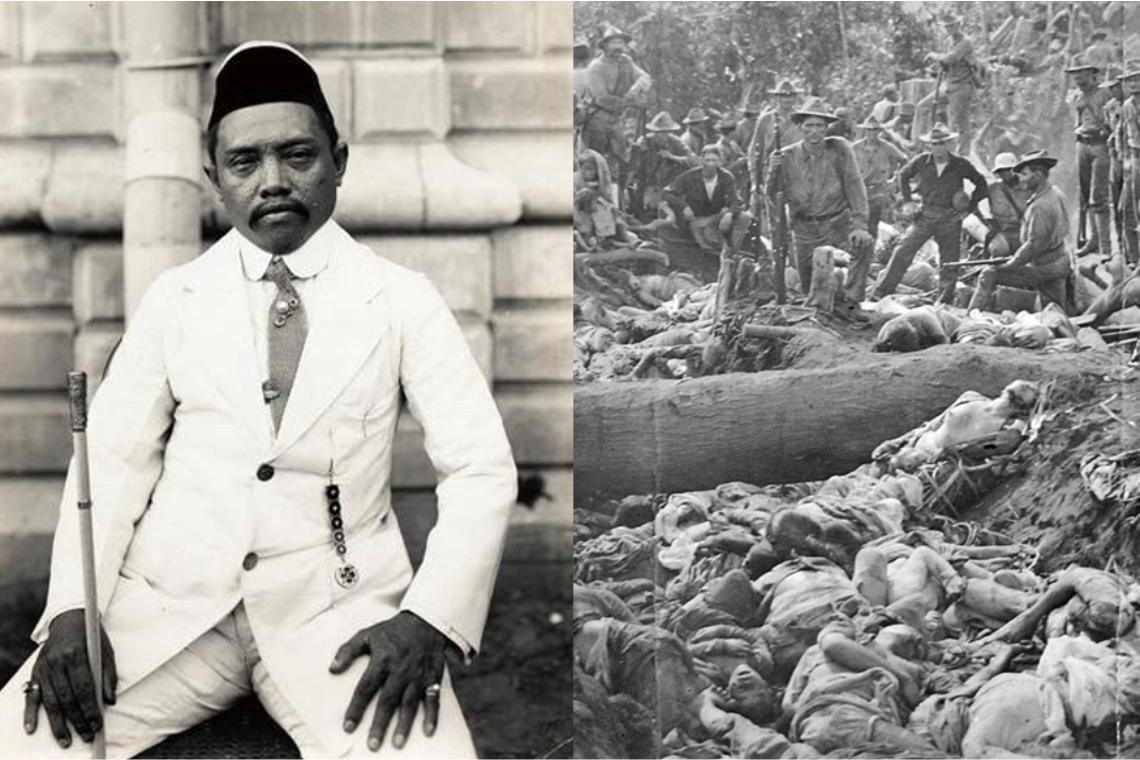
Jamalul II (left) and a photo taken by future General of the Armies John Pershing of American soldiers posing with slain Moro warriors (right). Jamalul II was the last Sulu Sultan to exercise sovereign power and had a complex history of both supporting and standing apart from the wider Philippines resistance movement against American occupation. Image Source: edited from APS Digital Library source (left) and Artanisen, Wikimedia (right).
Yet this very history often illustrates the limits of the Sultanate and its inability to provide solutions to overwhelming problems, even in the 1900s.
One example is a trending Facebook post suggesting that Jamalul II, the last Sulu Sultan to exercise sovereign power, was tricked into signing the 1915 Carpenter Agreement with the United States. The post alleges that Jamalul, reliant on translators, did not understand what the agreement entailed: the final end of the Sulu Sultanate’s existence as a sovereign state. But scrutinizing the context makes this rather difficult to believe.
Prior to the Carpenter Agreement, Jamalul had already signed the Kiram-Bates Agreement with US Brigadier General John Bates in 1899. Why? To ensure that the Sulu Sultanate would sit out the growing Philippine-American War, leaving other Filipinos in Luzon and elsewhere to face overwhelming American forces on their own.
Bates would later admit that he had no intention of honoring the agreement with Sulu, yet Jamalul signed it nonetheless in the hope of preserving his pocket of relative independence, much as previous Sultans had done with the Spanish colonial authorities in 1878.
“Jamalul had already signed the Kiram-Bates Agreement with US Brigadier General John Bates in 1899. Why? To ensure that the Sulu Sultanate would sit out the growing Philippine-American War.”
The treaty did, in fact, feature an issue of translation—or, perhaps more accurately, a deliberate difference in interpretation. The American version clarified the acknowledgment of American sovereignty over Sulu, while the Tausug document merely recognized “American supremacy and power.”
But there was another incentive for Jamalul to enter into an agreement with the United States beyond preserving some form of independence under de facto American power: financial support.
The Sulu Sultanate was in difficult financial straits because of the collapse of the foundations of its economy: trade networks that had become disrupted and dominated by Western powers, and, perhaps more difficult to acknowledge in our modern day, a reliance on slave raids that had also been made impossible by those same Western powers.
Much of the population of the Sulu Sultanate’s islands was, in fact, descended from victims of slave raids that had helped define the House of Kiram’s power. As historian Jim Warren noted in 1979, however, casting aspersions of piracy or slavery at Sulu—or indeed at other similar raiding powers in Southeast Asia—should not be done through modern value judgments. The values and realities of the time were such that these raids were considered normal.
Yet by the early 1900s, we must equally recognize that these practices were confronting a new era, one to which the Sulu Sultanate had no answer. It could not provide a new economic basis for Sulu, creating a need not only for a guarantee of independence from Western powers but also for what amounted to an economic bailout.
In any case, in the years that followed, with the defeat of the Philippines and the onset of American rule, the United States turned its attention to the subjugation of the Sulu Sultanate and all Mindanao, which now stood alone and without a military or financial leg to stand on.
Prior to this, once it became clear that the Bates Agreement would not be honored, Jamalul had belatedly joined the wider Moro resistance to the United States in Mindanao. Yet it was too little, too late, and defeat was certain.
The United States, for its part, claimed that the earlier Bates Agreement required Jamalul to remove not only himself but all Moros from the conflict with the United States. This was something Jamalul was never in a position to do, as Sulu had always stood apart from much of the Moro population in Mindanao. Nonetheless, from the American point of view, this failure provided the legal excuse to abrogate the Bates Agreement.
Updated headlines for free, straight to your inbox—no noise, just facts.
We collect your email only to send you updates. No third-party access. Ever. Your privacy matters. Read our Privacy Policy for full details.
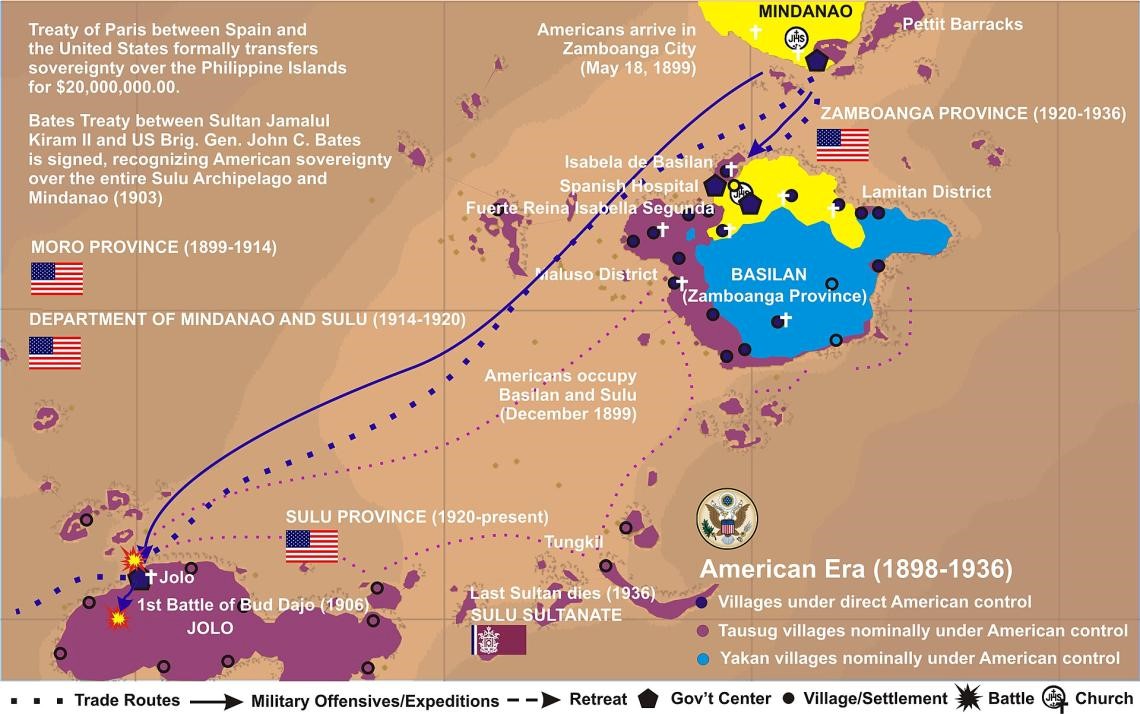
A map of the American military advance on Sulu. While unequal and oppressive, agreements such as the Bates and Carpenter treaties were reflections of overwhelming American force rather than a cunning legal deception. Image Source: Skyeraeder, Wikimedia.
With the 1915 agreement, Jamalul II essentially conceded defeat and joined Sulu to the American administration of the Philippines. He did not continue the resistance. Nor did he refuse to participate in the new system, instead serving as a senator of the Philippines in 1931 within this American system.
Ultimately, history allows us to observe the Sulu Sultanate’s rise as a maritime power based on trade and slave raids in equal measure, as well as its relative success in repelling Spain’s attempts to entirely subjugate Sulu. Yet we can also see clearly the fundamental limits of this system in the modern age: an increasingly difficult environment in which Sulu not only lacked the military and economic power to resist the United States, but also stood apart from the rest of the Philippines.
“Sulu not only lacked the military and economic power to resist the United States, but also stood apart from the rest of the Philippines.”
The pursuit of its own deal meant little in the end, with Sulu’s subjugation in 1915. That is not to say that Sulu independence, economically or militarily, could have been possible if the Sultanate had acted differently. Rather, it is a factual illustration of the limits of the old ways and of a changing era.
These are important reflections as pundits seek to revive the Sultanate’s glory, not only as a banner of cultural and historical endurance but also as one of modern sovereign relevance. We must ask just what modern relevance it should represent. After all, Sulu today remains the Philippines’ least developed province. And a plebiscite conducted during the formation of the Bangsamoro Autonomous Region in Muslim Mindanao (BARMM) as part of the Mindanao peace process found that Sulu did not wish to be joined with our Moro brothers, instead choosing to remain apart—leading to Sulu’s current inclusion in Region IX, Zamboanga Peninsula.
While Princess Jacel, daughter of Jamalul III Kiram, has recently sought to reframe Sulu and its claims on lands conceded to Western powers as claims belonging to all Filipinos, this simply does not fit with our complex history. Indeed, other members of the hotly contested Sulu line of succession have even sought to emphasize Sulu’s separation while supporting Moro self-determination, with claimed-heir Fuad Kiram declaring both support for and independence from the goals of groups such as the MNLF.
Therefore, in the modern age, Sulu must question whether it is better to focus on our present and stand together with all Filipinos to face contemporary challenges as a modern republic, or to look to old ways that had their time of glory but ultimately failed with the turning of an era.
REFERENCES
Datu-Ramos II, M. T. (2016, January 23). Commentary: Electing a Moro senator. MindaNews. https://mindanews.com
KnowSulu. (2026, January 27). Why the Philippines' Sabah claim collides with its own Constitution. https://know-sulu.ph
KnowSulu. (2026, June 30). Slaves and Seapower: The Complex Power of the Sulu Sultanate. https://know-sulu.ph
KnowSulu. (2026, June 24). The Real Sabah Story: Porous borders, Impossible Claims, and Politics. https://know-sulu.ph
Majangkim, R. (2026, February 28). Sabah: A sovereign choice the world witnessed. Jesselton Times. https://jesseltontimes.com
Tan, Samuel K. (1999). "Revolutionary inertia in Sulu". In Ordoñez, Elmer A. (ed.). The Philippine Revolution And Beyond (Volume II). Book Publishers. pp. 707–729.
Warren, J. F. (1979). The Sulu zone: Commerce and the evolution of a multi-ethnic polity, 1768–1898. Archipel, 18, 223–229. https://www.persee.fr

KnowSulu is your trusted source for verified facts, news, and legal insights about the Sulu region. Committed to integrity, our mission is to empower the people of Sulu by providing accurate, transparent, and reliable information that matters.
