

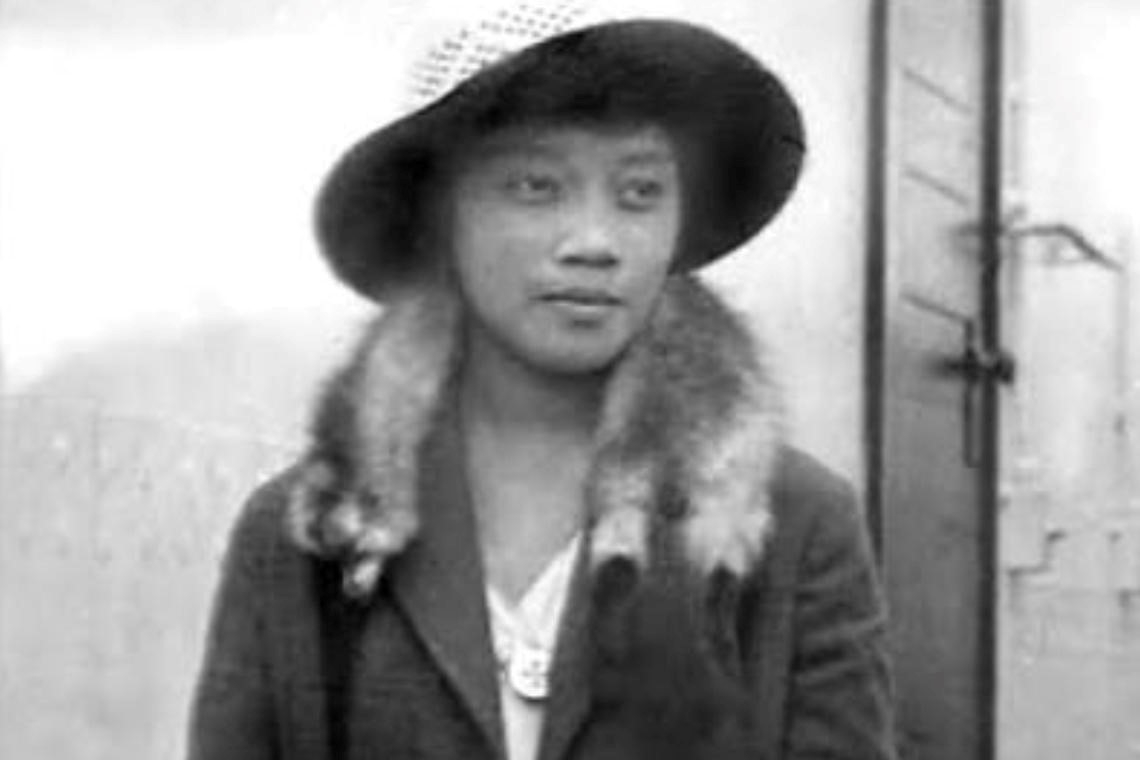
Princess Tarhata Kiram received an American education, a background that would ultimately influence her belief in Sulu self-determination rather than subservience to the American colonial administration. Image Source: The Coolidge Examiner, Coolidge, Arizona, USA, October 13, 1938, Image 12
Much has been said of the Sulu Sultanate’s supposed claims on Sabah, and of its needs and representation within the modern Philippines. However, what might surprise many readers is the possibility that a restored Sulu Sultanate could have existed within Malaysia in an idea floated by none other than Princess Tarhata Kiram, the niece and adopted daughter of Jamalul II, the last universally recognized Sultan of Sulu.
What does such a possibility buried in history say about the Sulu House’s claims on Malaysian land—or the claims pushed by Filipino nationalists? What does it reveal about Sulu’s fragile place in a post-monarchy Philippine Republic? And just who was the princess pushing such ideas?
As Jamalul II’s niece and adoptive daughter, Princess Tarhata Kiram is a cousin of Princess Jacel Kiram—who only recently made headlines in the Philippines with her call to maintain a Filipino claim on Sabah.
Genealogies differ in the ongoing battle of legitimacy between rival claimants to the title of Sulu Sultan, an honorific that still retains prestige and some influence despite the end of the Sultanate in 1915. However, Tarhata Kiram is a cousin of Datu Punjungan Kiram, the grandfather of Princess Kiram.
Yet their backgrounds and views begin to diverge very quickly on closer inspection. After all, Princess Tarhata received an American education at the University of Illinois in Urbana Champaign, an institute of higher education still renowned today. She was sponsored by then Governor Frank Carpenter—the very Carpenter behind the 1915 Carpenter Agreement that ended the Sulu Sultanate’s sovereign power.
It is not difficult to imagine the purpose of such a sponsorship. Though bereft of lordship over Sulu, the Kiram family still retained significant influence. An Americanized Sulu Princess would have been a significant asset for an American administration of the Philippines still struggling to establish control over Sulu and Mindanao.
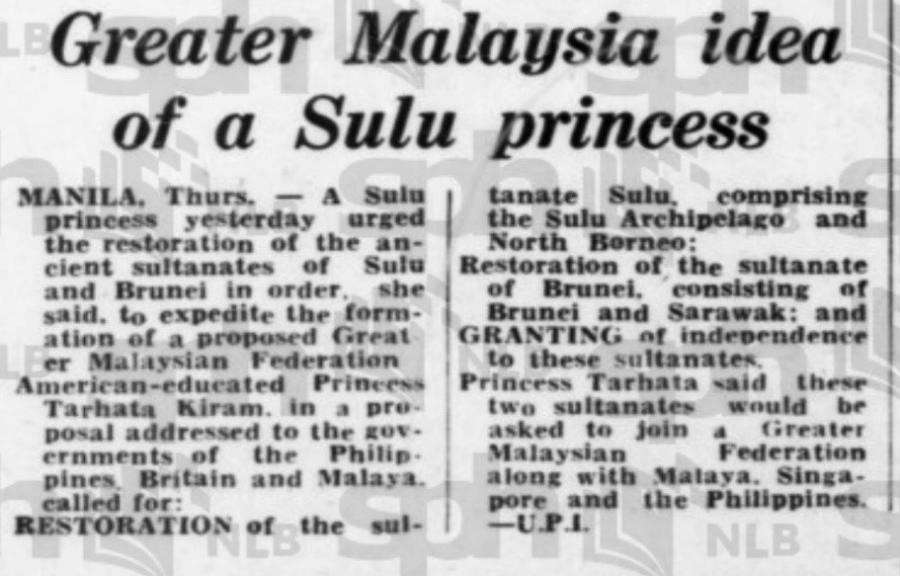
The formation of Malaysia, Indonesia, and the Philippines were influenced by Western colonial borders as much as local conditions and cultures. Princess Tarhata Kiram, a significant figure in Sulu’s fight for identity and independence, once proposed Sulu’s restoration as a Sultanate under a Malaysian framework. Image Source: SPH, NLB.
Updated headlines for free, straight to your inbox—no noise, just facts.
We collect your email only to send you updates. No third-party access. Ever. Your privacy matters. Read our Privacy Policy for full details.
Ironically, there was apparently concern that Tarhata Kiram was becoming too westernized with the possibility that she would refuse to return to Sulu. Such concerns were ultimately unfounded, and the Princess would, to the contrary, go down in history as one of the instigators of the 1927 Sulu uprising against American rule and their designated local intermediaries.
The uprising was staged with her husband, Datu Tahil, an older Moro chieftain, and short-lived. There was much media buzz upon her capture, with the American public decrying the failure of American attempts to “civilize” Sulu that one educated as her would turn. Yet in her media responses, we can glean important insight into Tarhata Kiram’s views on what was important for Sulu.
She reportedly said: “Since America took away the bolos and the barongs, weapons the Sulu needs to keep [Sulu’s] old enemy, the Filipino, from walking all over [Sulu], some one must help [Sulu] retain [its] standing in the South Sea.”
“Weapons the Sulu needs to keep [Sulu’s] old enemy, the Filipino, from walking all over [Sulu].”
Such statements grant us key insight into how some Sulu leaders once viewed nation-building that was growing along Western lines. The Philippines, from a historical lens, did not simply arrive at a union between an immense diversity of people that included the distinct Moro people in Mindanao—and of course, the Tausugs of Sulu. Instead, Western powers, whether the Spanish Empire or the American administration in the Philippines, coalesced the foundations of the modern republic through force.
From Tarhata Kiram’s point of view, the American-appointed Filipino representatives that she rebelled against was not a new opponent, but a group and identity from which Sulu had long striven to remain separate.
This stands in stark contrast to more recent remarks by Princess Jacel Kiram in the 21st century, which framed the Sulu heirs’ claim to Sabah not merely as a private matter concerning the Kiram family, but as a claim belonging to all Filipinos.
This bridging of identities runs contrary to the stances of other members of the Kiram family. Fuad A. Kiram, for example, not only maintained with consistency that Sabah was a royal property of the Sulu House, but that the claim and the cause of Sulu identity was also separate from the rest of the Moro identity—something he declared at an MNLF event.
Sulu itself voted to remain separate from the BARMM following a 2019 plebiscite, standing separate from the wider Moro movement. As a consequence, it is now a part of Region IX Zamboanga Peninsula, a majority Catholic region.
The history and struggle for representation is long and continuing, and casts Jacel Kiram’s recent attempts to graft the Sulu Sultanate’s identity and claims onto the modern Philippine union is problematic.
And nowhere is this more problematic than with an examination of the forgotten alternative: Sulu, not as a province generating claims on Malaysian provinces, but as a part of a larger Malaysian Federation. Perhaps a novelty, but it was an idea endorsed by Sulu’s own rebel Princess who fought for an independent Sulu identity.
“Sulu, not as a province generating claims on Malaysian provinces, but as a part of a larger Malaysian Federation.”
The idea went further, calling for the restoration of the Sultanates of Brunei and Sulu within a Malaysian framework, and even the inclusion of the Philippines itself. This vision of a greater ASEAN country that would ring the South China Sea is perhaps not easy to interpret. Was it an idea made possible by a belief in the shared purpose and culture of these lands, or a recognition of the inherent difference even within the boundaries of entities like the Philippines—thereby making any other form of division or union equally arbitrary.
It’s worth pointing out additional reasons that may have been on Princess Tarhata’s mind, beginning with the aforementioned restoration of sultanates under a modern federal framework. Indeed, where the Philippines is a republic that is constitutionally opposed to monarchies and noble titles, Malaysia has within its democracy an elected king—drawn from the monarchs of the nine Muslim Malay states. Though the offices are constitutional rather than executive, it is ironically easier to imagine a Sulu Sultanate under such a framework than under the Catholic majority republic of the Philippines.
In any case, it was a proposal that Sabahans rejected.
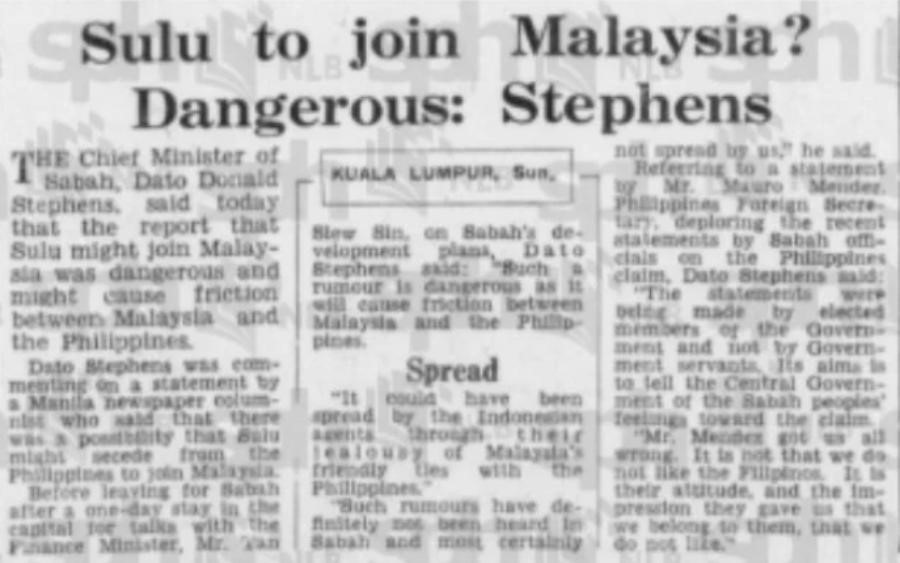
Sabahan leaders were immediately concerned about Sulu’s inclusion in Malaysia, citing concerns on diplomatic relations with Manila and the future of regional peace. Image Source: SPH, NLB
As stated by then Chief Minister of Sabah, Dato Donald Stephens, there was concern that a Sulu secession from the Philippines in favor of joining a larger Malaysian Federation would create substantial friction with Manila.
A loose confederation between the ASEAN countries of Malaysia, Indonesia, and the Philippines was also proposed: “Maphilindo,” a portmanteau of the three countries. This too failed almost immediately over the status of North Borneo and Sabah in the 1960s.
In the end, despite her significant efforts in fighting for Sulu freedom, Princess Tarhata Kiram’s forgotten vision of the future fits comfortably within no one’s understanding of the present. Yet it offers an important perspective: Sulu can determine its own identity, but precisely because of that independence, it cannot simultaneously advance the Sultanate’s historical and political interests as though they were interests shared by the rest of the Philippines.
What’s more, it’s clear that Sabah and Malaysia as a whole were not inherent opponents in the Princess’ eyes, so much so that she considered integrating Sulu into Malaysia.
REFERENCES
Charbonneau, O. (2018). Visiting the Metropole: Muslim Colonial Subjects in the United States, 1904–1927. Diplomatic History, 42(2), 204–227, 355. https://www.jstor.org
KnowSulu. (2026, January 27). Why the Philippines' Sabah claim collides with its own Constitution. https://know-sulu.ph
KnowSulu. (2026, June 30). Slaves and Seapower: The Complex Power of the Sulu Sultanate. https://know-sulu.ph
KnowSulu. (2026, June 24). The Real Sabah Story: Porous borders, Impossible Claims, and Politics. https://know-sulu.ph
Majangkim, R. (2026, February 28). Sabah: A sovereign choice the world witnessed. Jesselton Times. https://jesseltontimes.com
Tan, T. Y. (2008). Conclusion. In Creating “Greater Malaysia”: Decolonization and the politics of merger (pp. 189–198). ISEAS–Yusof Ishak Institute. https://www.cambridge.org
That wild little Sulu flapper we couldn't tame: How Princess Tarhata went back to the Philippines with her bobbed head full of American culture only to become a harem bride and lead the savage Moros on the war path. (1927, March 6). The Atlanta Constitution, F6. ProQuest Historical Newspapers.

KnowSulu is your trusted source for verified facts, news, and legal insights about the Sulu region. Committed to integrity, our mission is to empower the people of Sulu by providing accurate, transparent, and reliable information that matters.
