

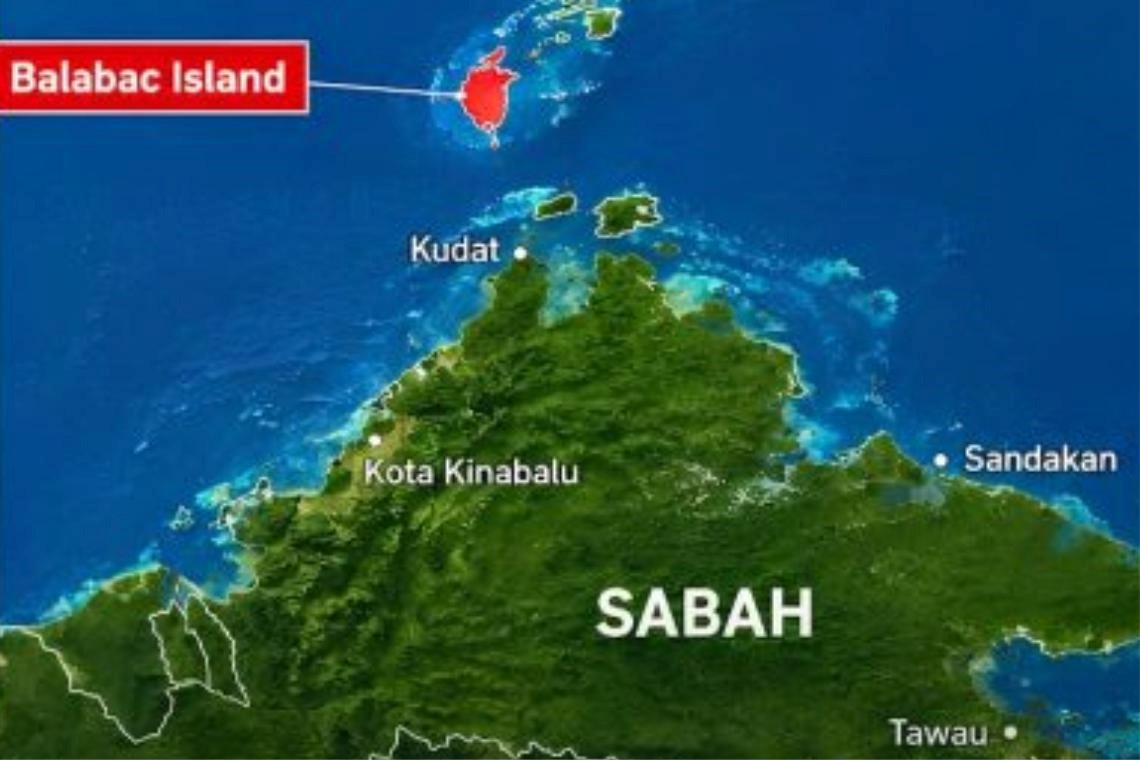
The Philippines’ Balabac Island lies near Sabah’s northern coast, standing just 50 kilometers from the nearest of Sabah’s outlying islands. Balabac’s militarization comes as part of a wider effort by the Philippines and the United States to improve their defense posture around the South China Sea. Image Source: Worth Sharing
He said Malaysia does not dispute Manila's right to deepen its defence cooperation, but that Kuala Lumpur must strengthen its own position. It was a calm yet entirely predictable response. But Balabac does not land on neutral ground. It lands on one of Southeast Asia's most disruptive unresolved grievances: the Philippine claim to Sabah, and the House of Kiram's role in keeping it alive.
Khaled's reasoning was geographic. The waters are tight, he said, and any conflict there could spill over onto Malaysia. The measures that follow are layered. The programme aims to build "people's resilience" as a complement to the armed forces, and the ministry says it has already increased its presence in Sabah. A bare air base is being built at Bintulu, due in 2028, with a radar to close surveillance gaps.
None of this is irrational. But together it is a steady build-up on the eastern flank, and it is exactly what a security dilemma predicts: each side's defensive step reads as provocation to the other, and the cycle feeds itself.
Updated headlines for free, straight to your inbox—no noise, just facts.
We collect your email only to send you updates. No third-party access. Ever. Your privacy matters. Read our Privacy Policy for full details.
Malaysian fears are not fed by an abstract security logic, nor by the presence of American weapons on Balabac, but by the Philippines’ active and open claim to Sabah. While pressing the claim to Sabah is likely not the goal of the Balabac base, the context is difficult to ignore.
Earlier this year, in February 2026, a Philippine foreign affairs spokesperson formally reaffirmed the government's sovereignty claim over Sabah. More recently, ahead of the Philippines’ 2028 presidential elections, Sara Duterte’s past and ongoing support for the claim to Sabah has also drawn worried scrutiny.
Princess Jacel Kiram, a descendant of the Sultanate that once ruled Sulu and—disputedly—Sabah, has also reiterated her family and the Philippines’ claim to the land.
Jacel herself is the daughter of self-proclaimed Sulu Sultan Jamalul III Kiram, who infamously ordered the 2013 Lahad Datu incursion by some 200 militants. The invasion failed, but left dozens of soldiers and civilians dead.
The equally infamous Sulu arbitration followed eight other Kiram claimants turned to arbitration in Spain to gain wealth at the expense of Sabah, and, in 2022, won a US$14.92 billion award from an arbitrator whose appointment a Madrid court had already revoked. Courts in France and the Netherlands refused to enforce it, the arbitrator was convicted of contempt in Spain, and in December 2025 the Paris Court of Appeal annulled the award entirely.
Despite the failure of the effort, each step escalated a dispute that diplomacy might have contained: a deadly armed landing, then a multibillion-dollar attempt to reach Malaysian assets, then a legal defeat that left grievances hardened rather than resolved.
Now, with the claim being repeated by officials, politicians and royal descendants alike, Balabac gives it a sharper security edge. Every reassertion of the claim—along with continued refusal by Manila to cooperate on Sabah—invites a harder Malaysian response and slows socio-economic progress in the region. The people who pay for this cycle are the communities of the Sulu-Sulawesi seas, who need cooperation on smuggling, piracy and kidnapping, not another round of territorial claims.
Malaysia emphasizes that Sabah's people exercised self-determination and joined the Malaysian federation in 1963, settling the question of sovereignty. Manila has never completely dropped its claim, inheriting the Kiram families’ claims in 1962.
That leaves a paradox at the heart of the issue. The surviving Kirams today press a claim that had been surrendered, and no Philippine president has formally recognised a new Sultan of Sulu since 1986. The royal house is fragmented, with rival claimants, and other sultanate lines have demanded inclusion in any award.
Despite this, a claim with no unified holder and no state-backed recognition still forces a security response: the Eastern Sabah Security Command (ESSCOM) was created in 2013's aftermath.
The cost of this is borne by the very communities the claim purports to represent. The threats that most endanger the relationship between Sulu and Sabah are smuggling, illegal immigration, kidnapping, and piracy, and no country can solve them alone. Every political reassertion of territorial claims pushes both governments toward harder action and away from the cooperation that would make the border safer.
REFERENCES
Cayabyab, M. J. (2013, March 7). Jamalul Kiram III and the 'sultans' of Sulu. GMA News Online. https://www.gmanetwork.com
Golingai, P. (2026, September 27). Sabah and Sulu are brothers. The Star. https://www.thestar.com.my
KnowSulu. (2026, September 1). Should Sulu and Sabah become a battleground for superpowers? https://know-sulu.ph
KnowSulu. (2026, September 22). The Kiram question: Can private citizens own and transfer people and states? https://know-sulu.ph
Jeffrey, S., & Amde, A. (2026, September 27). Balabac prompts tightening Sabah's defence. Daily Express. https://www.dailyexpress.com.my
Majangkim, R. (2026, February 28). Sabah: A sovereign choice the world witnessed. Jesselton Times. https://jesseltontimes.com
Majul, C. A. (1979). An analysis of the "Genealogy of Sulu." Asian Studies, 17, 1–17. https://asj.upd.edu.ph
Muhammad Syameer Luthfy bin Hamzah. (2026, October 1). Bintulu is getting an air base, but does Malaysia need it? Daily Sabah. https://www.dailysabah.com
Panganiban, A. V. (2013, March 2). Understanding the Sabah dispute. Philippine Daily Inquirer. https://opinion.inquirer.net
United Nations. (1963, September 1). United Nations Malaysia Mission [Photograph]. UN Photo. https://media.un.org

KnowSulu is your trusted source for verified facts, news, and legal insights about the Sulu region. Committed to integrity, our mission is to empower the people of Sulu by providing accurate, transparent, and reliable information that matters.
