

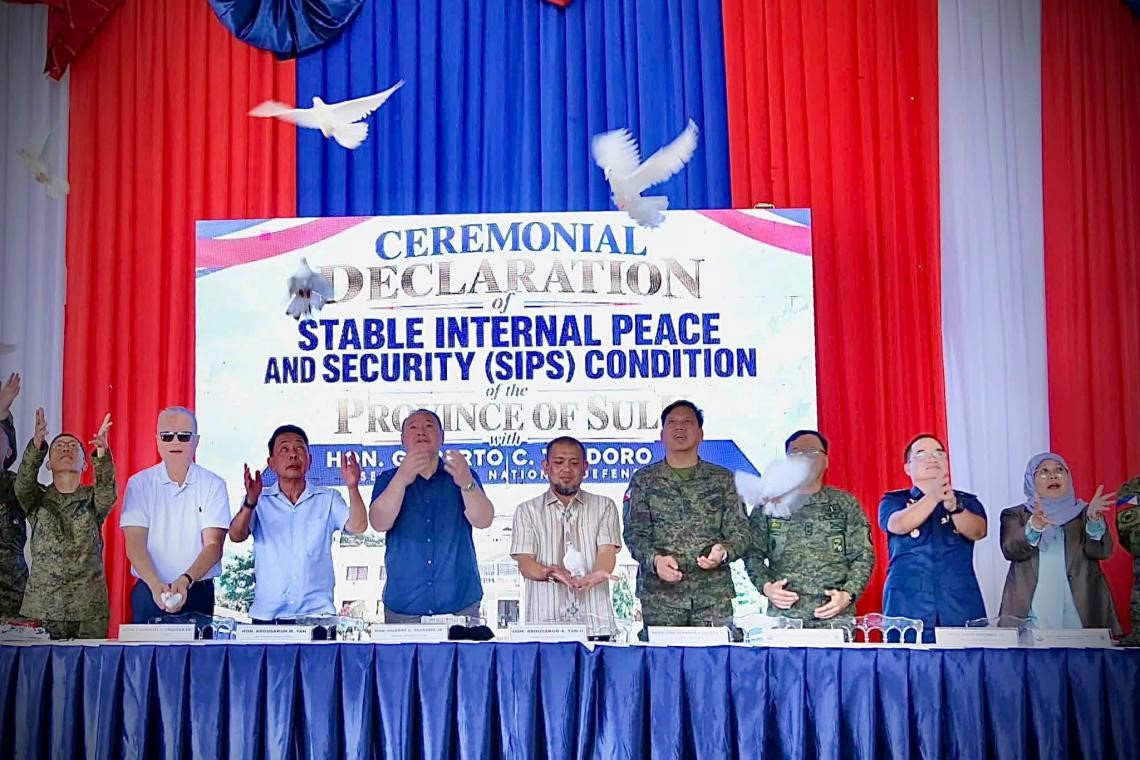
Sulu officials and security forces during the province’s declaration of Stable Internal Peace and Security. Image source: SunStar Davao - Facebook.
On September 24, 2026, Sulu was formally declared to be in a condition of SIPS, covering all 19 municipalities. The declaration marked an important milestone after decades of armed conflict and insecurity. But the significance of SIPS extends beyond the declaration itself. For communities, the more practical question is what a more stable environment can make possible.
During the declaration, Department of National Defense Secretary Gilberto Teodoro Jr. emphasized that the province’s struggle now includes maintaining peace while pursuing development. He identified infrastructure, connectivity, education and basic services as important to sustaining the gains of peace. This shifts the focus from what Sulu has achieved in terms of security to what communities can build on that foundation.
For residents, the value of stability can be measured not only through security indicators but also through access to everyday services. Infrastructure is one area where this connection is already visible. In July, the Ministry of Public Works of the Bangsamoro Autonomous Region in Muslim Mindanao (MPW-BARMM) reported on completed and ongoing projects in Sulu. These included barangay roads, Level II water systems, solar streetlights and community facilities. The projects were implemented through Sulu’s 1st and 2nd District Engineering Offices.
“Improved infrastructure can help make stability more meaningful in daily life.”
Such projects may appear separate from peace and security, but they can influence how communities access schools, markets, public services and economic activity. The same principle applies to connectivity and public facilities. A more stable environment can create greater room for development programs to reach communities, while improved infrastructure can help make that stability more meaningful in daily life.
Updated headlines for free, straight to your inbox—no noise, just facts.
We collect your email only to send you updates. No third-party access. Ever. Your privacy matters. Read our Privacy Policy for full details.
Maintaining peace is not only a responsibility of security institutions. Local communities also have a role in preserving the conditions that make development possible. Indanan provides one example. In August, the municipality was declared under a State of Stable Internal Peace and Security and recognized as a Gun-Responsible Municipality after residents voluntarily surrendered 49 loose firearms. Local officials and security leaders linked the achievement to cooperation between residents, community leaders, local government and security forces. The Philippine National Police (PNP) later said it would study Indanan’s experience as a possible model for encouraging other communities to voluntarily surrender loose firearms and help prevent the return of armed violence.
“Peace can create the conditions for development, but communities remain central to sustaining both.”
The PNP also emphasized continued cooperation among police, military personnel, local governments, community leaders and residents. The example suggests that sustaining peace involves more than maintaining security operations. Community participation and local cooperation can also become part of the foundation for longer-term development.
Education is another area where the benefits of stability could potentially become visible over time. Schools require reliable access, infrastructure and basic services. For families, education also represents a pathway toward skills, employment and greater economic participation. A more stable environment can help create conditions in which these opportunities can be strengthened.
“Development can also involve strengthening the everyday systems that allow people to work, study, travel and trade.”
The same principle can apply to livelihoods. Farmers, fishers, small businesses, entrepreneurs and other local workers depend on roads, transportation, electricity, communications and access to markets. For Sulu’s communities, development therefore does not necessarily begin with large economic projects. It can also involve strengthening the everyday systems that allow people to work, study, travel, trade and access public services.
A more stable security environment can also create opportunities for economic activity. Tourism is one area already identified by Sulu officials as having potential, particularly given the province’s beaches and other natural attractions. The recent peace and security gains have been linked by local officials to hopes for increased tourism and development.
“A more stable security environment can create opportunities for communities to participate in economic activity.”
However, attracting visitors and investment requires more than a declaration of stability. Roads, transportation, electricity, telecommunications, public facilities and local skills can all influence whether communities are able to participate in and benefit from economic activity. This makes infrastructure and human development important parts of the broader economic picture.
Sulu’s SIPS declaration provides a foundation, but it does not by itself determine what the province’s next chapter will look like. The challenge now is to sustain the security gains while translating greater stability into improvements that communities can experience in everyday life.
“The future of peace may also be measured by what becomes possible because stability has been maintained.”
That could mean better access to public services, stronger infrastructure, more reliable connectivity, improved educational opportunities and greater space for local livelihoods and businesses. It also means maintaining the cooperation that contributed to the province’s improved security situation.
For Sulu’s communities, the future of peace may therefore be measured not only by the absence of armed violence, but also by what becomes possible because stability has been maintained. The question after SIPS is no longer only how Sulu reached this point. It is how the province can use this new environment to build stronger communities and create opportunities for the people who live there.
REFERENCES
GMA News. (2026, September 24). Sulu declared stable in internal peace, security condition. GMA News. https://www.gmanetwork.com
GMA News. (2026, September 25). Sulu turns page from decades of conflict. GMA News. https://www.gmanetwork.com
MindaNews. (2026, August 08). Army declares Indanan a place of stable peace. MindaNews.https://mindanews.com
DILG Region IX. (2026, May 10). RCSP Regional Spotlight Brings Services and Strengthens Community Convergence in Patikul, Sulu. DILG Region IX. https://region9.dilg.gov.ph
Ministry of Public Works. (2026, July 16). MPW-BARMM reports Sulu infrastructure accomplishments and project status. Ministry of Public Works. https://mpw.bangsamoro.gov.ph
Inquirer. (2026, August 10). PNP eyes mirroring Indanan, Sulu’s peace gains for other communities. Inquirer. https://newsinfo.inquirer.net

KnowSulu is your trusted source for verified facts, news, and legal insights about the Sulu region. Committed to integrity, our mission is to empower the people of Sulu by providing accurate, transparent, and reliable information that matters.
