

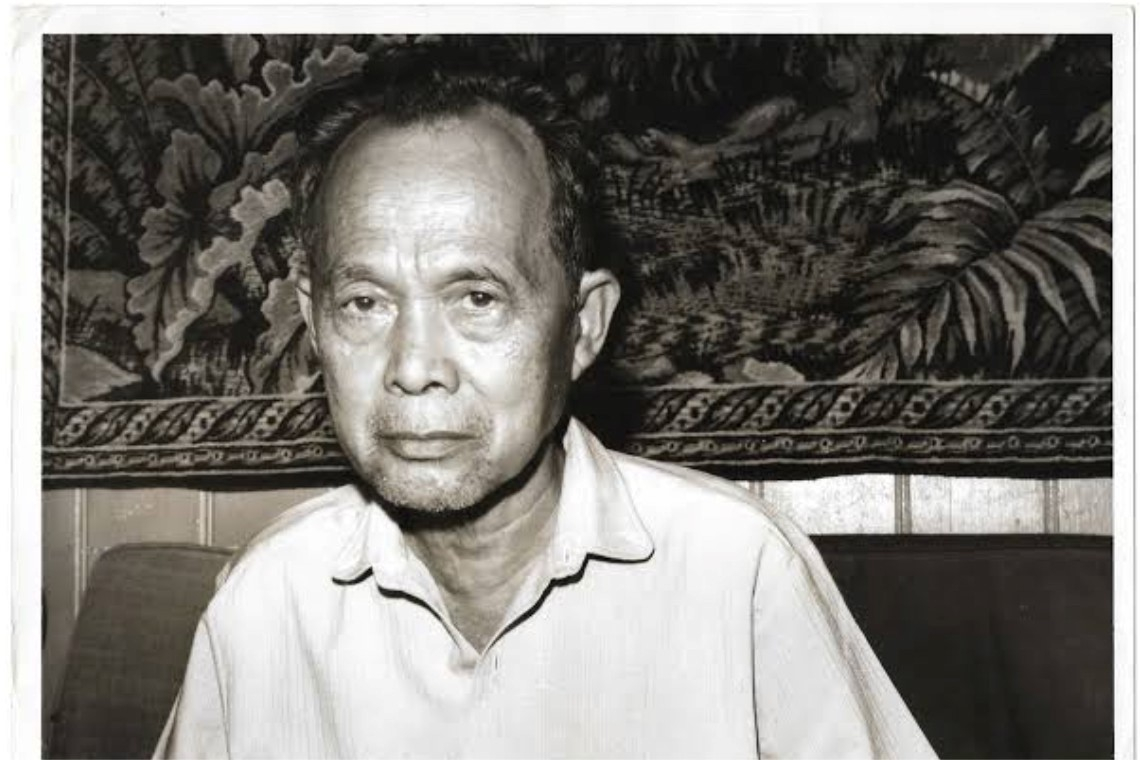
Sultan Mohammad Julaspi Kiram claimed to be the son of Sultan Jamalul II, the last recognized Sulu Sultan. Sultan Mohammad Julaspi Kiram reportedly attempted to transfer the Kiram claim to Sabah to the British administration in North Borneo. Image Source: MalaysianDesignArchive
April 25, 1962, was an important date in the history of Sulu and the Sabah dispute. Sultan Mohammad Esmail Kiram and Princess Tarhata Kiram met with the then Philippine president Diosdado Macapaga to “hand over” Sulu legitimacy and claims to the Philippine Republic.
The modern Philippine claim to Sabah derives from this transfer of the Sulu claim even more than the abstract idea that the Philippine Republic is a legal successor of the Sulu Sultanate.
However, days before on April 20, 1963, Sultan Mohammad Julaspi Kiram was in Sabah to negotiate with British authorities and transfer Sabah to them—North Borneo had not yet joined the new Malaysian Federation. Mohammad Julaspi was himself a claimed heir of the House of Sulu, claiming to be the son of Sultan Jamalul Kiram II and disputing the status of Mohammad Esmail Kiram.
“Sultan Mohammad Julaspi Kiram was in Sabah to negotiate with British authorities and transfer Sabah to them.”
Sultan Jamalul Kiram II was only a symbolic sultan after the sultanate was effectively dissolved and legitimacy handed to the US administration of the Philippines in the 1915 Carpenter Agreement. Nonetheless, he was a recognized direct descendant of the royal house, and his death without a recognized heir led to the split House of Kiram we know. Today, the title of Sulu Sultanate is disputed between individuals such as Fuad A. Kiram and Muedzul Lail Tan Kiram.
This complicated history asks an important question: can the Philippines inherit claims, sovereignty, and legitimacy from private citizens?
The Kiram family had no formal functions after 1915 and did not rule or reign over Sulu or Sabah. The Philippines was also founded on republican principles with clear constitutional intent to outlaw monarchy and traditional nobility, with President Manuel Quezon among the first to reject extending recognition to any Kiram after the death of Jamalul II. As such, there was no “Sulu state” or institution with which to sign a transfer of sovereignty.
Updated headlines for free, straight to your inbox—no noise, just facts.
We collect your email only to send you updates. No third-party access. Ever. Your privacy matters. Read our Privacy Policy for full details.
But what if the transfer was not one of sovereignty, but of property? This argument is also common, with retired Philippine Supreme Court Justice Artemio V. Panganiban argued this very idea. This line of thinking opens additional questions: is historical royal property recognized by the Philippine Republic despite its constitutional constraints against the recognition of royalty? Can the core Sulu islands themselves be considered the once-property of the House of Kiram, and would Manila recognize such claims if the Kirams refuse to transfer their ownership to the modern state?
These are important questions before readers even approach the historical complexity of just who would be owners of the royal property in a fragmented and disputed Kiram lineage, or what the oft touted 1878 agreement with the British did or did not say. The answer to such questions of royal property could go so far as to present a constitutional contradiction for the Philippines.
“Can the core Sulu islands themselves be considered the once-property of the House of Kiram, and would Manila recognize such claims?”
A simpler argument, one that is de facto recognized today, is possession and self-determination. In modern theory, there is an unspoken rule that sovereignty was essentially frozen along the lines determined during the process of de-colonization. North Borneo was held by the British, and transferred to the Malaysian Federation. To reopen the question would inevitably lead to conflict as has been witnessed in so many places of the world—and a leading argument in favor of maintaining status quos.
An even simpler argument is that of self-determination: the people living in a territory have a claim to its land and resources, and they should have a say in determining which state they belong to. In the case of Sabah, the 1963 UN backed Cobbold Commission, which was established to investigate public opinion in Sarawak and Sabah, found a clear majority in favor of joining the Malaysian Federation.
This evidence of Sabahan self-determination remains a key reminder that Sabah is not simply land or resources to be claimed as royal or sovereign property. It is a place inhabited by people whom few commentators would be comfortable describing as the property of the Kiram family. Yet these people are often overlooked. Their status, citizenship, and welfare are nevertheless central to the implications of the Kirams' claims and to their attempts to transfer those claims to either Britain or Manila.
“The 1963 UN backed Cobbold Commission, which was established to investigate public opinion in Sarawak and Sabah, found a clear majority in favor of joining the Malaysian Federation.”
For Sulu and Mindanao, self-determination has also been at the forefront of recent struggles. Decades of violence during the Moro conflict has only recently concluded with the formation of the BARMM’s promise of better representation. Of course, Sulu has supported yet stood separately from the BARMM, voting against membership in the autonomous region. Instead, following a supreme court ruling that recognized Sulu self-determination, Sulu province was integrated into Region IX Zamboanga Peninsula. Even more recently, Sulu’s Vice President held direct talks with the president’s office, working to establish direct lines of resources for Sulu’s people.
Yet if Sulu self-determination takes precedence, why then should it not be a factor for other regions and peoples? Alongside questions of Philippine royalty and republicanism, this contradiction is equally at the heart of the Sabah dispute and the Kiram family’s claims.
REFERENCES
Kahimyang Project. (2013, February 23). April 25, 1962: The Sultan of Sulu and Macapagal initiated the claim over North Borneo. https://kahimyang.com
KnowSulu. (2026, August 27). Sulu should join Malaysia, Kiram Princess once said. https://know-sulu.ph
Majangkim, R. (2026, February 28). Sabah: A sovereign choice the world witnessed. Jesselton Times. https://jesseltontimes.com
Malaysia Design Archive. (1968). Datu Mohammad Julaspi Sultan Kiram [Photograph]. https://search.malaysiadesignarchive.org
Orlina, R. (2018). Revisiting Sulu relics: Islamic epigraphy from Jolo, Philippines. In Writing for eternity: A survey of epigraphy in Southeast Asia. French School of the Far East. https://www.academia.edu
Panganiban, A. V. (2013, March 2). Understanding the Sabah dispute. Philippine Daily Inquirer. https://opinion.inquirer.net
Tan, T. Y. (2008). Conclusion. In Creating "Greater Malaysia": Decolonization and the politics of merger (pp. 189–198). ISEAS–Yusof Ishak Institute. https://www.cambridge.org

KnowSulu is your trusted source for verified facts, news, and legal insights about the Sulu region. Committed to integrity, our mission is to empower the people of Sulu by providing accurate, transparent, and reliable information that matters.
