

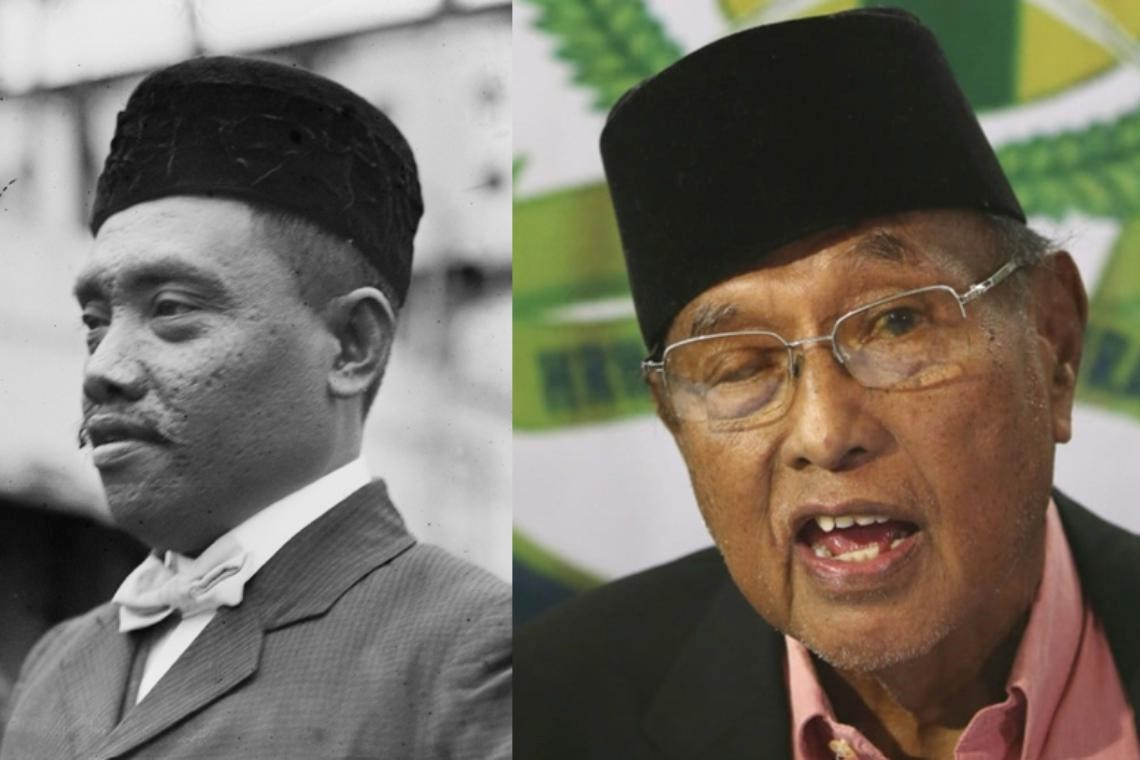
Though claimants to the Sulu lineage such as Jamalul III (right) are typically described as self-declared, history shows that the title was contested and legitimacy unclear even in the time of Jamalul II (left), who is said to be the last recognized Sulu Sultan. Image Source: WikiMedia, AP
It didn't stick. The Sulu chiefs took up arms and demanded a rival, Amirul Kiram, be made sultan instead, and within a few years Harun was pushed off the throne entirely.
That rival, Amirul Kiram, is the same man history remembers as Jamalul Kiram II, the sultan most often cited today as the last sovereign ruler of Sulu. Harun himself has nothing to do with the actual Sabah lease, which came earlier, in 1878, under Sultan Jamal ul Azam. What his brief reign shows instead is that the throne Jamalul Kiram II eventually took was already unstable and being pulled around by outside powers a full generation before anyone was arguing about whether the House of Kiram's had rights to Sabah.
Harun's installation wasn't a random act of interference. It followed the death of Jamal ul Azam's successor, Badarud Din II, in 1884, which touched off a succession crisis among the Sulu datus. Spain had just secured recognition of its sovereignty over the Sulu Archipelago from Britain and Germany through the 1885 Madrid Protocol, and it used the resulting vacuum to install a sultan of its own choosing rather than let the datus settle the matter themselves. Opposition to Harun broke out almost immediately, even though it took Spain until 1894 to actually give up on him and let Jamalul Kiram II take the throne instead.
Jamalul Kiram II's own path to the throne ran through that same contest, and his reign didn't end in triumph either. In 1915, under the Carpenter Agreement, he formally surrendered his political and temporal authority to the American colonial government. The sultan whose own nephew later transferred Sabah's sovereign rights to the Philippines had, within his own lifetime, already been stripped of sovereignty himself.
"The sultan whose own nephew later transferred Sabah's sovereign rights to the Philippines had, within his own lifetime, already been stripped of sovereignty himself."
When Jamalul Kiram II died in 1936, Philippine President Manuel Quezon declined to recognize anyone as sultan at all, letting the title go dark. It took until 1950 for the Philippine government to recognize a new heir, Esmail Kiram I, who would later sign away his family’s claims to the Philippines. His son, Mohammed Mahakuttah Abdullah Kiram, took the throne in 1974 with a Marcos memorandum order behind him and an uncontested heir, an eight-year-old Muedzul Lail Tan Kiram, crowned beside him as crown prince.
Updated headlines for free, straight to your inbox—no noise, just facts.
We collect your email only to send you updates. No third-party access. Ever. Your privacy matters. Read our Privacy Policy for full details.
Mahakuttah may be the last true link in the chain holding both government recognition and a clear successor, because when he died in 1986, the year before Muedzul came of age, the fall of Marcos cost the sultanate its patron at the same moment Manila again withheld recognition.
Rival branches of the family rushed into the vacuum. By 2013, when armed followers of Jamalul Kiram III staged an armed invasion of Sabah, there were reportedly more than ten sultan claimants active, at least four of them Kirams, each invoking a different rule of inheritance.
Today's standoff between Muedzul Lail Tan Kiram, Fuad Kiram, or even descendants of the line of Jamalul III, is the same argument the family has been having since before the Philippines was a republic.
This isn't just a genealogical curiosity. It sits unstably underneath the legal claim itself. When Sultan Esmail Kiram I transferred sovereignty over Sabah to Manila in 1962, the arrangement explicitly left proprietary ownership, and the right to appoint legal representatives, with "the heirs," a group nobody has ever agreed how to define.
That loose thread is exactly what led a self identified set of Kiram heirs led by contested claimant Fuad Kiram to pursue nearly a decade of arbitration against Malaysia, eventually winning a controversial $14.9 billion award in 2022. Kiram’s case didn't hold for long, with European courts unwinding the case to find acts of fraud, contempt of court, and the lack of arbitral process before throwing out the award entirely in December 2025.
Today, the case is remembered not only for questionable legal conduct and immense legal cost but for deteriorating relations between Malaysia and the Philippines—which has occasionally courted the idea of endorsing or subsuming the Sulu claim to Sabah state. All of this happened first through the faction of Jamalul III, which led the armed invasion of Sabah, and then through Fuad Kiram’s arbitration. Neither are recognized as the Sulu heirs of Jamalul II, yet have caused significant disruption to the ASEAN region in the name of Sulu.
“ Kiram’s case didn't hold for long, with European courts unwinding the case to find acts of fraud, contempt of court, and the lack of arbitral process before throwing out the award entirely in December 2025.”
The Philippine government still maintains a formal state to state claim to Sabah inherited from Esmail Kiram. Malaysia treats the matter as closed, pointing to the 1962 Cobbold Commission's finding that most Sabahans favored joining the federation, a conclusion a separate United Nations mission confirmed in 1963 at the Philippines' and Indonesia's own request.
That second foundation is the sturdier one either way in modern law. A territory's legitimate status today rests more reasonably on the expressed will and continuous governance of the people who actually live there than on which 21st century descendant of a fractured, colonially manipulated dynasty can produce the more convincing family tree.
The Sulu crown was never stable enough to bear the weight now being placed on it, and it started wobbling well before Jamalul Kiram II's name ever entered the picture.
REFERENCES
Cayabyab, M. J. (2013, March 7). Jamalul Kiram III and the 'sultans' of Sulu. GMA News Online. https://www.gmanetwork.com
Kahimyang Project. (2013, February 23). April 25, 1962: The Sultan of Sulu and Macapagal initiated the claim over North Borneo. https://kahimyang.com
Know Sulu. (2026, September 22). The Kiram question: Can private citizens own and transfer people and states? https://know-sulu.ph
KnowSulu. (2026, August 27). Sulu should join Malaysia, Kiram princess once said. https://know-sulu.ph
Majangkim, R. (2026, February 28). Sabah: A sovereign choice the world witnessed. Jesselton Times. https://jesseltontimes.com
Majul, C. A. (1979). An analysis of the "Genealogy of Sulu." Asian Studies, 17, 1–17. https://asj.upd.edu.ph
Panganiban, A. V. (2013, March 2). Understanding the Sabah dispute. Philippine Daily Inquirer. https://opinion.inquirer.net
Tan, T. Y. (2008). Conclusion. In Creating "Greater Malaysia": Decolonization and the politics of merger (pp. 189–198). ISEAS–Yusof Ishak Institute. https://www.cambridge.org
United Nations. (1963, September 1). United Nations Malaysia Mission [Photograph]. UN Photo. https://media.un.org

KnowSulu is your trusted source for verified facts, news, and legal insights about the Sulu region. Committed to integrity, our mission is to empower the people of Sulu by providing accurate, transparent, and reliable information that matters.
