

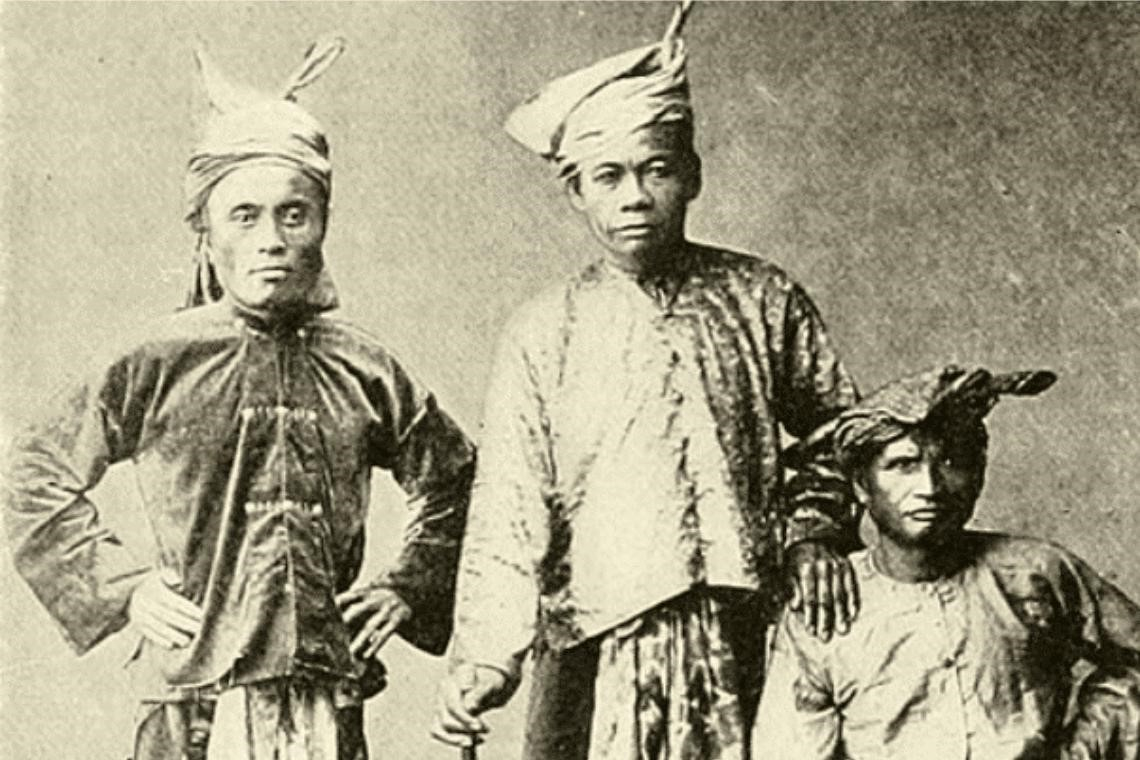
Historical photographs of Panglima Bandahala are rare, here chieftains of Sulu from the Philippine Islands are portrayed ca. 1899, which could include him. His influence in Sulu history shows how leadership could mean restraining violence, preserving institutions, and guiding communities through colonial upheaval. Source: Lala.
In the final decades of the Sultanate of Sulu, Sultan Jamalul Kiram II ruled during a period increasingly shaped by armed resistance, American colonial expansion, and the erosion of Sulu's political authority. Within this turbulent environment stood Panglima Bandahala, a powerful warrior and political leader whose influence was repeatedly exercised in a different direction. While Kiram II became associated with a politics increasingly defined by conflict and resistance, Bandahala emerged as a figure of restraint, negotiation, and mediation when further bloodshed threatened Sulu communities.
Bandahala was not an outsider to the Sultanate. He belonged to its political structure and was associated with Kiram II, yet his own record reveals a markedly different approach to moments of crisis. He was a warrior and a political chief with followers and authority, but his historical significance rests particularly on occasions when he used that authority to negotiate rather than escalate. His career demonstrates that leadership within a warrior society could involve not only the ability to fight, but also the ability to prevent fighting.
Kiram II's reign coincided with one of the most difficult periods in Sulu's encounter with the United States. In 1899, he signed the Bates Agreement with the United States, recognizing American sovereignty over Sulu while providing assurances concerning religion, customs, and the position of the Sultan. The United States later declared the agreement void in 1904, after which American administrative and military control expanded throughout the archipelago.
"Nevertheless, Kiram II's reign unfolded within, and became inseparable from, this increasingly war-oriented political environment."
The political consequences were profound. American authorities introduced taxation, disarmament measures, land registration, and other administrative policies that challenged established systems of authority. Resistance grew among sections of the Sulu population, and confrontations increasingly became military affairs. The period cannot fairly be attributed to Kiram II alone; American colonial policy, local datus, religious leaders, community grievances, and competing political interests all contributed to the violence. Nevertheless, Kiram II's reign unfolded within, and became inseparable from, this increasingly war-oriented political environment.
The eventual outcome was particularly damaging to the Sultanate. On March 22, 1915, Kiram II signed the Carpenter Agreement, formally recognizing U.S. sovereignty and relinquishing the Sultan's temporal governing authority. The agreement marked a major reduction in the political power of the institution he represented.
Updated headlines for free, straight to your inbox—no noise, just facts.
We collect your email only to send you updates. No third-party access. Ever. Your privacy matters. Read our Privacy Policy for full details.
Against this background, Bandahala's role becomes especially significant. He was not a pacifist in the modern sense and should not be removed from the warrior culture in which he lived. His authority was partly based upon loyalty, political standing, and the ability to command followers. Yet the surviving record repeatedly shows him using that influence to seek accommodation when armed confrontation threatened to produce greater destruction.
"Rather than approaching them as a military commander seeking another battle, he approached them as a negotiator attempting to prevent one."
One of the clearest examples came during the Bud Dajo crisis. American administrative records and later historical accounts identify Bandahala among the leaders involved in attempts to persuade the defenders of Bud Dajo to surrender. His local standing made him an important intermediary between American authorities and the people occupying the mountain. Rather than approaching them as a military commander seeking another battle, he approached them as a negotiator attempting to prevent one.
The crisis at Bud Dajo provides the strongest evidence for Bandahala's role as a voice of restraint. Datu Jolkarnain, Datu Kalbi, and Panglima Bandahala were sent to persuade the people on the mountain to come down and surrender their arms. Historical accounts describe the three leaders remaining for several days and repeatedly attempting to convince the defenders to abandon their position. Their efforts failed, and the American authorities eventually ordered a military assault.
The importance of Bandahala's role lies in what he attempted to accomplish before the fighting began. He was a warrior speaking to other warriors, yet his mission was not to encourage resistance. It was to stop the confrontation through persuasion. The defenders refused, and the resulting assault caused catastrophic loss of life. Contemporary and later accounts differ over the precise number of victims, but the battle remains one of the most devastating episodes of the American occupation of Sulu.
"He represented an alternative to escalation at a moment when political leaders and military authorities were moving toward confrontation."
Bandahala's failure to prevent the battle should not obscure the significance of his intervention. His presence demonstrates that negotiation was attempted before military force was used. He represented an alternative to escalation at a moment when political leaders and military authorities were moving toward confrontation.
The contrast between Kiram II and Bandahala is therefore not simply a contrast between a Sultan and one of his followers. It is a contrast between two forms of political influence during a period of crisis. Kiram II possessed the formal authority of the Sultanate, yet the political order under his reign became increasingly consumed by conflict and ultimately suffered a profound loss of temporal authority. Bandahala possessed no comparable throne, but he exercised practical influence among local communities and was repeatedly placed in situations where mediation was necessary.
"Kiram II possessed the formal authority of the Sultanate, yet the political order under his reign became increasingly consumed by conflict and ultimately suffered a profound loss of temporal authority."
This does not establish that Bandahala openly opposed Kiram II or that the two men were political enemies. Rather, Bandahala can be understood as a restraining force within a political environment increasingly shaped by warfare. He could recognize Sulu's interests while also recognizing that continued armed confrontation could impose enormous costs upon the very communities those interests were supposed to protect.
His approach represented a different understanding of strength. A leader could demonstrate authority by mobilizing fighters, but he could also demonstrate authority by persuading those fighters to stand down. In Bandahala's case, his credibility gave him access to people whom military officials could not easily persuade.
Bandahala's importance also extended beyond Bud Dajo. Historical records associate him with political leadership in Luuk and Tandu and with the broader administrative life of Sulu. His influence therefore cannot be understood solely through warfare. As the traditional political order weakened under American rule, leadership increasingly required negotiation, representation, and adaptation.
"Rather than defining leadership entirely through armed resistance, his career demonstrates the importance of maintaining relationships with communities and finding practical solutions to political crises."
This makes Bandahala's career particularly significant. He belonged to an older warrior political tradition, yet his influence could be redirected toward political accommodation when circumstances demanded it. Rather than defining leadership entirely through armed resistance, his career demonstrates the importance of maintaining relationships with communities and finding practical solutions to political crises.
The history of Sultan Jamalul Kiram II's reign is often dominated by war, colonial expansion, resistance, and the eventual decline of the Sultanate's political authority. Yet within that history was another form of leadership represented by Panglima Bandahala. He was a warrior, but he was also a mediator. He possessed authority, but he understood that authority could be used to restrain violence.
Kiram II remained the Sultan, but his reign ended with the Sultanate's temporal political power greatly reduced under American rule. Bandahala's legacy lies elsewhere. At Bud Dajo, he attempted to persuade armed defenders to surrender before the assault. In his wider political career, he exercised influence through community leadership and negotiation. His historical importance therefore rests not merely on whom he served, but on how he used his own authority.
"Sometimes strength meant standing between opposing sides, negotiating when possible, and attempting to prevent another community from being destroyed by war."
Panglima Bandahala deserves to be remembered as a counterweight to the war-minded political environment of Kiram II's era. He demonstrated that a warrior did not have to measure strength only by the battles he could fight. Sometimes strength meant standing between opposing sides, negotiating when possible, and attempting to prevent another community from being destroyed by war. His legacy is ultimately that of a leader who understood the cost of conflict and recognized that protecting one's people could require something more difficult than fighting: the courage to seek restraint.
REFERENCES
Ansarmahdi (2025, August 03). Panglima Bandahala. Ansarmahdi. https://ansarmahdi.mataroa.blog
Filipino History and Culture. (2025, August 26). Records regarding Panglima Bandahala - Facebook. Filipino History and Culture. https://www.facebook.com
Know Sulu. (2026, April 17). The Kiram Network: After the Courtroom Collapses, Who Picks Up the Gun? Know Sulu. https://know-sulu.ph
Medium. (2025, August 24). Remembering Tausug Heroes This National Heroes Day. Medium. https://medium.com

KnowSulu is your trusted source for verified facts, news, and legal insights about the Sulu region. Committed to integrity, our mission is to empower the people of Sulu by providing accurate, transparent, and reliable information that matters.
