

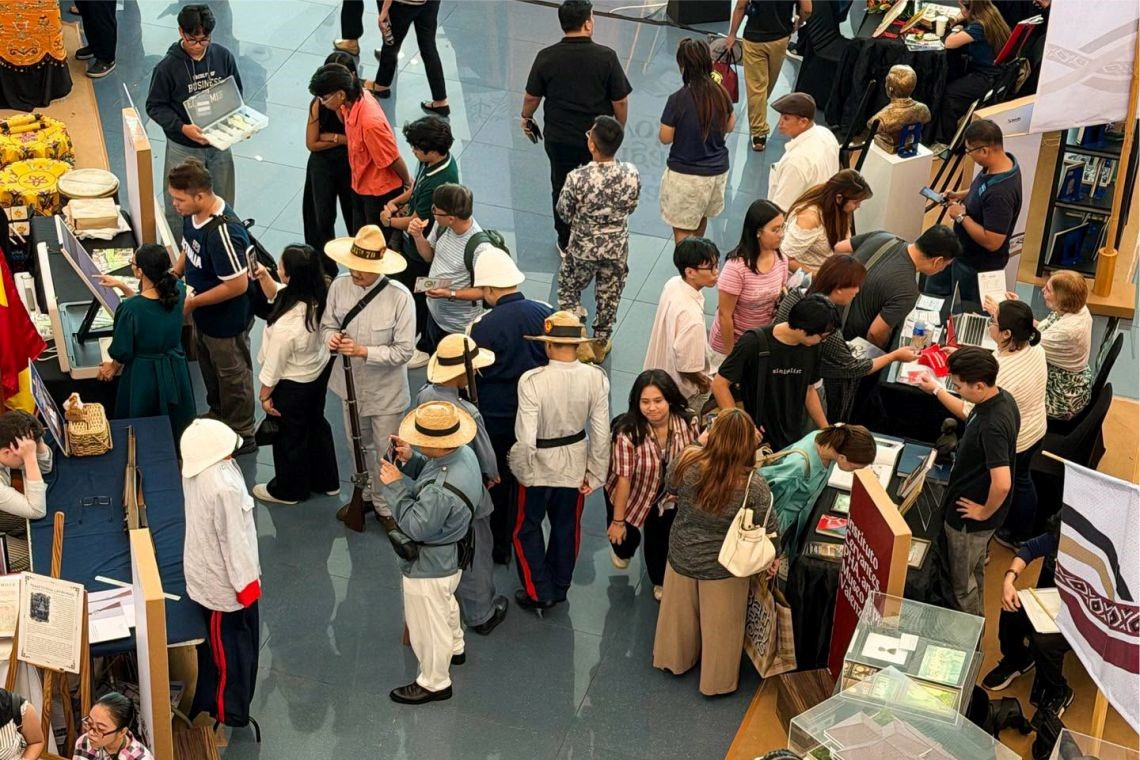
Visitors and participants during HistoEx 2026 in Pasay City. Image source : SM Mall of Asia – Facebook.
For generations, much of Sulu’s cultural memory has been transmitted through spoken words. Stories shared within families, advice from elders, religious teachings, proverbs, poems, and traditional narratives have carried knowledge across generations without depending on written archives. Tausug oral traditions remain closely connected to everyday community life.
A 2024 study by Camille Lucille A. Bello of the University of the Philippines Open University examined how oral traditions are transmitted across four generations in a community in Indanan, Sulu. The research identified pandu’, meaning advice and guidance, and maasalla, or proverbs and sayings, as important forms of traditional knowledge. Religious leaders, parents, and other elders continue to play important roles in passing such knowledge to younger members of the community.
However, the same research points to a gradual decline in the transmission of more complex forms of oral tradition, including tarasul poems and kissa narratives. Changing lifestyles, generational differences, and new forms of communication are reshaping the way cultural knowledge moves through Sulu communities. The shift does not necessarily mean that oral tradition is disappearing. Instead, traditional storytelling is increasingly finding new spaces through mobile phones, social media, and other digital platforms.
Digital technology offers new possibilities for preserving cultural knowledge that once depended almost entirely on face-to-face transmission. Bello’s research found growing use of mobile phones and Facebook among younger generations for transmitting Tausug oral traditions. Digital communication provides opportunities for stories, sayings, language, and cultural knowledge to reach audiences beyond the household or local community.
“Digital technology offers new possibilities for preserving cultural knowledge that once depended almost entirely on face-to-face transmission.”
Updated headlines for free, straight to your inbox—no noise, just facts.
We collect your email only to send you updates. No third-party access. Ever. Your privacy matters. Read our Privacy Policy for full details.
Language preservation provides another example. Research published in 2026 examined the integration of Tausug, Sama, and Yakan languages into higher education at Sulu State University, highlighting both the cultural importance of local languages and the institutional challenges surrounding greater use in education. Earlier research has also explored a Bahasa Sug mobile learning application for toddlers in Jolo. The study involved 160 toddlers and 160 parents across eight barangays and reported significantly better results with the mobile learning application than with traditional teaching methods for mother-tongue development.
Such initiatives suggest a broader change in cultural preservation. A smartphone can become more than a communication device. Audio recordings, videos, digital lessons, photographs, scanned documents, and social media posts can all become part of a wider cultural record. The digital environment also creates challenges. Oral traditions traditionally depend on context, personal relationships, repetition, and direct interaction with knowledgeable elders. Moving stories into digital spaces can raise questions about authenticity, interpretation, ownership, and the loss of cultural context. Bello’s research specifically notes concerns surrounding authenticity when technology becomes part of traditional transmission.
The growing attention to digital preservation comes at a significant moment for Sulu. In July 2026, Sulu’s historical and cultural heritage received national attention at HistoEx 2026 in Pasay City. The exhibition, organized by the National Historical Commission of the Philippines (NHCP), presented historical photographs, traditional crafts, clothing, food, and other examples of Sulu’s living heritage.
The exhibition demonstrated that cultural preservation does not have to mean placing traditions in the past. Living heritage remains connected to communities, contemporary identity, and future generations. Digital preservation can strengthen that process by creating additional records of traditions that might otherwise become difficult to recover. Historical photographs can be digitized. Elders can be recorded while recounting community histories. Traditional songs and poems can be preserved in audio formats. Young people can document ceremonies, crafts, language, and everyday practices through responsible digital storytelling.
Sulu’s own history provides a strong argument for preserving such material. The province has long been connected to neighboring communities and maritime networks across Southeast Asia. Historical records from the Sulu Sultanate, including materials now available through the NHCP’s National Memory Project, demonstrate the importance of accessible historical documentation.
“Living heritage remains connected to communities, contemporary identity, and future generations.”
The transition from oral tradition to digital memory, therefore, represents more than a technological development. Digital tools can complement elders, families, schools, cultural institutions, and researchers in safeguarding knowledge that forms part of Sulu’s identity. The strongest form of preservation may ultimately combine both worlds; elders continuing to tell stories, communities continuing to practice traditions, and younger generations using modern technology to record, share, and carry those traditions forward. For Sulu, digital memory can provide another way for history to remain alive.
REFERENCES
Bangsamoro Government. (2026, July 29). Sulu’s living heritage takes national spotlight at HistoEx 2026 in Pasay City. Bangsamoro Government. https://bangsamoro.gov.ph
University of the Philippines Open University. (2024). Tausug Orality: An Analysis of Transmission Practices in a Sitio in Indanan, Sulu. University of the Philippines Open University. https://repository.upou.edu.ph
International Journal of Special Education. (2026, July 28). Integrating Endangered Indigenous Languages into Higher Education Pedagogy: The Case of Sulu State College. International Journal of Special Education. https://www.internationalsped.com
International Journal of Learning, Teaching and Educational Research. (2023). Preserving and Nurturing Tausug Language: The Bahasa Sug Mobile Learning Application Tool for Enhancing Mother Tongue Development for Toddlers. International Journal of Learning, Teaching and Educational Research. https://ijlter.ijhss.net
National Memory Project. Sabah documents. National Memory Project. https://memory.nhcp.gov.ph

KnowSulu is your trusted source for verified facts, news, and legal insights about the Sulu region. Committed to integrity, our mission is to empower the people of Sulu by providing accurate, transparent, and reliable information that matters.
