

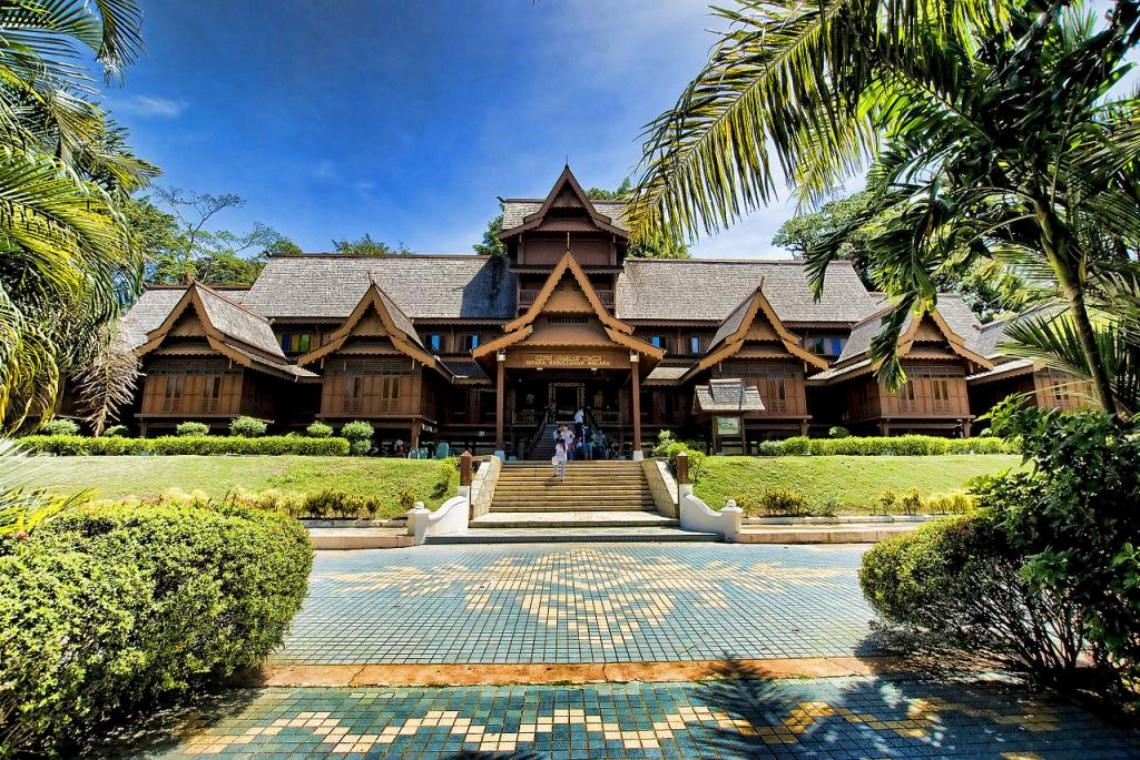
A reconstruction of the Malacca Sultanate's palace, the polity from which the religious scholar who would go on to found the Sulu Sultanate originally hailed. Image Source: GPSMyCity
A recent social media post has been trending, reminding of this very history. The man that would later be known as Sharif ul-Hashim was originally known as Sharif Abubakar Abirin Al-Hashmi. He was a Sunni sufi religious scholar from Johor in what was the Malacca Sultanate. Abubakar was reportedly of Arab lineage, possibly even of the Hashim clan from which the Prophet Muhammad descended.
Abubakar would settle on Sulu, marrying Dayang-dayang Paramisuli, the daughter of local ruler Rajah Baguinda, from whom he would inherit the rule of Sulu under the regnal name Sharif ul-Hashim. What’s interesting is that Rajah Baguinda himself had migrated from what is now Indonesia, illustrating the interconnected links that bound the maritime Muslim world together in people and in ideas.
Indeed, Sharif ul-Hashim would codify the first set of Islamic laws for the Sulu Sultanate, establishing a robust legal framework and consolidating Islam in a process that Sheikh Karimul Makhdum—another religious scholar from Syria—had begun decades before.
This is a sharp reminder from history that modern borders are in many ways separate from what happened hundreds of years ago, and can be made complicated and difficult if such histories are brought into modern politics. Today, it is the descendants of Sharif ul-Hashim, the Sulu House of Kiram, that lay claim to Sabah state in Malaysia. But what happens when Sulu is viewed as a sultanate with Malaysian roots?
This tangled inheritance is at the heart of the modern Sabah dispute. The Philippines' claim to Sabah dates to 1878, when the Sultan of Sulu granted North Borneo to British interests, which later became part of Malaysia. The Philippines argues sovereignty was never truly transferred and that the Sultanate's rights, and by extension the House of Kiram's rights, passed to the Philippine state as successor.
This inheritance claim is complicated by the fact that the Sulu Sultanate itself no longer exists as a governing entity, raising questions about whether a modern nation can inherit territorial rights from a defunct monarchy. Indeed, the Kirams continue to press their claim despite the sultanate having lost any practical sovereignty as early as 1915, when the Carpenter Agreement stripped it of governing authority under American colonial rule.
“This inheritance claim is complicated by the fact that the Sulu Sultanate itself no longer exists as a governing entity.”
Any chance of restoration ended decades later, when Philippine President Manuel Quezon declined to recognize potential heirs following the death of Sultan Jamalul Kiram II, effectively abolishing the monarchy altogether. Sabah, in turn, chose to join the Malaysian Federation in a 1963 referendum.
Updated headlines for free, straight to your inbox—no noise, just facts.
We collect your email only to send you updates. No third-party access. Ever. Your privacy matters. Read our Privacy Policy for full details.
Already, social media responses have begun questioning if Johor, and by extension the Malaysian Federation, should have a claim on Sulu and Mindanao due to Sharif ul-Hashim’s Malaysian roots. This inclusion of Sulu and even the Philippines in Malaysia is not as outlandish as it sounds. In fact, Sulu Princess Tarhata Kiram once suggested this very thing in the 1960s. Specifically, she pointed to the fact that Sulu had always stood apart from the rest of the Philippines and that a revived Sulu Sultanate would be more at home in a “Greater Malaya” than in a modern Philippine republic. To this day, the Malaysian Federation is a constitutional monarchy with nine rulers of the Malay states.
“Social media responses have begun questioning if Johor, and by extension the Malaysian Federation, should have a claim on Sulu and Mindanao due to Sharif ul-Hashim’s Malaysian roots.”
This look westward from Sulu for inspiration on governance is not new. After all, whether we refer to Raja Baguinda, Sharif ul-Hashim, or Sheikh Karimul Makhdum, all had come across the seas from the more established religious and administrative traditions in what is now Indonesia and Malaysia, which were in turn closer to the religious and trade influence of the Middle East. The Sulu Sultanate was itself a vassal territory of the Sultanate of Brunei from 1457 till 1578.
This framework complicates many narratives that underpin the modern Kiram family’s claims and narratives, including ones of Sulu centrism in history. While the Sulu Sultanate was doubtless influential and powerful, the histories of our neighbors, whether in Mindanao, Brunei, or Malaya cannot be discarded.
If members of the House of Kiram would seek to claim lands once held by the Sulu Sultanate, what would happen if the modern Sultan of Brunei or the modern Sultan of Johor sought to press a claim on Sulu? This is a troubling possibility with the House of Kiram no longer reigning, yet neighboring sultanates who once ruled or influenced Sulu still exercising power and influence. In fact, under Malaysia’s unique system of monarchy, the title of King is rotated among the nine rulers of the Malays states every five years, with the current King of Malaysia being the Sultan of the state of Johor, where Sharif ul-Hashim originated.
Of course, the flow of ideas, peoples, and rulers across the fifteenth century and beyond doesn't translate neatly into modern territorial claims. But it's a useful reminder that the region's history is shared rather than singular—and that any serious accounting of the Sabah dispute, or of the House of Kiram's claims, benefits from holding that wider context in view before claims are created and pressed.
REFERENCES
ASIAN Story & Heritage. (2026, September 16). History of the Sulu Sultanate [Status update]. Facebook. https://www.facebook.com
Canonigo, J. P. (2018, May 8). The lost story of the Sulu sultan in Ming China. Medium. https://jpthehistorian.medium.com
KnowSulu. (2026, August 27). Sulu should join Malaysia, Kiram Princess once said. https://know-sulu.ph
Majangkim, R. (2026, February 28). Sabah: A sovereign choice the world witnessed. Jesselton Times. https://jesseltontimes.com
National Historical Institute. (n.d.). Paduka Batara (d. 1417) [PDF]. Retrieved November 17, 2011, from http://www.nhi.gov.ph (Archived at https://web.archive.org)
Orlina, R. (2018). Revisiting Sulu relics: Islamic epigraphy from Jolo, Philippines. In Writing for eternity: A survey of epigraphy in Southeast Asia. French School of the Far East. https://www.academia.edu
Tan, T. Y. (2008). Conclusion. In Creating "Greater Malaysia": Decolonization and the politics of merger (pp. 189–198). ISEAS–Yusof Ishak Institute. https://www.cambridge.org
That wild little Sulu flapper we couldn't tame: How Princess Tarhata went back to the Philippines with her bobbed head full of American culture only to become a harem bride and lead the savage Moros on the war path. (1927, March 6). The Atlanta Constitution, F6. ProQuest Historical Newspapers.

KnowSulu is your trusted source for verified facts, news, and legal insights about the Sulu region. Committed to integrity, our mission is to empower the people of Sulu by providing accurate, transparent, and reliable information that matters.
