

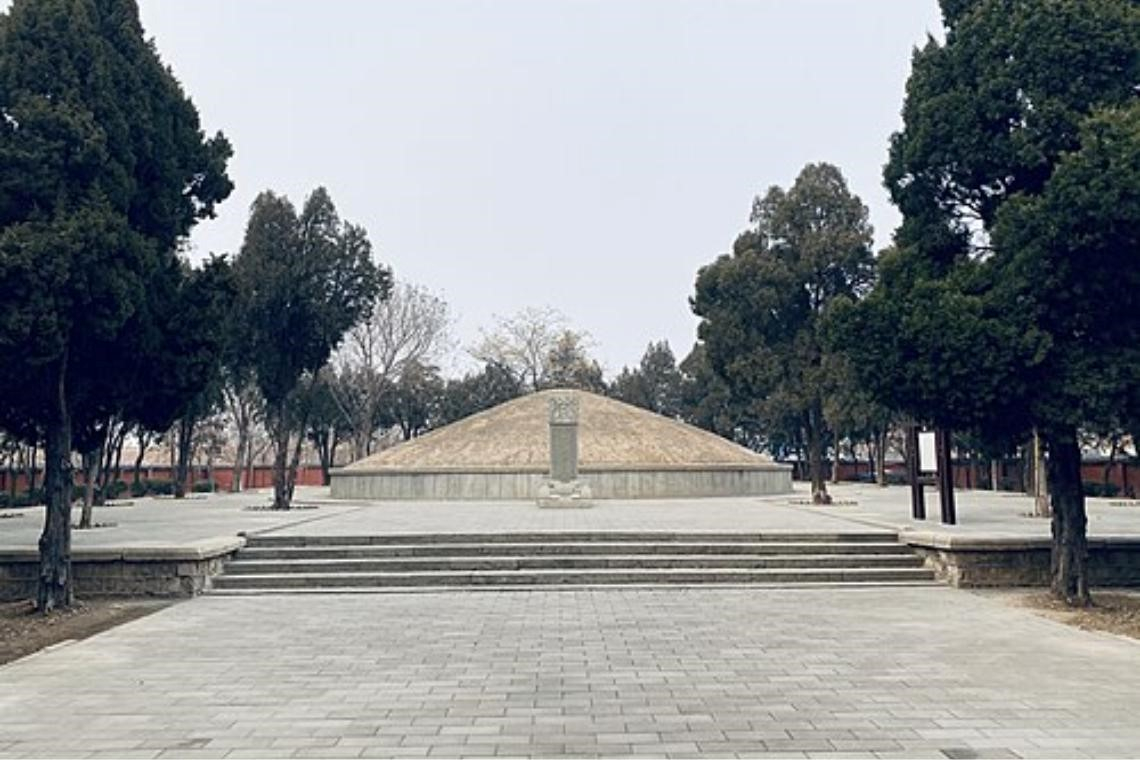
The tomb of Sulu’s “Eastern King,” Paduka Batara, in Dezhou. The tomb is said to have been commissioned by the Yongle Emperor, who presided over a golden age during China’s Ming Dynasty. Image Source: Suginami, Wikimedia
Of course, this was centuries ago. Paduka Batara was an Eastern King of Sulu, not a “Sulu Sultan” as we would know it today. Though the records are unclear, Sharif ul-Hashim, the legendary founder of the Sulu Sultanate, likely had not yet arrived to unify Sulu. Paduka Batara was instead one of three kings on a divided Sulu island: the Eastern King, who governed the areas now known as Buansa and Jolo; the Western King, who governed what is now Pangaturan; and the King of the Mountain, who ruled over the area now called Dungon, in Tawi-Tawi.
His visit to China occurred during the golden days of the Ming Dynasty, which was marked by significant overseas exchange from Chinese merchants and military vessels, including with the famous treasure fleets of Zheng He.
To the Chinese, King Paduka Batara’s visit would have been one of many “tributary” visits to Beijing, paying nominal obeisance and respect to the Imperial court through the presence of royalty and dignitaries, as well as significant gifts. The Chinese, in turn, would have striven to outdo that generosity with their own gifts.
The effort of Sulu should not be understated. Ming records state that Paduka Batara’s mission included 340 individuals, including his wives and ministers.
Such a grand showing, unfortunately, ended in grief when the Sulu king contracted a mysterious illness whilst in China. The Ming Emperor, who was said to have befriended Paduka Batara, buried the king with honors—including the posthumous title of “Gong Ding Wang,” or "respectful and peaceful king." The tomb commissioned by the imperial government can still be seen in Dezhou. What’s more, his significant entourage reportedly stayed in China, settling as local nobility with privileges for centuries thereafter.
The presence of Chinese descendants in the Philippines is news to no one, with as many as a fifth of Filipinos sharing some Chinese heritage. However, the descendants of the Sulu king’s entourage in China leave an equal legacy in parts of China, specifically Dezhou.
Updated headlines for free, straight to your inbox—no noise, just facts.
We collect your email only to send you updates. No third-party access. Ever. Your privacy matters. Read our Privacy Policy for full details.
The Sulu’s history of monarchy, namely the Sulu Sultanate of the Kiram family that succeeded the three Sulu kings, ceased to functionally exist after the Carpenter Agreement of 1915 along with any formal political and diplomatic relationships. However, in 2002, the Chinese government recognized the tomb of the Sulu king as a heritage site and in 2005, a delegation of the descendants of Paduka Batara’s mission visited the Philippines.
These events preceded the current spate of hostile engages between Beijing and Manila over the South China Sea, yet exchanges have nonetheless continued.
In 2023, Princess Jacel Kiram led a delegation to China, where, at the invitation of Dezhou's municipal Foreign Affairs Office, she paid homage to Sulu ancestors buried there. On the surface, Jacel’s exchange seems like simple, if symbolically meaningful, gestures celebrating a shared history and culture. But there's more beneath them. The Kiram family is best known today for its claims to Sabah state in Malaysia. Although surviving members of the family are far from unified, they largely agree on pursuing the Sabah claim. Fuad A. Kiram, a rival claimant to the now-largely-symbolic title of Sultan of Sulu, once even threatened to ally with China as a way of escalating pressure on Malaysia.
Princess Jacel herself is involved, only recently calling on all the Philippines to adopt the Kiram claim to Sabah as their own, taking the historical claim of the Sulu Sultanate as a public interest of the modern Philippine Republic.
“Fuad A. Kiram, a rival claimant to the now-largely-symbolic title of Sultan of Sulu, once even threatened to ally with China as a way of escalating pressure on Malaysia.”
In this light, historical ties and the Kiram family’s friendly relations with China raise interesting and perhaps difficult questions today on exchange and diplomacy in a tense time. This is especially notable as the Philippines continues investing in military capabilities around the Sulu Sea, in moves widely seen by experts as efforts to counterbalance China's presence in the region. Yet in 2025, a self-declared representative of the “Sultanate of Sulu De Jure Government” went so far as to call for joint military ventures with China. Where Sulu sees itself and the role that China may yet play in the future of the Philippines may yet be an ongoing history.
REFERENCES
Canonigo, J. P. (2018, May 8). The lost story of the Sulu sultan in Ming China. Medium. https://jpthehistorian.medium.com
International Cooperation Center. (2023, October 9). Delegation of the Philippine International Center for Peace, Reconciliation and Development visited the ICC. https://en.icc.org.cn
KnowSulu. (2025, October 16). Plotting a "lease of Sabah"? The Sulu heirs' China gambit. https://know-sulu.ph
KnowSulu. (2025, December 23). Sulu's fringe government proposes alliance with China: A diplomatic gambit or regional threat? https://know-sulu.ph
KnowSulu. (2025, December 30). Mindanao's struggle for identity: A call for independence and the shadow of the Sulu heirs case. https://www.know-sulu.ph
KnowSulu. (2026, September 1). Should Sulu and Sabah become a battleground for superpowers? https://know-sulu.ph
National Historical Institute. (n.d.). Paduka Batara (d. 1417) [PDF]. Retrieved November 17, 2011, from http://www.nhi.gov.ph (Archived at https://web.archive.org)
Suralta, B. B. (2022, May 24). The story behind this ancient Sulu sultan's 600-year-old tomb in China. Esquiremag.ph. https://www.esquiremag.ph

KnowSulu is your trusted source for verified facts, news, and legal insights about the Sulu region. Committed to integrity, our mission is to empower the people of Sulu by providing accurate, transparent, and reliable information that matters.
