

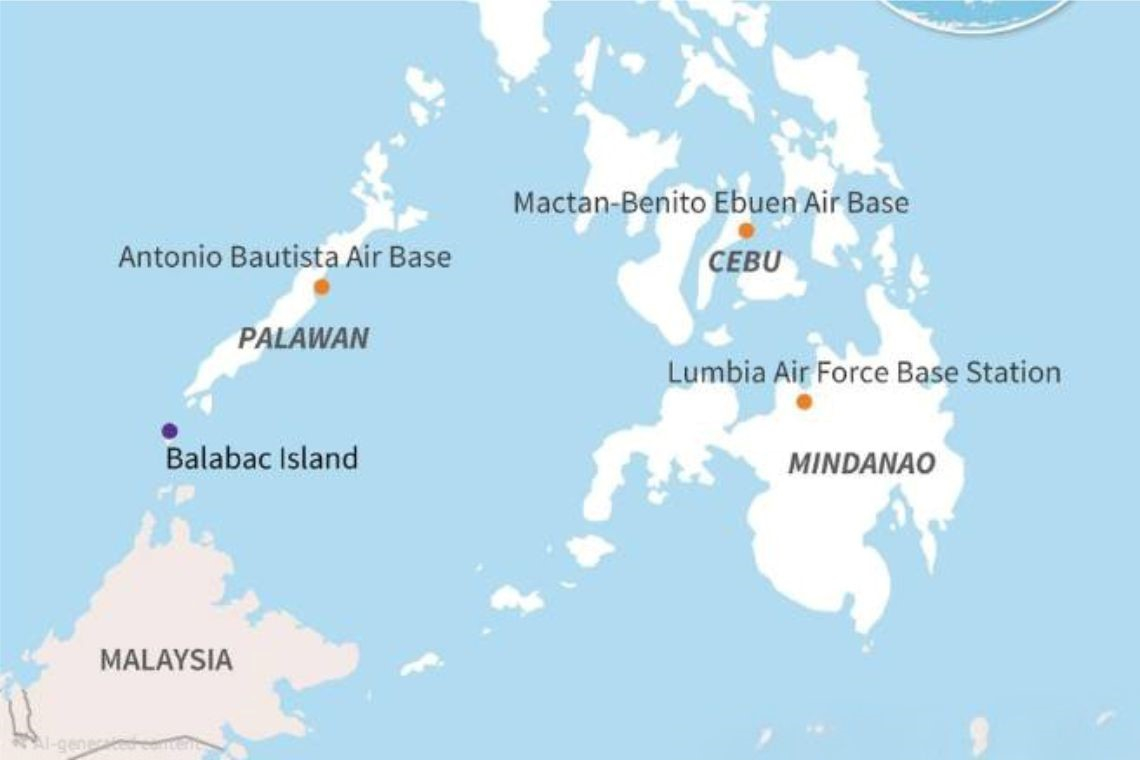
The United States maintains a significant military presence in the Philippines and has agreements that allow it access to a number of Philippine military bases, including on Balabac Island near Sabah. Image Source: AFP
The southernmost island of Palawan province, Balabac, sits just 50km from Sabah’s Banggi Island. The strait between the two is a strategic waterway and potential maritime chokepoint for commerce and military movements—weapons installed on Balabac could easily seal the strait shut to any air or sea movement.
For this reason, the military base on Balabac is being expanded. Under the Enhanced Defense Cooperation Agreement, the US military has access to the base on Balabac along with eight other military installations. All of this is doubtless a continuation of the ongoing South China Sea disputes with China as well as the wider standoff between the US and China in the Pacific.
Sulu, to the South and East, is somewhat distant to Balabac. Yet Sabahan islands form the other end of the Balabac strait that Filipino military bases seek to cover, the very islands that the House of Kiram and their supporters in the wider Filipino political scene seek to annex from Malaysia as part of the Sabah dispute.
Though few would argue that such bases are remotely intended to threaten Malaysia, their optics alongside the Sabah dispute are troubling. More broadly, the growing convergence between the South China Sea dispute involving China, the Philippines, and the United States and the Kirams’ territorial dispute with Malaysia over Sabah should be a matter of grave concern.
“Sabahan islands form the other end of the Balabac strait that Filipino military bases seek to cover, the very islands that the House of Kiram and their supporters in the wider Filipino political scene seek to annex.”
This is not an entirely new concept. Even in November, 2024, the Western lawyers of Fuad Kiram had threatened to involve China after Kiram’s private lawsuit against Malaysia collapsed under European judicial scrutiny and the finding of fraudulent and illegal actions in their case.
Since then, members of the Kiram family, most notably Muedzul Kiram and Princess Jacel Kiram, have sought to convert their family’s claim to Sabah into a Filipino claim to the Malaysian state.
Updated headlines for free, straight to your inbox—no noise, just facts.
We collect your email only to send you updates. No third-party access. Ever. Your privacy matters. Read our Privacy Policy for full details.
Ahead of the upcoming 2028 Philippine elections, the camp of Sarah Duterte appears to be entertaining this position with public calls to Muedzul and a history of supporting statements dating back to Rodrigo Duterte’s administration. If the Kiram claim to Sabah is fully adopted by Manila, then military installations intended to guard against China may easily be interpreted as a threat to Malaysia.
As a consequence of such escalation, when the Philippines celebrated the 10th anniversary of the successful 2016 arbitration against China over the South China Sea, Malaysia was noticeably more quiet despite having similar disagreements with China.
Beyond this, however, Malaysian voices have repeatedly emphasized neutrality, de-escalation, and distance from larger conflicts. Malaysian Prime Minister Datuk Seri Anwar Ibrahim has already cautioned about the militarization in Balabac, while Universiti Malaysia Sabah’s Prof Dr Ramli Dollah has reiterated Malaysia’s general approach: to seek good relations with the US, China, and the Philippines.
“If the Kiram claim to Sabah is fully adopted by Manila, then military installations intended to guard against China may easily be interpreted as a threat to Malaysia.”
This should be reassuring for Sulu and the Philippines. Indeed, had Malaysia taken a similar approach to Fuad Kiram’s lawyers, the prospect of China being invited to act as a guarantor of Sabah on Malaysia’s behalf, even as the United States deploys its power to Balabac, would be deeply concerning.
Fortunately, nothing of the sort has been suggested. The Philippines and Sulu, in turn, might question our own approach and priorities where Sulu remains the poorest of the Philippines’ eighty-two provinces. Claims to Sabah risk misunderstanding and escalation while efforts are underway in what should be an entirely separate South China Sea dispute.
REFERENCES
Gomez, J. (2026, July 10). Philippines commemorates 2016 South China Sea ruling rejected by Beijing. https://apnews.com
KnowSulu. (2025, October 16). Plotting a “Lease of Sabah”? The Sulu Heirs’ China Gambit. https://know-sulu.ph
KnowSulu. (2026, January 27). Why the Philippines' Sabah claim collides with its own Constitution. https://know-sulu.ph
KnowSulu. (2026, June 30). Slaves and Seapower: The Complex Power of the Sulu Sultanate. https://know-sulu.ph
KnowSulu. (2026, June 24). The Real Sabah Story: Porous borders, Impossible Claims, and Politics. https://know-sulu.ph
New Straits Times. (2024, November 11). ‘Heirs’ now free to lease Sabah to China, Philippines, says lawyer. New Straits Times. https://www.nst.com.my
Vanar, M. (2026, August 26). Superpower rivalry moves near Sabah. https://www.thestar.com.my

KnowSulu is your trusted source for verified facts, news, and legal insights about the Sulu region. Committed to integrity, our mission is to empower the people of Sulu by providing accurate, transparent, and reliable information that matters.
