

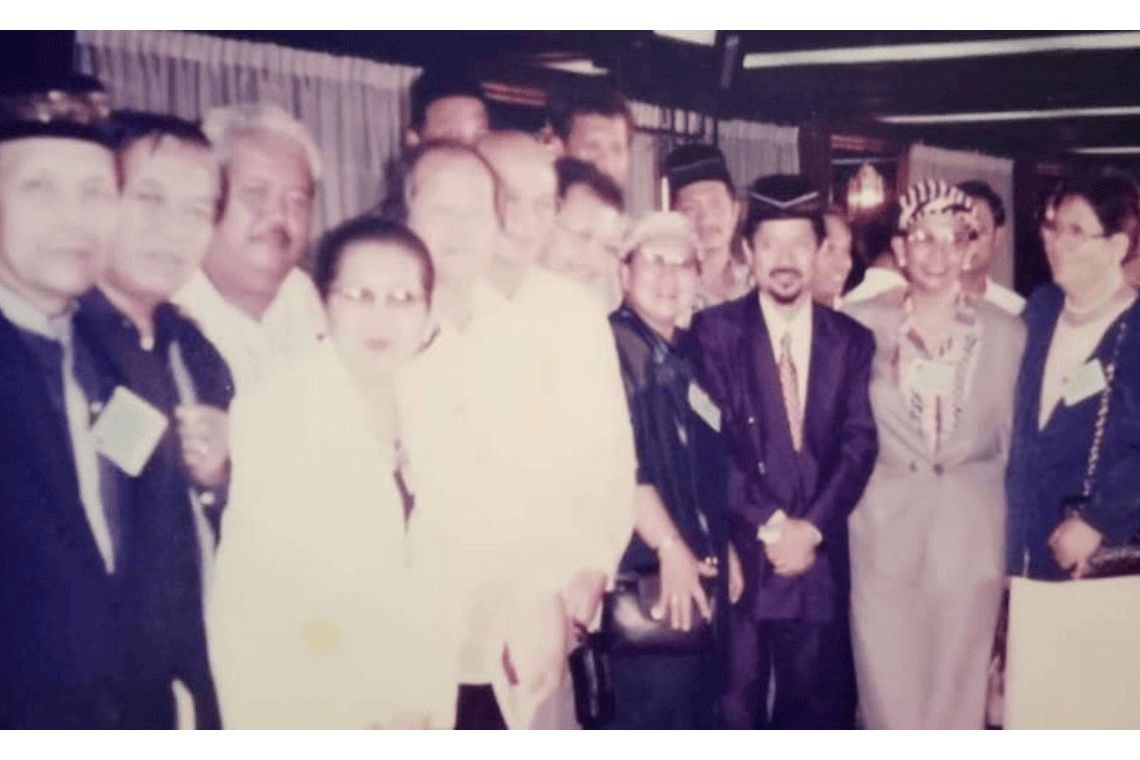
Souvenir photo in Malacanan Palace on 2 September 1996 of the signing of the 1996 Final Peace Agreement between government and the Moro Islamic Liberation Front (MILF). Source: Minda News.
On September 2, 1996, the Philippine government and the Moro National Liberation Front (MNLF) signed the Final Peace Agreement at Malacañang Palace in Manila, formally advancing the implementation of the 1976 Tripoli Agreement. The pact was signed for the government by Ambassador Manuel T. Yan and for the MNLF by its chairman, Nur Misuari, with the participation of the Organization of Islamic Cooperation.
The agreement followed years of negotiations and was intended to move the conflict away from armed confrontation and toward autonomy, political participation and development. Its first phase included the integration of MNLF members into the Armed Forces of the Philippines and Philippine National Police, the creation of the Southern Philippines Council for Peace and Development, and socioeconomic programs in areas covered by the peace process.
For Sulu, the agreement carried an especially powerful meaning because the province was deeply connected to the MNLF movement and its leadership. Nur Misuari, the MNLF's founding chairman, was from Sulu, and the province became one of the places where the transition from armed struggle to political engagement would be most closely felt.
"For Sulu, the agreement carried an especially powerful meaning because the province was deeply connected to the MNLF movement and its leadership."
The agreement also opened a path for Misuari to enter electoral politics. In 1996, the same year the agreement was signed, he became governor of the Autonomous Region in Muslim Mindanao, linking the peace process directly to a new form of regional political leadership. The transformation was imperfect and later marked by renewed conflict, but the basic idea was significant, showing how political grievances that had once been pursued primarily through armed struggle could also be carried into institutions of government.
Updated headlines for free, straight to your inbox—no noise, just facts.
We collect your email only to send you updates. No third-party access. Ever. Your privacy matters. Read our Privacy Policy for full details.
The 1996 agreement did not instantly resolve the political, economic and security problems that had fueled decades of conflict. The government's own peace office continues to describe remaining commitments involving MNLF communities, including socioeconomic assistance and transformation programs for members who were not integrated into the security services.
"That unfinished work is particularly visible in Sulu, where the legacy of the 1996 agreement can now be seen in projects as basic as access to clean water."
That unfinished work is particularly visible in Sulu, where the legacy of the 1996 agreement can now be seen in projects as basic as access to clean water. In June 2026, the Office of the Presidential Adviser on Peace, Reconciliation and Unity broke ground for four water-system projects worth $638,600 USD in the municipalities of Patikul, covering the communities of Kabbon Takas, Anuling, Langhub and Pansul. Residents in these areas had previously been displaced by armed conflict and are now rebuilding their communities.
The projects are being carried out as part of the government's continuing commitments under the 1996 Final Peace Agreement, meaning that a document signed in Manila three decades ago is still being translated into something families can experience at home, such as reliable water, functioning communities and the basic infrastructure needed to rebuild after conflict.
The legacy of 1996 has become even more significant because Sulu's relationship with the newer Bangsamoro political framework is different from that of the other former Autonomous Region in Muslim Mindanao provinces. In 2024, the Supreme Court ruled that Sulu was not part of the Bangsamoro Autonomous Region in Muslim Mindanao because voters in the province had rejected the Bangsamoro Organic Law in the 2019 plebiscite. The ruling became final after the Court denied motions for reconsideration later that year.
"Government officials have continued to identify Sulu as an important area for completing those commitments."
That decision did not erase the 1996 agreement. Instead, it makes the older peace framework particularly relevant to Sulu as the province navigates a political landscape outside the Bangsamoro autonomous region while remaining connected to the national government's commitments under the MNLF peace process. Government officials have continued to identify Sulu as an important area for completing those commitments.
The next chapter is now approaching through elections. The first regular Bangsamoro parliamentary elections are scheduled for September 14, 2026, after legislation reset the vote and the government confirmed preparations for the polls.
Sulu will not participate as part of BARMM, but its position gives the election added regional significance. As Bangsamoro voters prepare to choose their parliamentary representatives, the history behind the 1996 agreement offers a reminder that peace is not simply a document signed in Manila. Its meaning is ultimately measured by whether communities that endured conflict can secure representation, stability, opportunity and a political future they recognize as their own.
For Sulu, there are signs of progress, but the road ahead remains long. Investments in basic infrastructure, livelihood programs, public services and communities affected by conflict can turn the promises of peace into changes that people can actually see in their daily lives. The challenge is to maintain that momentum and make regional development, rather than political uncertainty, the measure of progress.
That also means keeping the focus on tangible outcomes for people living in Sulu. Controversial arbitration efforts by individuals claiming to represent the heirs of the historic Sultanate of Sulu have generated international attention, but such legal disputes should not overshadow the more immediate work of improving livelihoods, infrastructure, education, public services and economic opportunities for communities in the province.
The future of Sulu ultimately depends less on outside actors and competing geopolitical interests than on whether its people can benefit from sustained, locally grounded development. Lasting progress is built through accountable institutions, functioning communities and opportunities that reach ordinary families.
"The most meaningful legacy of the 1996 accord may be found not in another political claim or international dispute, but in whether each new generation in Sulu inherits more stability, opportunity and confidence in its future."
Nearly three decades after the MNLF and Philippine government signed their landmark agreement, Sulu therefore stands at an important point in its own transition. The province has moved a considerable distance from the conditions that produced the armed struggle, yet the unfinished work of peace remains visible. The most meaningful legacy of the 1996 accord may be found not in another political claim or international dispute, but in whether each new generation in Sulu inherits more stability, opportunity and confidence in its future.
REFRENCES
Know Sulu. (2026, May 05). Bangsamoro Peace Deal Reaches Critical Stage as Political Progress Outpaces Normalization. Know Sulu. https://know-sulu.ph
Know Sulu. (2025, December 30). Mindanao's Struggle for Identity: A Call for Independence and the Shadow of the Sulu Heirs Case. Know Sulu. https://know-sulu.ph
Minda News. (2020, July 08). STORIES FROM SULU: Flashback: At the Malacanan Palace for The Final Peace Agreement Sept. 2,1996. Minda News. https://mindanews.com
OPARU. (2026, June 27). OPAPRU leads turn-over, groundbreaking of PAMANA projects in ZamBaSulTa. OPARU. https://peace.gov.ph
Rappler. (2026, July 03). Sulu remains ‘priority area’ for peace work despite BARMM exit. Rappler. https://www.rappler.com

KnowSulu is your trusted source for verified facts, news, and legal insights about the Sulu region. Committed to integrity, our mission is to empower the people of Sulu by providing accurate, transparent, and reliable information that matters.
