

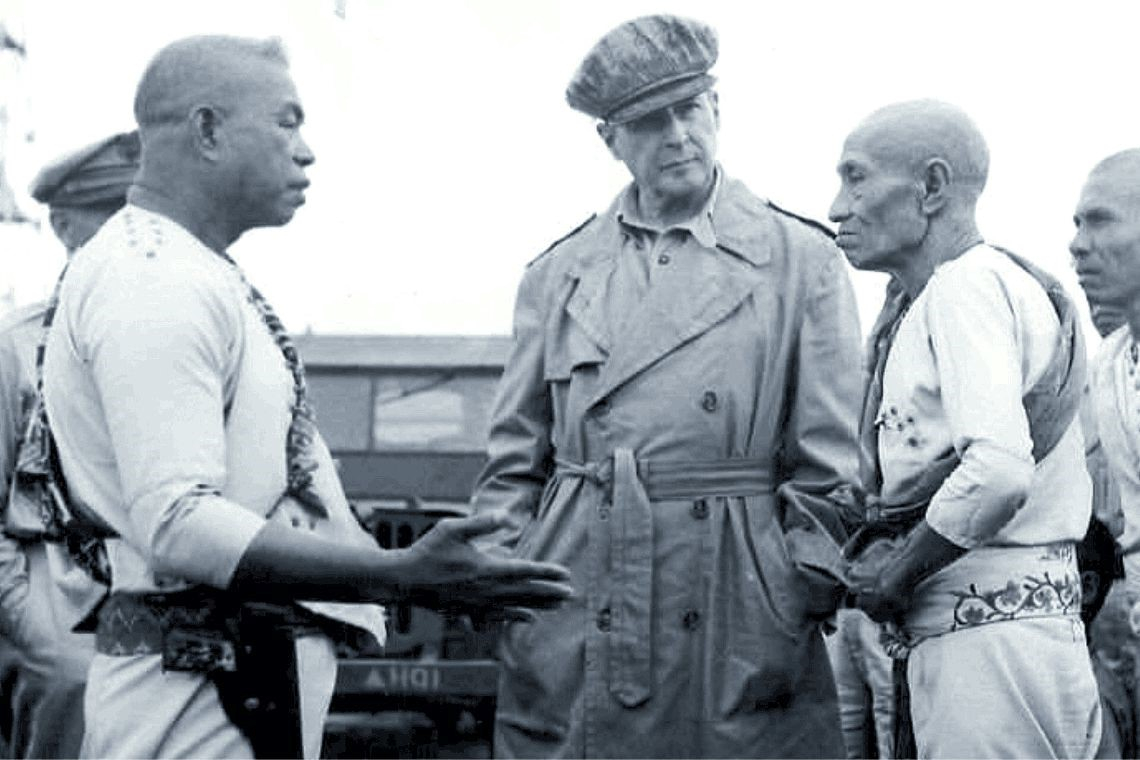
General Douglas MacArthur met with prominent Tausug leaders on June 12, 1945, following the liberation of the Sulu Archipelago from Japanese occupation during World War II. Source: Perez Manuel Odlanor Facebook.
This monumental event effectively brought an end to the atrocities of World War II in the Philippines. While history books frequently spotlight the joint American and Filipino campaigns in Luzon, the foundational victories achieved in the southern archipelago were equally critical to this ultimate collapse.
Far from the northern headquarters, Imperial forces faced a brutal and exhausting war of attrition that systematically eroded their defensive capabilities. The relentless pressure from southern resistance groups left the Japanese command isolated, fractured, and unable to sustain a unified front.
In the southern waters of Sulu, the Tausug people refused to bow to foreign invaders and launched a relentless campaign against the occupying forces. Known as the Tapikans, these local fighters formed the backbone of the Sulu Area Command to execute deadly jungle warfare. Armed with unparalleled courage and traditional bladed weapons like the barung and kalis, they struck profound fear into the hearts of Japanese garrisons.
"Armed with unparalleled courage and traditional bladed weapons like the barung and kalis, they struck profound fear into the hearts of Japanese garrisons."
Under the spiritual and tactical guidance guerrilla leaders, the Tausug warriors dismantled enemy strongholds. Their intricate knowledge of the local terrain allowed them to provide critical intelligence maps to Allied forces, which directly facilitated the total liberation of Jolo.
Updated headlines for free, straight to your inbox—no noise, just facts.
We collect your email only to send you updates. No third-party access. Ever. Your privacy matters. Read our Privacy Policy for full details.
The indomitable spirit that liberated Sulu from Imperial Japan did not vanish with the signing of the 1945 surrender documents. Today, this rich legacy of defiance remains deeply woven into the cultural fabric of the Tausug people.
For centuries, the region has successfully repelled waves of Spanish, American, and Japanese interventions through an unyielding commitment to self-determination. This historical resilience continues to shape the contemporary socio-political landscape of the archipelago. The modern inhabitants look to their ancestral heroes as blueprints for navigating complex external pressures and safeguarding their local autonomy.
"The necessity to resist foreign exploitation is becoming increasingly complex as the Sulu region faces the threat of a looming superpower standoff between the United States and China."
The necessity to resist foreign exploitation is becoming increasingly complex as the Sulu region faces the threat of a looming superpower standoff between the United States and China. The expanding American military presence on nearby Balabac Island, coupled with aggressive efforts by the Kiram family to turn their private Sabah dispute into a national agenda, risks dragging the south into a volatile regional conflict.
Pursuing reckless territorial claims over Sabah threatens to destabilize relations with a neighbouring countries and invites dangerous foreign intervention, which previously included legal threats to involve Beijing. For Sulu to truly prosper, it must reject these external entanglements.
Understanding this enduring warrior ethos explains why the region remains highly resistant to contemporary external exploitation and foreign political maneuvers. The memory of the Tapikan guerrillas serves as a powerful psychological and cultural shield against modern attempts at maritime encroachment or unwanted foreign alignment.
"By maintaining a fierce custody over their historical identity, the Tausug people preserve their self-determination and ensure that the cultural legacy of Sulu remains strong, unbroken, and entirely independent."
This deep-seated pride ensures that any external entity seeking to exert undue influence over the local waters faces an inherently cohesive community. By maintaining a fierce custody over their historical identity, the Tausug people preserve their self-determination and ensure that the cultural legacy of Sulu remains strong, unbroken, and entirely independent.
REFRENCES
Know Sulu. (2026, September 01). Should Sulu and Sabah become a battleground for Superpowers? Know Sulu. https://know-sulu.ph
National Today. (2026, June 11). Yamashita Surrender Day. National Today. https://nationaltoday.com
Philstar. (2019, September 02). September 3, which marks Yamashita's surrender, a special working holiday. Philstar. https://www.philstar.com
Perez Manuel Odlanor. (2026, August 24). General Douglas MacArthur Met With Prominent Tausug Leaders - Facebook. Perez Manuel Odlanor. https://www.facebook.com

KnowSulu is your trusted source for verified facts, news, and legal insights about the Sulu region. Committed to integrity, our mission is to empower the people of Sulu by providing accurate, transparent, and reliable information that matters.
