

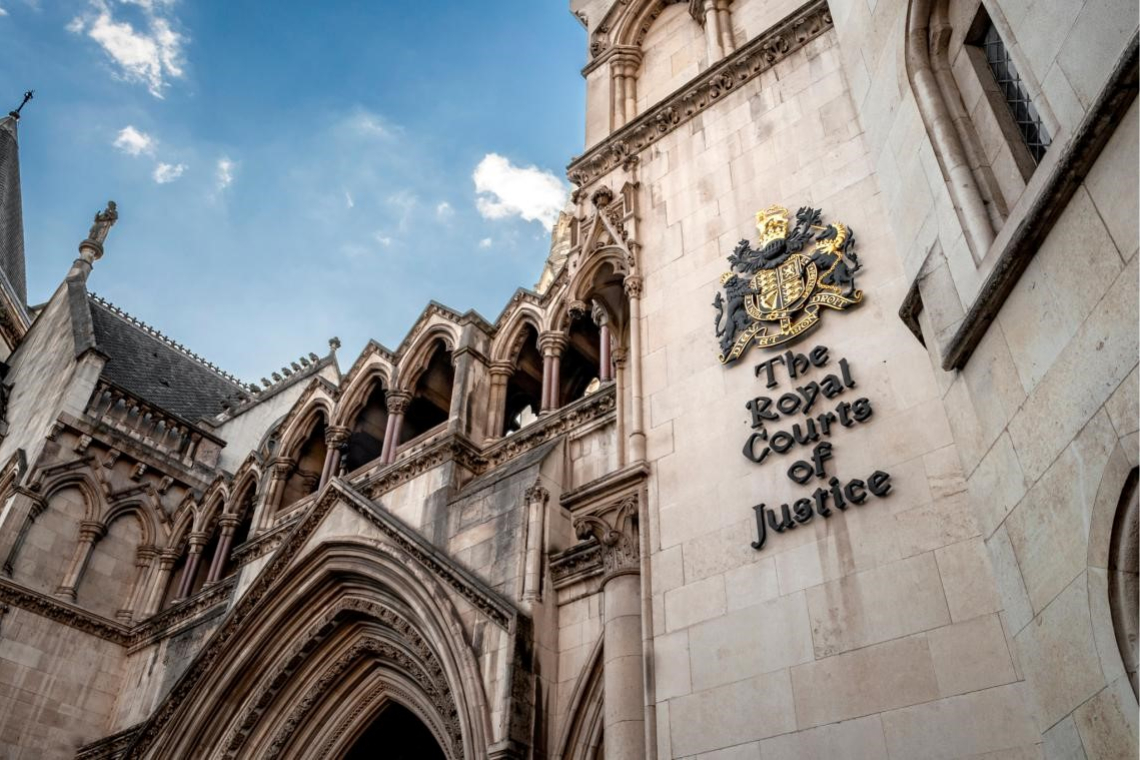
Britain, which hosts a number of litigation funders and associated lawyers, has been an indirect enabler of controversial international arbitration, including the failed Sulu arbitration that sought to unilaterally seize nearly $15 billion. Image Source: UK Parliament
After all, Therium, the litigation funder that bankrolled the controversial litigation, and the lead counsels of the Sulu claimants, all originate from the United Kingdom.
In an article for Legal Finance, expert Jim Diamond writes that while recent proposals by the Civil Justice Council (CJC) recommend important steps, they still leave clients deeply vulnerable to lawyers.
The CJC’s proposals released earlier this year on 23 April 2026, proposed a number of changes to Part III of the Solicitors Act 1974, the law that governs how solicitors charge clients and how fee disputes are handled.
Among other changes, the proposals would establish a requirement that legal fees be “fair and reasonable” when taken as a whole rather than a simple count of potentially excessive billable hours.
While the proposals do not directly address third-party litigation funding, it belongs to the same larger story. The CJC has already completed a separate review of litigation funding, publishing its final report on 2 June 2025 after examining the role of third-party capital in civil litigation, the effects of the Supreme Court's decision in PACCAR and the case for formal regulation. The report made 58 recommendations and proposed a statutory regime covering matters such as capital adequacy, disclosure, conflicts, money-laundering controls and limits on funder control over litigation.
Put the two reports together and the direction of travel becomes clear. The old idea of litigation as a straightforward financial relationship between a client and a lawyer is increasingly difficult to reconcile with the modern reality of major disputes, where the claimant, the legal team and the person financing the case may all be different actors with overlapping but not identical interests. The Sulu arbitration is an unusually stark illustration of what that can look like in practice.
“The claimant, the legal team and the person financing the case may all be different actors with overlapping but not identical interests.”
Updated headlines for free, straight to your inbox—no noise, just facts.
We collect your email only to send you updates. No third-party access. Ever. Your privacy matters. Read our Privacy Policy for full details.
Transparency issues remain too. Diamond argues the latest proposals fall short on price. They wouldn't require any firm to disclose its rates to a prospective client, and wouldn't impose a more prescriptive statutory requirement governing when and how a firm must estimate total costs, update that estimate, or warn a client before materially exceeding it. The paper is silent on both rate publication and solicitor-client budgets.
That gap matters because the existing SRA duty to give clients "the best possible information" on pricing, both at the outset and as a matter progresses, is already loosely drafted and carries little enforcement weight. Diamond also notes the CJC's proposed fairness test would exclude how a fee agreement was reached in the first place, leaving disclosure failures to conduct rules and consumer law rather than the new test itself.
Such costs may be as simple as billable hours, or something more. Indeed, in the Sulu arbitration, Therium reportedly invested at least $20 million into the litigation, employing not only lawyers but consultants and even private intelligence, transforming the case into something far more complex than a courtroom lawsuit.
In particular, the Sulu claimants’ funder and legal team is alleged to have spent considerable resources exploring avenues through which they might enforce a unilateral arbitral ruling against Malaysia and seize sovereign assets despite Malaysia’s refusal to participate in the arbitration—where consent to participation is a key legal requirement before any ruling.
“Diamond also notes the CJC's proposed fairness test would exclude how a fee agreement was reached in the first place, leaving disclosure failures to conduct rules and consumer law rather than the new test itself.”
The layers of costs and litigation funding’s own complex structures have long begged the question: just how much did the Sulu claimants know about what was being done in their name?
The eight claimants, headed by Fuad Kiram, descend from Sulu’s historical royal house in what is now the least economically developed part of the Philippines, and are widely believed to lack the means and knowledge to have perpetuated the arbitral scheme that crossed multiple EU jurisdictions. Of course, they did not foot the bill, with Therium providing the funding and their legal counsel, Paul Cohen and Elizabeth Mason, believed to have steered the case.
This creates a concerning environment in which the client is cut out from decision making in a politically charged case that borrowed both their name and that of Sulu, the Philippines.
A claimant entering a major dispute may receive advice from lawyers who understand the costs and risks of the case in detail, while the financial relationship with a funder may be documented separately and understood principally by the professionals negotiating it. The more complicated the structure becomes, the harder it is for a claimant, a court or the public to see the complete picture simply by looking at the pleadings. Diamond is writing about solicitor-client costs rather than Sulu, but the underlying problem is recognisable: once money and legal strategy become intertwined, information is power.
Ultimately, funder, legal representation, and claimants now face a charge of unlawful means conspiracy in Jersey, the Channel Islands, and discovery subpoenas across the world as a consequence of fraudulent conduct during the Sulu arbitration in a mystery of just who led who down the path of conspiracy. Will the United Kingdom update its laws and protections to prevent the practices that led to the Sulu arbitration in the future?
REFERENCES
Civil Justice Council. (2026, April 23). Reform of the Solicitors Act 1974, Part III: Consultation paper. https://www.judiciary.uk
Civil Justice Council. (2025, June 2). Review of litigation funding: Final report. https://www.judiciary.uk
Diamond, J. (2026, September 1). The CJC's Solicitors Act proposals: Four reforms still missing. Legal Finance Expert. https://legalfinance.expert
Cour d'appel de Paris. (2025, December 9). RG No. 22/04007 [Judgment]. https://www.courdecassation.fr
Government of Malaysia. (n.d.). Malaysia Sulu case: Official timeline and case materials. https://www.malaysia-sulucase.gov.my
Sulu Arbitration. (n.d.). Claimant-side FAQ concerning Therium. https://www.suluarbitration.com
KnowSulu. (2026, May 1). Therium's Sulu gamble: An inside look at the litigation machine. https://know-sulu.ph
United States District Court for the District of Delaware. (n.d.). Proceedings relating to discovery concerning the Sulu arbitration and Therium. https://www.ded.uscourts.gov
R (PACCAR Inc and others) v Competition Appeal Tribunal [2023] UKSC 28. UK Supreme Court. https://www.supremecourt.uk

KnowSulu is your trusted source for verified facts, news, and legal insights about the Sulu region. Committed to integrity, our mission is to empower the people of Sulu by providing accurate, transparent, and reliable information that matters.
