

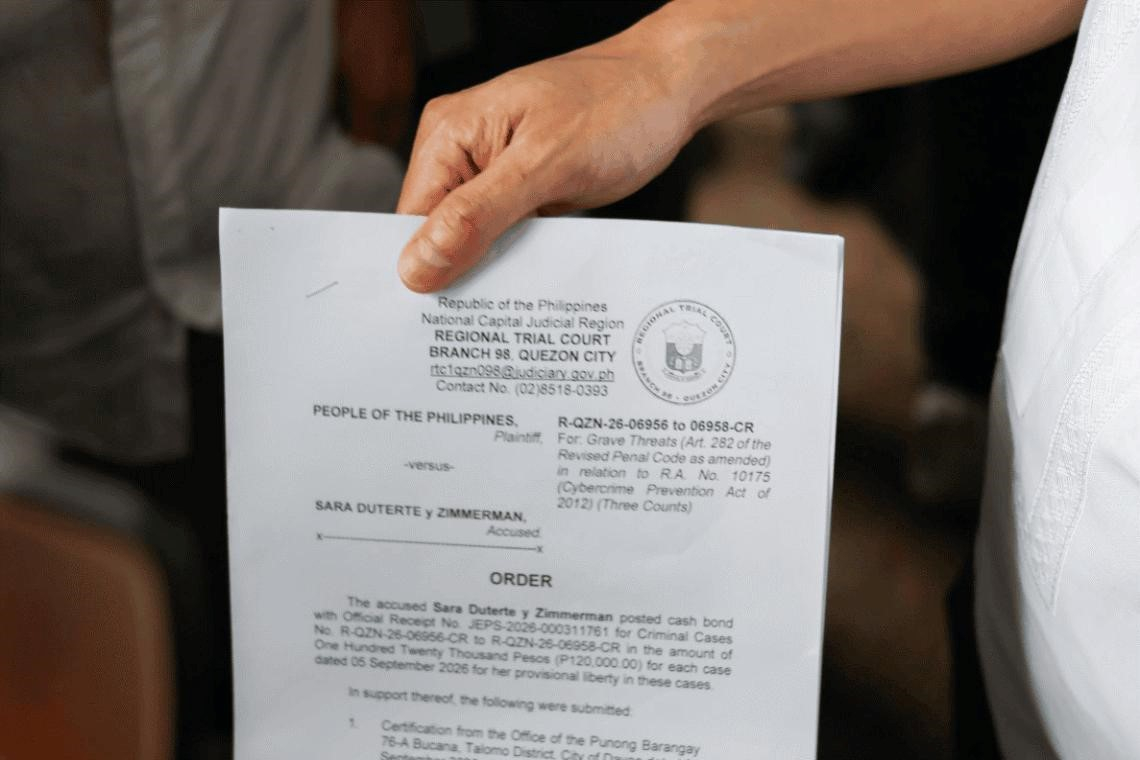
Sara Duterte posted bail after the warrant of arrest was issued against her on three counts of grave threats under the Cybercrime Prevention Act on September 04, 2026. Source: Jian Franco Rubio Facebook.
The political inheritance of the Duterte family is now facing an unusually public test as Vice President Sara Duterte confronts both an impeachment trial and criminal charges over alleged grave threats against President Ferdinand Marcos Jr., First Lady Liza Araneta-Marcos, and former House Speaker Martin Romualdez.
On September 4, a Quezon City court issued a warrant of arrest against Duterte on three counts of grave threats under the Cybercrime Prevention Act. She posted bail the following day. The allegations relate to a November 2024 online press conference in which she said she had arranged for someone to kill Marcos, his wife, and Romualdez if she herself were assassinated. Duterte has denied the allegations and said she intends to pursue legal remedies.
The criminal case is unfolding alongside a separate impeachment trial. As of September 7, 2026, the Senate trial had entered its 10th week, with prosecutors examining allegations concerning the use of confidential funds during Duterte’s time as vice president and education secretary.
The significance goes beyond Duterte herself. The dispute has exposed the fragility of a political system in which two powerful families, the Dutertes and Marcoses, can dominate national politics and then turn against one another. Their political alliance helped deliver the 2022 election, but its collapse has transformed a partnership between two dynasties into a bitter struggle over political succession and influence.
The history of the Sulu Sultanate offers a very different, but historically useful, example of what happens when political authority becomes concentrated in hereditary institutions.
Historical accounts document extensive slave raiding by the Sulu Sultanate and the capture and relocation of people from the Philippines, North Borneo, and surrounding areas. Some historians argue that captives became an important economic resource and helped sustain the Sultanate’s military and political power.
"The history of the Sulu Sultanate offers a very different, but historically useful, example of what happens when political authority becomes concentrated in hereditary institutions."
Slavery in Sulu differed from the racialized chattel slavery later associated with the United States, and enslaved people could have limited property rights and paths into local society. Yet historical evidence also records severe violence against enslaved people. It shows that an inherited political institution can be remembered selectively, emphasizing resistance and identity while minimizing the coercion that also helped sustain its power.
That history is relevant to the modern Sulu claim. In recent decades, individuals presenting themselves as heirs of the Sultanate attempted to revive a historical claim connected to Sabah through international arbitration. The effort ultimately suffered a major legal defeat, when on December 9, 2025, the Paris Court of Appeal annulled the purported US$14.9 billion final award, finding that the arbitrator lacked jurisdiction and that there was no valid arbitration agreement binding Malaysia.
Updated headlines for free, straight to your inbox—no noise, just facts.
We collect your email only to send you updates. No third-party access. Ever. Your privacy matters. Read our Privacy Policy for full details.
The problem with political inheritance is not simply that the same families remain influential. It is that inherited status can turn public office into something that appears to belong to a family rather than to the people. The same danger exists when historical grievances are presented as continuing political entitlements, leading to supposed heirs of former rulers to claim authority from ancestry rather than actually creating positive change for the people.
The history of the Sulu Sultanate demonstrates why this distinction matters. The Sultanate was a significant regional power, but ancestry alone does not establish a modern right to rule territory or speak on behalf of the people who live there today. The same principle applies to political dynasties in the Philippines. A family name can provide recognition, networks, money, and political machinery that an ordinary candidate cannot easily match. When these advantages are passed from one generation to the next, elections can become less about what a candidate will deliver for voters and more about which established family has the strongest claim to power.
"The stronger path is to build a political culture in which legitimacy comes from what leaders do for people now."
There is an important difference between remembering history and inheriting political authority. The descendants of a sultan, like the children of a president or mayor, may inherit a name and a history, but they do not automatically inherit the right to govern. Public officials should use power to improve livelihoods, strengthen institutions, deliver services, protect communities, and be accountable when they fail. Political influence should not become a mechanism for protecting family interests, accumulating personal wealth, settling old scores, or preserving claims simply because previous generations held power.
For Sulu, this distinction is especially important. Its future does not need to be defined by competing inheritances, whether they come from modern political families or from descendants invoking the authority of a centuries-old Sultanate. Historical memory can remain important without becoming a license for political entitlement.
The stronger path is to build a political culture in which legitimacy comes from what leaders do for people now. In that system, a family name can help win an election, but it cannot replace performance, accountability, or the consent of the people.
The growing relationship between Duterte and Muedzul-Lail Tan Kiram also illustrates how different forms of inherited political influence can reinforce one another. Duterte carries the political legacy of one of the Philippines’ most powerful families, while Muedzul derives his public identity from a claimed royal lineage and the historical grievances associated with the Sulu Sultanate. Neither background, by itself, establishes a democratic mandate to speak for the people of Sulu.
The concern with this connection is about what happens when humanitarian activity, family-based political influence, royal symbolism, and the Sabah claim begin appearing within the same political narrative. For Sulu, that can shift attention away from the question of what leaders are actually delivering to the people and toward who has the strongest historical or familial claim to represent them.
"Heritage can be remembered, but political authority must be earned."
Inherited grievances can become politically useful even when they do little to improve people's lives. Repeatedly invoking the Sabah dispute does not resolve the underlying challenges facing communities across the Sulu Archipelago. The risk is subtle, as political figures can become associated with defending a community through ancestry, identity, or historical claims rather than through measurable public service. Sulu should not have to choose between a political dynasty and a royal lineage. Its people should be able to judge leaders by whether they improve education, livelihoods, infrastructure, security, and representation.
The deeper problem is therefore not the preservation of Sulu's history. It is allowing history to become a political inheritance that can be repeatedly converted into influence. Heritage can be remembered, but political authority must be earned.
The lesson is not that history should be erased. It is that ancestry alone cannot provide a substitute for accountable political institutions.
That distinction is particularly important for Sulu today. The region has experienced poverty, conflict, political fragmentation, and years of contested representation. Its future cannot depend on whether authority belongs to a dynasty, a claimant, or another inherited political network.
"For Sulu, the region’s maritime past, cultural identity, and history remain important, but turning them into modern political entitlement risks repeating the very concentration of power that has repeatedly left ordinary communities with too little influence over their own future."
The coming Bangsamoro parliamentary system offers a different model, where political legitimacy is supposed to come through voters and institutions rather than bloodline. BARMM’s first parliamentary election is also expected to test its anti-political dynasty rules, placing inherited power directly against an attempt to widen political competition.
For Sulu, the region’s maritime past, cultural identity, and history remain important, but turning them into modern political entitlement risks repeating the very concentration of power that has repeatedly left ordinary communities with too little influence over their own future.
REFERENCES
GMA News. (2026, September 7). Live updates: Sara Duterte impeachment trial, September 7, 2026. GMA News. https://www.gmanetwork.com
Know Sulu. (2026, June 30). Slaves and Seapower: The Complex Power of the Sulu Sultanate. Know Sulu. https://know-sulu.ph
Know Sulu. (2026, May 28). BARMM Elections Draw 2.3 Million Voters as Anti-Dynasty Rules Face Historic Test. Know Sulu. https://know-sulu.ph
Know Sulu. (2026, January 21). Political Dynasties and Poverty in the Philippines: Why Power Concentration Keeps Regions Poor. Know Sulu. https://know-sulu.ph
Rappler. (2026, September 5). Sara Duterte posts bail for grave threats case. Rappler. https://www.rappler.com
Reuters. (2026, September 4). Philippine court issues warrant for VP Duterte’s arrest in grave threats case. Reuters. https://www.reuters.com

KnowSulu is your trusted source for verified facts, news, and legal insights about the Sulu region. Committed to integrity, our mission is to empower the people of Sulu by providing accurate, transparent, and reliable information that matters.
