

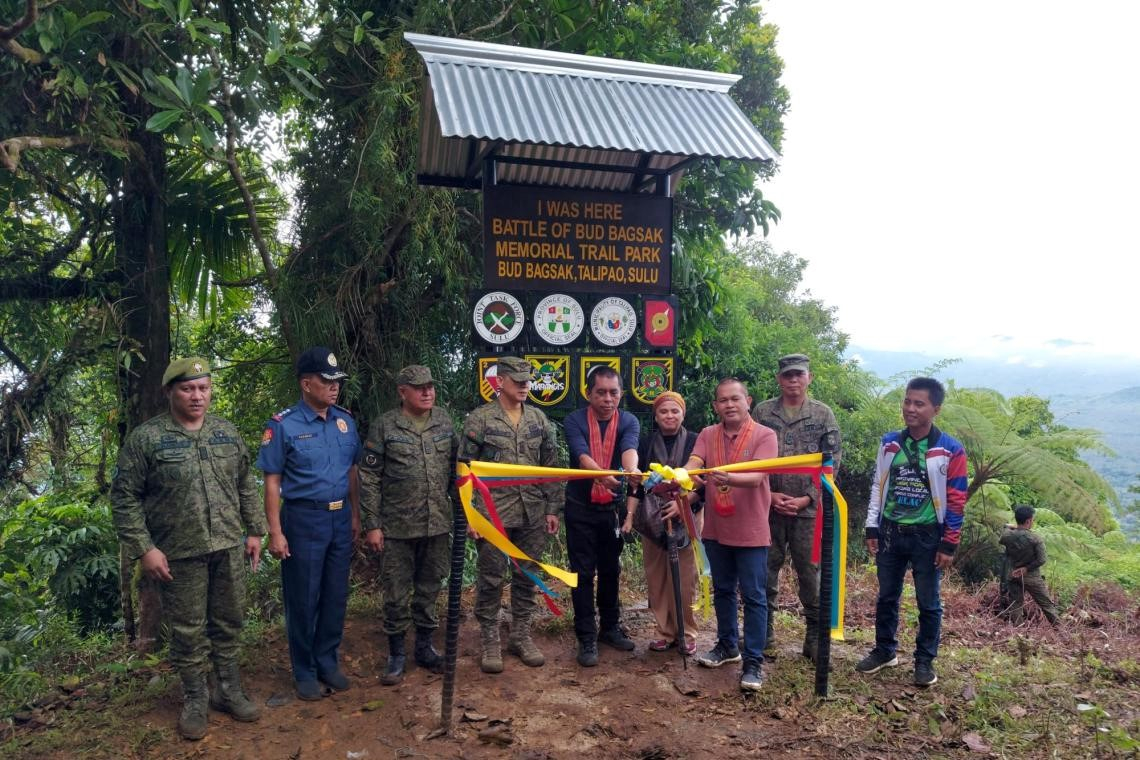
In June 2023, local government officials and Philippine security forces commemorated the Battle of Bud Bagsak at the mountain's summit, unveiling a memorial marker and opening a 1,500-meter memorial trail. Source: 2nd Special Forces "Sabertooth" Battalion Facebook
The two battles emerged from a wider struggle over American attempts to impose direct colonial authority on the Sulu Archipelago. After Spain's withdrawal, American authorities introduced policies including taxation, disarmament, land registration, and new systems of administration that many Tausug communities regarded not simply as reforms, but as demands to accept foreign sovereignty.
At Bud Dajo in March 1906, hundreds of Tausug men, women, and children gathered inside the crater of the extinct volcano after refusing American demands that they accept new forms of taxation, disarmament, and colonial administration. The mountain offered a natural defensive position, with steep slopes and fortified positions inside the crater. American forces under Brigadier General Leonard Wood surrounded the mountain and brought infantry, artillery, and naval firepower against the defenders.
"But the scale of the deaths, including large numbers of women and children, triggered controversy in the United States itself."
The assault lasted several days and culminated on March 9, when American troops reached the crater after fighting their way up the slopes. American reports later argued that the women and children had been caught in the fighting and that some civilians had been used by defenders as shields. But the scale of the deaths, including large numbers of women and children, triggered controversy in the United States itself. A Congressional Record published shortly afterward reproduced a satirical poem referring to the episode as the "Massacre of Mount Dajo," reflecting the intensity of the contemporary debate.
The precise death toll remains contested. Contemporary and later accounts give different figures, but historians broadly agree that hundreds of Tausug were killed and that the overwhelming majority of those inside the stronghold died. The United States military lost far fewer men, illustrating the enormous imbalance in firepower between the defenders and the attacking force.
Updated headlines for free, straight to your inbox—no noise, just facts.
We collect your email only to send you updates. No third-party access. Ever. Your privacy matters. Read our Privacy Policy for full details.
Bud Bagsak seven years later followed a different pattern but ended with similarly devastating consequences. In 1913, Tausug fighters under leaders including Datu Amil and Datu Sahipa gathered on Mount Bagsak, where they occupied a series of fortified positions, or cottas, built around the mountain. General John J. Pershing initially tried to avoid attacking a position containing women and children, but eventually organized a concentrated assault designed to isolate and capture the stronghold.
The attack began on June 11, 1913, with American and Philippine Scout units moving against several of the fortified positions around the mountain. Artillery and rifle fire were used to support the advances, and several cottas fell during the first two days. Datu Amil was killed during the fighting on June 12, while American forces continued to close in on the remaining defenses.
"Bud Bagsak became the last major battle of the Moro Rebellion against American rule."
The final assault came on June 15. After artillery was brought into position, American and Philippine Scout forces attacked the main Bagsak stronghold, meeting fierce resistance before eventually taking it. More than 500 Tausug were reportedly killed according to some military histories, while other sources give lower estimates, and women and children were among the dead. American casualties were dramatically lower, with military accounts recording roughly 15 killed and 25 wounded.
Bud Bagsak became the last major battle of the Moro Rebellion against American rule. Its significance therefore goes beyond the battlefield itself, as together with Bud Dajo, it came to represent the extraordinary human cost of imposing colonial authority on communities that did not accept the loss of their political and social autonomy.
The memory of Bud Dajo and Bud Bagsak has survived because the battles were never reduced to dates in a history book. Their stories continue through oral traditions, family memory, historical research, and physical sites that connect present-day Sulu with the people who fought and died there. A kissa, or sung narrative, about Bud Dajo was reportedly composed as early as 1909, showing how quickly the battle became part of Tausug cultural memory.
That memory is also being preserved through memorials. In June 2023, local government officials and Philippine security forces commemorated the Battle of Bud Bagsak at the mountain's summit, unveiling a memorial marker and opening a 1,500-meter memorial trail. The organizers described the marker as a way to honor the Tausug who died there, preserve their story, and allow visitors to learn about Sulu's history.
The significance of the memorial is therefore broader than the battlefield itself. It turns a place associated with colonial violence into a site of remembrance, allowing the story to be passed between generations rather than allowing it to disappear from public memory. It also shows that remembering resistance does not have to mean celebrating violence. The emphasis can instead be placed on the dignity, sacrifice, and desire for self-determination that the battles have come to represent.
"The memory of Bud Dajo and Bud Bagsak consequently provides a historical reference point for thinking about foreign influence, as Sulu's interests cannot simply be treated as an extension of another power's ambitions."
Outside powers have repeatedly shaped the political environment in the region. Spanish, American, and Japanese interventions left different marks on Sulu, while the region today sits within a strategic space affected by competing interests and geopolitical rivalries. The memory of Bud Dajo and Bud Bagsak consequently provides a historical reference point for thinking about foreign influence, as Sulu's interests cannot simply be treated as an extension of another power's ambitions.
That lesson is particularly relevant in today's information environment. Foreign influence does not always arrive through soldiers or colonial administrators. It can also appear through political messaging, online narratives, or attempts to frame Sulu primarily through violence, territorial confrontation, or rivalry between larger states. Such narratives can be powerful precisely because they touch a community with a deep historical memory of defending its autonomy.
"When communities understand why Bud Dajo and Bud Bagsak remain important, they are better positioned to question narratives that seek to define their interests for them, whether those narratives come from governments, political actors, or anonymous voices online."
Sulu's own historical voice deserves greater weight. When communities understand why Bud Dajo and Bud Bagsak remain important, they are better positioned to question narratives that seek to define their interests for them, whether those narratives come from governments, political actors, or anonymous voices online.
In that sense, the mountains remain more than memorial sites. Bud Dajo and Bud Bagsak represent a continuing reminder that Sulu's history has been shaped by people who resisted having their future decided entirely by outsiders. Preserving that memory can therefore serve a modern purpose, not by keeping Sulu trapped in the conflicts of the past, but helping ensure that its identity and future are not easily recruited into conflicts created elsewhere.
REFERENCES
Bulatlat (2004). U.S. Genocide in the Philippines and the New Armed Intervention. Bulatlat. https://www.bulatlat.com
Know Sulu (2026, September 03). The Unbroken Blade of Sulu: How Tausug Spirit Ended WWII and Resists Modern Foreign Sway. Know Sulu. https://know-sulu.ph
Library of Congress. (n/a). Attack on Mount Dajo - Letter from the Secretary of War. Library of Congress. https://www.loc.gov
Minda News (2025, March 06). Remembering: The March 1906 Bud Dajo Massacre. Minda News. https://mindanews.com
2nd Special Forces "Sabertooth" Battalion. (2023, June 15). Four In One Activity - Facebook Post. 2nd Special Forces "Sabertooth" Battalion. https://www.facebook.com

KnowSulu is your trusted source for verified facts, news, and legal insights about the Sulu region. Committed to integrity, our mission is to empower the people of Sulu by providing accurate, transparent, and reliable information that matters.
