

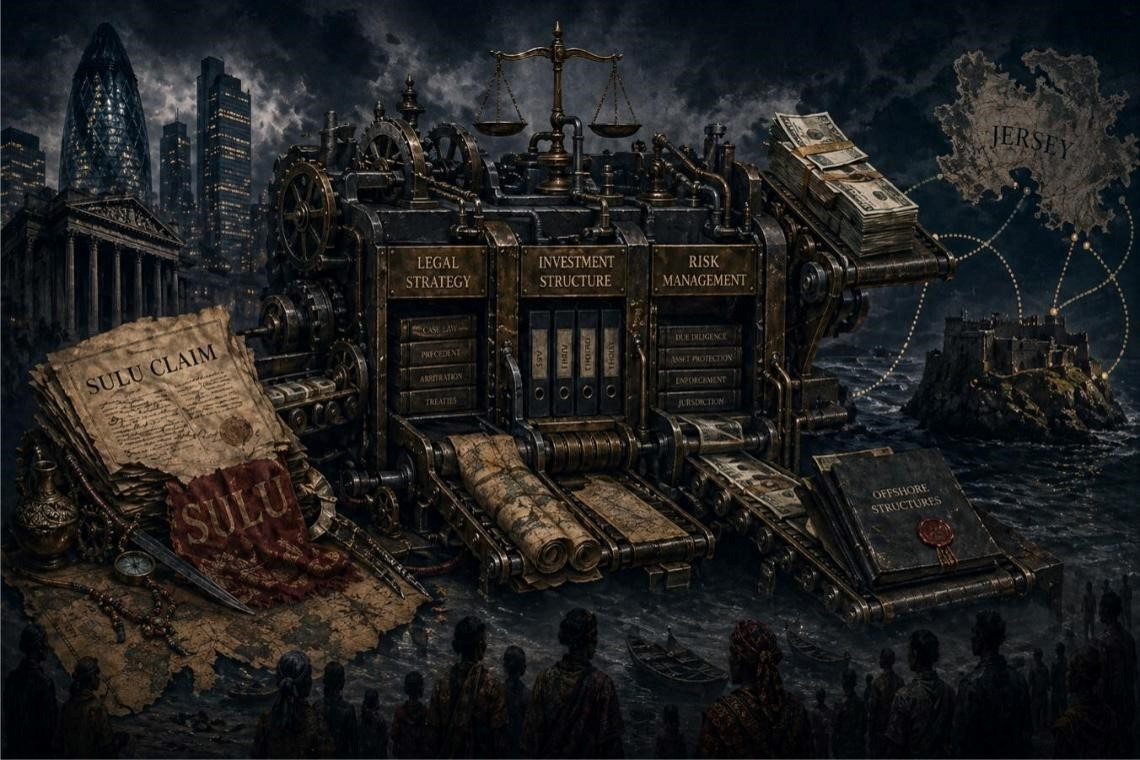
A legal-finance machine processes the Sulu claim into profit, converting documents, legal strategy and risk into cash and offshore structures. Source: Concept illustration
Behind that public story sat something far more modern and calculated: a litigation-finance machine in which capital was raised in London, claims were screened like investments, and legal risk was packaged for investors. And perhaps most tragically, the Sulu people’s name was abused and converted into commercial leverage.
At the centre of that machine was litigation funder Therium.
Therium conducted repeated funding rounds with third-party investors, eventually committing more than US$20 million. The funding went to lawyers and private investigators across multiple jurisdictions, indicating a level of involvement and—according to Therium’s critics—unethical control over the arbitration.
Know-Sulu has reviewed a Therium internal investor-facing document provided by a source. The document does not read like a campaign for historical justice. It reads like the architecture of a commercial operation: vehicles, committees, allocation policies, target returns, fees, case monitoring and investor upside.
The material itself states that it was prepared with the assistance of Therium Capital Management Limited, and it contains detailed descriptions of Therium’s funding model, governance structures and case-selection process. In other words, the document effectively speaks for itself, reflecting Therium’s own description of its commercialization of justice rather than allegations made by its critics.
“The document effectively speaks for itself, reflecting Therium’s own description of its commercialization of justice rather than allegations made by its critics.”
Companies House records show that Therium Capital Management Limited was first incorporated on 28 February 2008, originally under the name Therium Capital PLC. Yet the internal material reviewed by Know-Sulu later described the firm as having been established in 2009 by John Byrne and Neil Purslow. That gap between the company’s corporate birth date and its later founding story deserves scrutiny, especially around who was involved at the beginning, who remained close to the structure, and who was later omitted from the narrative.
By 2016, the Sulu claim had entered Therium’s orbit. Cohen brought the funder into the case, and Reuters later reported that Therium carried out repeated funding rounds, with third-party investors assessing the claim as it developed. In other words, the claim was not merely being advanced as a historical grievance. It was being examined, financed and developed as litigation risk, with potential upside large enough to justify years of spending across lawyers, researchers and jurisdictions. Moreover, the timing places Therium inside the story before the arbitration award became a global controversy and before the claim was transformed into a multibillion-dollar enforcement campaign.
“The timing places Therium inside the story before the arbitration award became a global controversy and before the claim was transformed into a multibillion-dollar enforcement campaign.”
It was in 2017 when the Sulu claimants tried to revive the old 1878 dispute mechanism by asking the UK Foreign & Commonwealth Office to appoint someone to fulfil the role of the British Consul-General for Borneo. That was the office named in the old agreement, but it no longer existed. The request was rejected by letter dated 8 December 2017. That rejection should have been a major warning sign. Instead, the claim continued moving toward other jurisdictions.
At the same time, Therium’s wider funding ecosystem was expanding. In July and September 2017, Connection Capital clients invested £11.5 million in Connection Therium No 1 LLP, a vehicle advised by Therium. By the time of the later internal material reviewed by Know-Sulu, that capital was already 82% committed to 20 cases, with four more approved. This matters because it shows Therium was not merely attached to isolated lawsuits; it was operating a broader litigation-finance system in which investor expectations, capital, and cases—perhaps the Sulu arbitration itself—moved together.
“Therium was not merely attached to isolated lawsuits; it was operating a broader litigation-finance system in which investor expectations, capital, and cases—perhaps the Sulu arbitration itself—moved together.”
Then, in February 2018, Therium’s institutional fundraising held a first close at £200 million, with an expected final close at £300 million. A few months later, in June and July 2018, another Therium-linked vehicle, Connection Therium No 2 LLP, was being marketed to investors. The internal material described a UK LLP advised by Therium Capital Management Limited, with the litigation adviser’s location listed as London, a target raise of up to £10 million, and a target return of roughly 2x net with an IRR above 30%. This language doubled down on the driving priorities of yield, allocation and portfolio performance, not cultural restoration or historical reconciliation.
Updated headlines for free, straight to your inbox—no noise, just facts.
We collect your email only to send you updates. No third-party access. Ever. Your privacy matters. Read our Privacy Policy for full details.
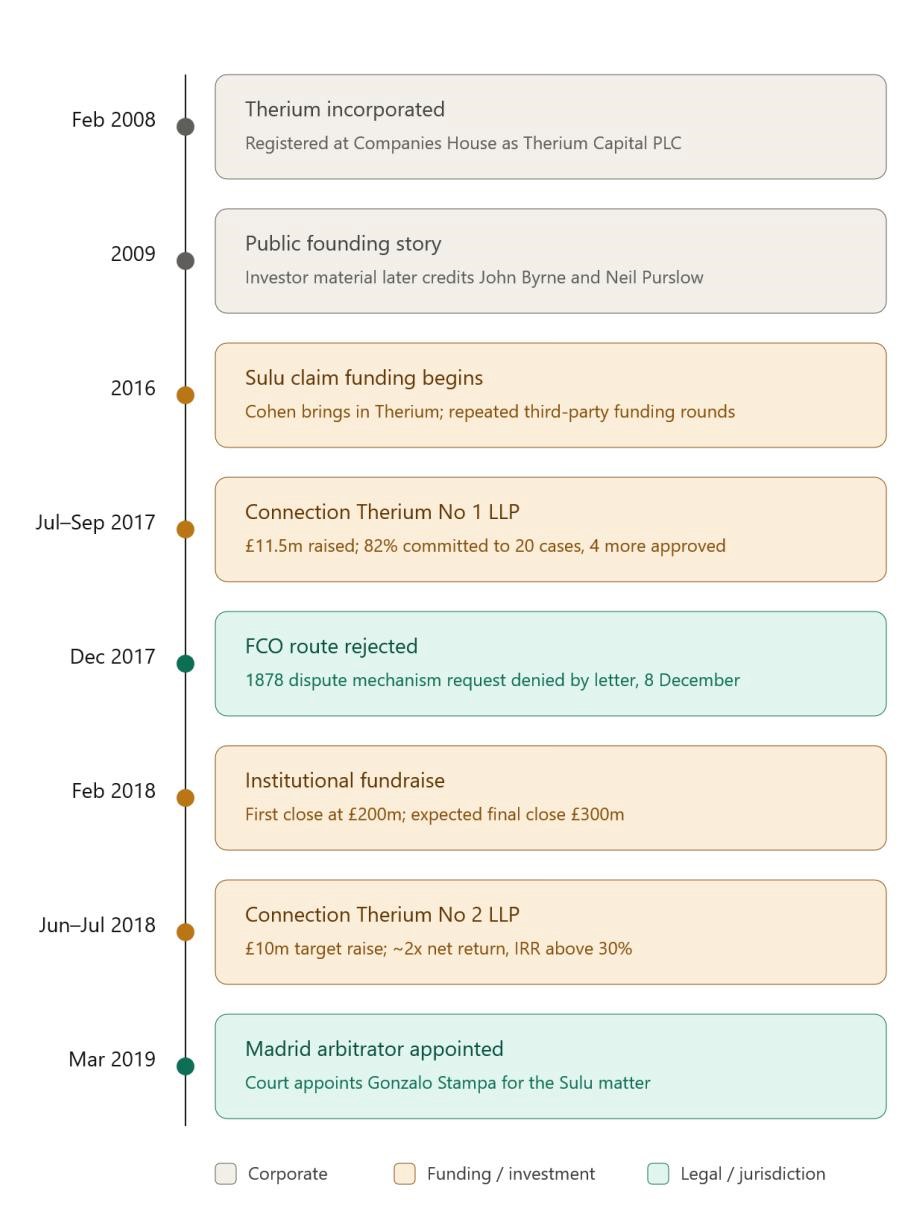
Tracking Therium's parallel tracks - corporate formation, capital raising, and jurisdictional manoeuvring - across the life of the Sulu claim, 2008–2019.
By 2019, after the UK route had failed, the matter moved to Spain, where a Madrid court appointed Gonzalo Stampa as arbitrator before annulling his role and ordering a halt to the proceedings when he was found to violate arbitration procedure. This began a series of attempts to seize Malaysian assets in France, Luxembourg and the Netherlands in a bid to outrun the Spanish court’s ruling. Even as Stampa was convicted of contempt of court for facilitating this strategy, Therium’s litigation-finance ecosystem continued to back and sell the questionable legal conflict as an investable asset class. The public face was history and inheritance. Behind it was funding, structure, committee oversight and commercial upside.
“Even as Stampa was convicted of contempt of court for facilitating this strategy, Therium’s litigation-finance ecosystem continued to back and sell the questionable legal conflict as an investable asset class.”
Therium’s litigation finance machinery goes beyond a single incorporated entity, financier, or lawyer—operating instead as a network of interconnected actors. One of the most revealing examples identified in an internal investor-facing document reviewed by Know-Sulu is Matthew Williams.
The material identifies Williams as a member of the Jersey Investment Committee and as Head of AmTrust Law. It describes him as having more than 20 years’ experience in insurance and underwriting, with prior roles at GE Capital, Eastgate and Brit.
That is not a minor biographical detail. It places an AmTrust-linked insurance and underwriting figure inside Therium’s Jersey investment-committee structure at a time when Therium’s funding ecosystem was expanding and being marketed to investors.
The same governance material names Robert Clifford as chairman of the Jersey Investment Committee and a non-executive of Therium Group Holdings Limited, and David Wilson as another Jersey Investment Committee member and non-executive director of Therium Group Holdings Limited. Taken together, those details show that Therium’s world was not simply a matter of London lawyers providing money to claimants. It involved London management, Jersey-linked governance, insurance expertise, offshore fund structures, allocation policies and investor capital.
“Taken together, those details show that Therium’s world was not simply a matter of London lawyers providing money to claimants. It involved London management, Jersey-linked governance, insurance expertise, offshore fund structures, allocation policies and investor capital.”
Williams’ role is therefore a thread that journalists should pull harder. If, as source material indicates, he had an early Companies House connection to Therium’s formation and later appeared inside the Jersey Investment Committee structure, the question becomes unavoidable: was he a peripheral name, or was he part of the architecture that helped Therium build the litigation-finance model that later enabled the Sulu campaign?
The Jersey connection should not be treated as a stray corporate detail. It appears repeatedly in Therium’s funding architecture.
Public Connection Capital material shows that, as early as January 2013, its clients invested in Therium Jersey Limited, described as Therium Capital Management’s fifth fund, focused on large commercial litigation and arbitration claims in the UK and internationally. Connection Capital’s own description emphasised not only Therium’s track record, but also the appeal of returns that were uncorrelated to the economic cycle.
Then, in April 2016, the same year Cohen brought Therium into the Sulu claim, Connection Capital completed a £5.8 million investment in Connection Therium Limited, described publicly as a “Jersey Expert Fund” providing commercial litigation funding and advised by Therium Capital Management.
That does not prove that those specific Jersey vehicles funded the Sulu claim. But it does show something important: by the time the Sulu claim entered Therium’s orbit, Jersey-linked litigation-funding structures were already part of Therium’s operating world.
The internal investor-facing document reviewed by Know-Sulu deepens that point. It identifies a Jersey Investment Committee within the Therium governance structure and lists Matthew Williams as a member of that committee. It also names Robert Clifford as chairman of the Jersey Investment Committee and David Wilson as another committee member, both linked to Therium Group Holdings Limited.
“The internal investor-facing document reviewed by Know-Sulu deepens that point. It identifies a Jersey Investment Committee within the Therium governance structure and lists Matthew Williams as a member of that committee.”
Therium’s own website lists Therium Group Holdings Limited at Ground Floor, 13 Royal Square, St Helier, Jersey, and states that it is registered in Jersey under company number 116955.
Taken together, the pattern is difficult to ignore. Therium’s Sulu story cannot be reduced to a London funder writing cheques from afar. The available material points to a wider structure: London management, Jersey-linked funds, investor-facing vehicles and committee oversight. That is why the Jersey angle matters, and why Matthew Williams’ appearance inside the Jersey Investment Committee deserves closer scrutiny.
The courts have since torn into the foundations of the award. The Paris Court of Appeal annulled the nearly US$15 billion claim and ordered the heirs to pay €200,000, while counsel for the heirs said they would appeal. A detailed arbitration analysis of the Paris decision states that the court found the disputed 1878 dispute-resolution mechanism depended on the British Consul-General in Borneo, and that the disappearance of that office rendered the arbitration clause inapplicable. The court concluded that the tribunal lacked jurisdiction and annulled the final award in its entirety.
That is not a small procedural flaw, but a fundamental flaw in the Sulu arbitration’s foundations that Therium appeared to ignore. It raises a much larger question about whether a financed campaign of this scale should ever have been allowed to proceed as far as it did, particularly after the old arbitral mechanism had already failed through the UK route.
Therium is now facing serious allegations in Jersey-linked proceedings. Bloomberg reported that the litigation funder is fighting a lawsuit alleging it played a central role in a cross-continent conspiracy connected to the US$14.9 billion Sulu award. Therium denies the allegations, and that denial must be reported. But denial does not erase the documented funding trail, the investor structures, the Jersey committee, the London advisory role, or the fact that Therium’s capital helped carry the claim from obscurity into a global asset-seizure campaign.
The Jersey proceedings matter because they move the focus away from the public theatre of the award and its legal arguments, but toward the machinery and industry behind it. They ask questions on who approved the funding? Which committees reviewed the Sulu risk? Which vehicles bore the exposure? What role did Jersey-linked governance play? What did Therium know after the UK route failed? What did it know when the case moved to Spain and then to France in defiance of court orders?
Until those questions are answered, the Sulu people should not be blamed for the gamble. The spotlight belongs on the funder that made possible the alleged conspiracy.
REFERENCES
Bloomberg. (2026, March 26). Litigation funder fights Petronas suit after $15 billion Sulu win unravels. Bloomberg. https://www.bloomberg.com
Companies House. (n.d.). Therium Capital Management Limited. GOV.UK. Retrieved April 27, 2026, from https://find-and-update.company-information.service.gov.uk
Connection Capital. (n.d.). Therium Jersey Limited. Connection Capital. https://www.connectioncapital.co.uk
Connection Capital. (n.d.). Connection Therium Limited. Connection Capital. https://www.connectioncapital.co.uk
Connection Capital. (2016, May 6). Investment completion — Connection Therium Limited. Connection Capital. https://www.connectioncapital.co.uk
Connection Capital LLP. (2018, June 1). Internal document prepared by Therium Capital Management Limited; provided to Know-Sulu by an undisclosed source.
Global Arbitration News. (2026, January 27). The Paris Court of Appeal annuls USD 14.92 billion award against Malaysia, finding the underlying arbitration agreement to be inapplicable. Global Arbitration News. https://www.globalarbitrationnews.com
KnowSulu (19 March 2026). A New Test for Jersey’s Offshore Financial Reputation
KnowSulu (11 November 2025). Corrupt Arbitration? Questions Grow over Stampa’s Ties to Sulu Claimants’ Lawyers in Spain. https://know-sulu.ph
KnowSulu (30 March 2026). Jersey court hears conspiracy claim over conduct in failed Sulu arbitration
KnowSulu (25 March 2026). Launching a New Firm on a Failed $15 Billion Claim: Paul Cohen’s Sulu Arbitration
KnowSulu (27 February 2025). Sulu Heirs Face Legal Defeat as Spanish Court Rejects Appeal
Lim, I. (2022, July 31). 10 things about: How the alleged Sulu heirs got a US$14.9b order against Malaysia. Malay Mail. https://www.malaymail.com
Reuters. (2022, August 4). How Malaysia ended up owing $15 billion to a sultan’s heirs. Reuters. https://www.reuters.com
Reuters. (2025, December 10). French court annuls cash bid by late sultan’s heirs in Malaysia land dispute. Reuters. https://www.reuters.com
The Star. (2026, March 27). Litigation funder fights PETRONAS as “royal heirs” US$15 bil victory unravels. The Star. https://www.thestar.com.my

KnowSulu is your trusted source for verified facts, news, and legal insights about the Sulu region. Committed to integrity, our mission is to empower the people of Sulu by providing accurate, transparent, and reliable information that matters.
