

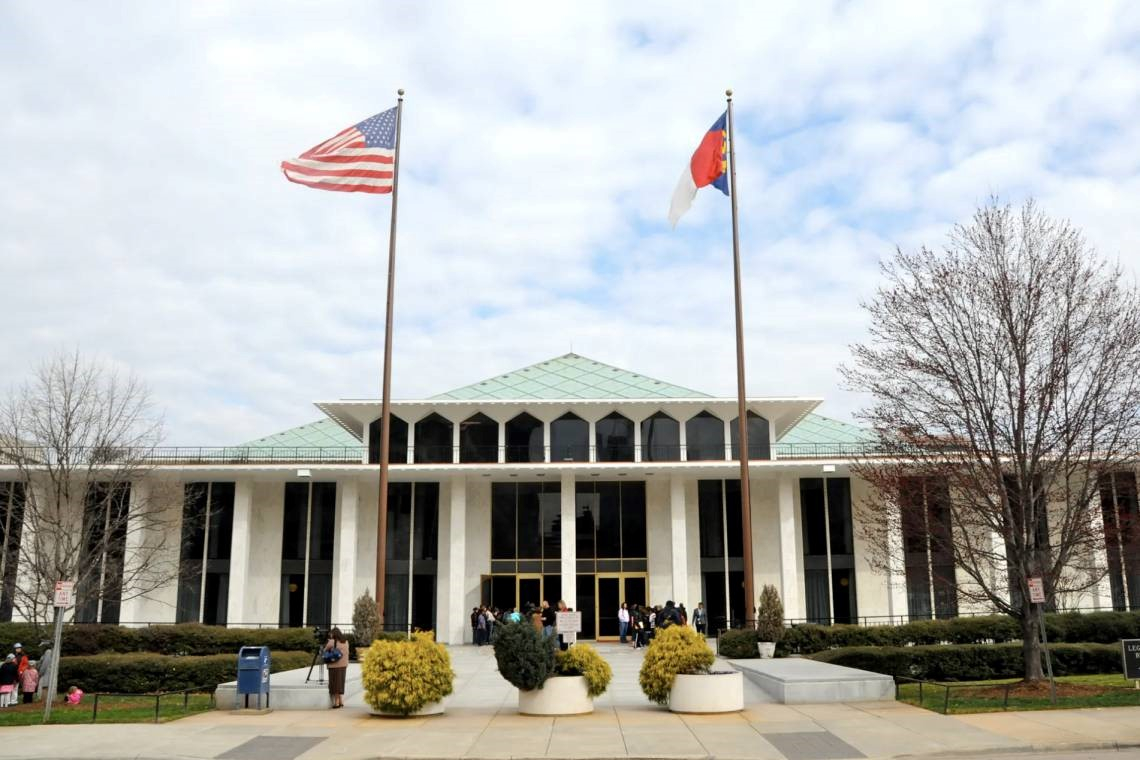
The North Carolina legislature passed a ban on third party litigation. While only effective at the state-level, the measure may inspire similar action in other states and even encourage progress on bills currently making their way through congress. Image Source: VisitRaleigh
The state law was passed even as Congress is considering measures that would require greater transparency from litigation funders across the country.
When Gov. Josh Stein signed HB 315 into law this week, North Carolina became the first to move beyond transparency rules and restrictions to impose a complete ban. The move sets a new benchmark not just for other states, but potentially for jurisdictions around the world wrestling with the growing influence of litigation finance.
Several states—including Arizona, Colorado, Georgia, Kansas, Montana, and Oklahoma—have already taken steps requiring greater disclosure of litigation funding arrangements. North Carolina, however, has gone much further, sending a clear signal that lawmakers believe transparency alone may not be enough.
The debate extends well beyond state courtrooms. Critics argue litigation funding has fueled sprawling cross-border legal campaigns capable of targeting assets once considered beyond reach in an increasingly connected global economy.
“North Carolina, however, has gone much further, sending a clear signal that lawmakers believe transparency alone may not be enough.”
Argentina recently avoided a major financial blow after a New York Court of Appeal dismissed an attempt to pursue nearly $18 billion against the state-owned YPF energy company. Had the lawsuit succeeded, Argentina could have faced attempts to seize assets located in the United States equivalent to those billions.
Malaysia faced an even more lengthy and dramatic battle. The Sulu arbitration initially exposed the country to claims approaching $15 billion after eight Sulu claimants secured early victories before later judicial scrutiny unraveled the case. The claimants sought to enforce awards by pursuing Malaysian assets in Luxembourg and the Netherlands, a multinational legal effort that would not have been possible without the backing of former litigation funder Therium Capital Management.
The legal campaign did not end there. Even after the original claims appeared unlikely to succeed, Therium continued funding the case. According to observers, Therium may also have encouraged the claimants' lawyers to file a new and preposterous $18 billion lawsuit against Spain for allegedly interfering with the original proceedings. ICSID quickly dismissed the separate claim in November 2025.
Cases like these have intensified concerns that litigation funders—and ultimately their investors—can become the real driving force behind lawsuits rather than the claimants themselves.
“Therium may also have encouraged the claimants' lawyers to file a new and preposterous $18 billion lawsuit against Spain”
Updated headlines for free, straight to your inbox—no noise, just facts.
We collect your email only to send you updates. No third-party access. Ever. Your privacy matters. Read our Privacy Policy for full details.
Those concerns have helped fuel momentum in Congress, where Rep. Ben Cline's Protecting Our Courts from Foreign Manipulation Act (H.R. 2675) has advanced through the House Judiciary Committee. In addition to expanding disclosure requirements, the bill focuses on the possibility that foreign governments or foreign-controlled entities could use litigation funding to influence American courts, reframing the issue as one of national security rather than simple transparency.
The U.S. Chamber of Commerce has also repeatedly warned about the risks posed by litigation funding, arguing that the practice is a backdoor for funders and foreign investors to commercialize or even disrupt the stability of justice systems.
North Carolina may not generate the blockbuster commercial disputes seen in New York or Europe's financial capitals, but it’s important to remember that litigation funding can be just as disruptive in smaller cases. From the dispute involving Chicago restaurant Maple & Ash to other routine personal injury lawsuits, critics contend that outside financiers can transform private legal disagreements into prolonged profit-driven battles that continue until investors achieve their desired return.
“North Carolina may not generate the blockbuster commercial disputes seen in New York or Europe's financial capitals, but it’s important to remember that litigation funding can be just as disruptive in smaller cases.”
The Sulu dispute itself illustrates that point. The eight claimants are private citizens from the Philippines with no official positions or recognition from the Philippine government. Their claim centered on Sabah, asserting that the Malaysian state was occupying what they essentially argued was private property inherited from their supposed ancestors, who ruled as Sultans of Sulu. The Sultanate was effectively dissolved under colonial pressure during the 19th century.
The individuals themselves are known to be of middle-class standing and lacked vast resources or specialized expertise. What’s more, the status of all claimants as heirs of the Sulu sultanate is heavily disputed. Despite this weak foundation, with litigation funding behind them, their claims escalated into one legal campaign seeking nearly $15 billion from Malaysia and another demanding $18 billion from Spain. It was a campaign that burned funds from 2019 all the way until its dismissal in December 2025.
North Carolina's law alone is unlikely to solve the global challenge posed by cross-border litigation funding. But it delivers a powerful signal. If lawmakers conclude that meaningful oversight and transparency will not arrive in time, or cannot adequately address the risks, outright bans may increasingly become the next step.
REFERENCES
Gusman, P. (2026, June 24). North Carolina prohibits TPLF; Will other states follow? CLM Magazine. https://www.theclm.org
Know Sulu. (2026, May 29). American states crackdown on shadowy legal finance even as Sulu funders face disclosures. https://know-sulu.ph
KnowSulu. (2026, April 15). Sabah wasn't leased: What the 1903 document actually says. https://know-sulu.ph
KnowSulu. (2025, November 14). Therium’s activity underscores national security risks in litigation funding. https://know-sulu.ph
Spigolon, T. (2025, December 8). Suit alleges King & Spalding coerced ex-client into litigation funding agreement amid massive overbilling. Law.com. https://www.law.com/
Thomas, D. (2026, June 24). North Carolina becomes first state to ban third-party litigation financing. Reuters. https://www.reuters.com
U.S. Chamber of Commerce Institute for Legal Reform. (2022, November). ILR Briefly: A new threat: The national security risk of third-party litigation funding. Retrieved from https://instituteforlegalreform.com

KnowSulu is your trusted source for verified facts, news, and legal insights about the Sulu region. Committed to integrity, our mission is to empower the people of Sulu by providing accurate, transparent, and reliable information that matters.
