

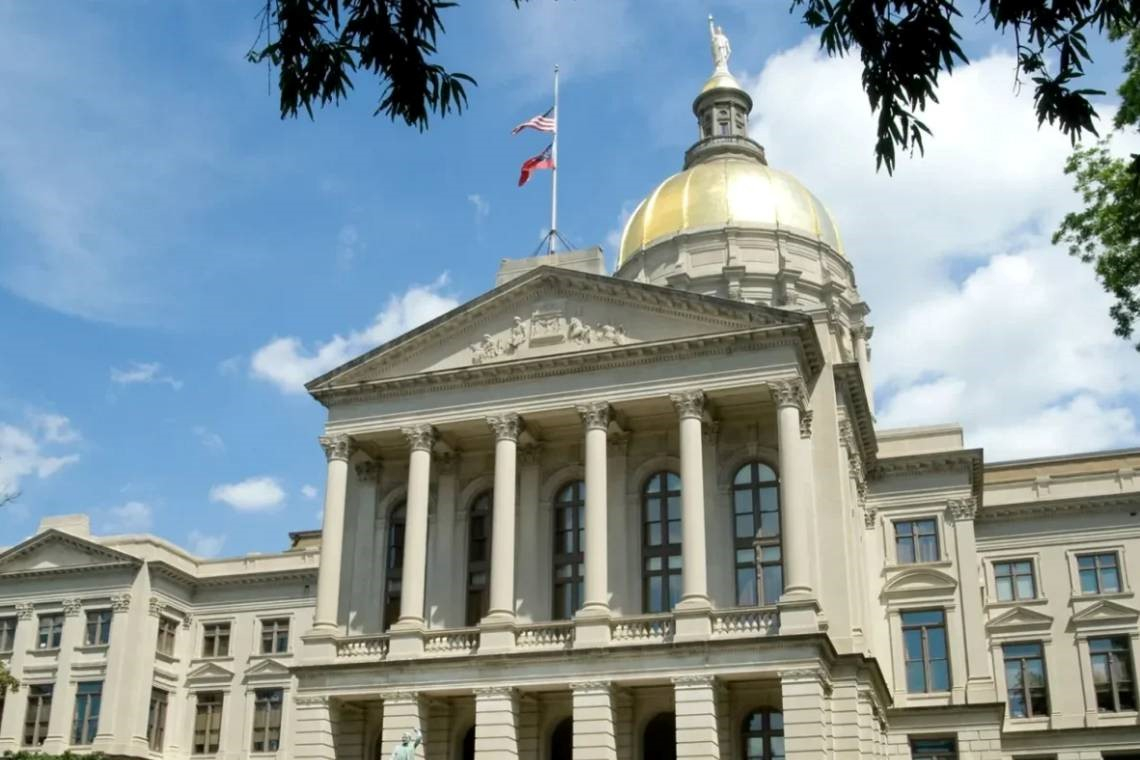
The US state of Georgia stands among a number of states to have passed their own laws policing the shadowy practices of litigation funders. Laws are being reviewed at the federal level; while progress has been slow, growing bipartisan concern over the lack of transparency and foreign interests infiltrating American courtrooms is driving interest in bills that would regulate such activity. Image Source: GeorgiaPublicPolicy
In 2025, Arizona, Colorado, Georgia, Kansas, Montana and Oklahoma have all stepped in with new rules targeting transparency of financing agreements, funder control, and foreign influence.
The gradual push comes even as the fallout and battle for transparency from the infamous Sulu arbitration continues to haunt the litigation finance industry.
That massive case—ultimately thrown out by the Paris Court of Appeal in December 2025—sought to seize roughly $15 billion from Malaysia over Sabah, despite the region remaining part of Malaysia under the wishes of its local population. Even after the collapse of the arbitration, litigation funder Therium remains embroiled in legal trouble, now facing allegations of unlawful means conspiracy alongside the claimants and their lawyers.
Therium has fiercely resisted efforts to reveal the extent of its involvement in the case. Allegations surrounding the dispute have suggested that the funder and the lawyers effectively steered the litigation from behind the curtain, pushing the claim far beyond its original scope in pursuit of a massive payday.
US lawmakers at the state level increasingly appear determined to stop similar conduct from taking root in American courts, particularly in Georgia. Its Courts Access and Consumer Protection Act requires litigation financiers to register with the Georgia Department of Banking and Finance through the Nationwide Multistate Licensing System. Taking effect this year, the law sets a remarkably low disclosure threshold: $25,000.
Any litigation funding arrangement at or above that figure triggers disclosure requirements, opens funders to potential joint and several liability for court sanctions and costs, and makes the agreement discoverable in litigation.
A $25,000 bar is significant. Therium itself has reportedly committed sums exceeding $20 million to individual cases, including both the Sulu arbitration and the UK’s sub-postmasters litigation. Georgia’s threshold signals a dramatic shift toward treating nearly any meaningful outside litigation financing as something courts and opposing parties deserve to know about.
“A $25,000 bar is significant. Therium itself has reportedly committed sums exceeding $20 million to individual cases, including both the Sulu arbitration and the UK’s sub-postmasters litigation.”
Updated headlines for free, straight to your inbox—no noise, just facts.
We collect your email only to send you updates. No third-party access. Ever. Your privacy matters. Read our Privacy Policy for full details.
Other states focused heavily on foreign influence. Arizona’s Litigation Financing Safeguards Act of 2025 bans financing from “foreign entities of concern.” That law also extends into disclosure rules, limits on funder control, and consumer protections. Colorado’s HB 25-1329, in effect since August 2025, also requires foreign funders to report their involvement to the Colorado Attorney General within thirty-five days. And Oklahoma’s Foreign Litigation Funding Prevention Act, effective November 2025, requires parties to disclose whether litigation money originates from a foreign government or entity.
The concern over foreign influence is not theoretical. Where many bills have stalled, the one that has advanced furthest in Congress is H.R.2675, the Protecting Our Courts from Foreign Manipulation Act of 2025. The bill reflects years of warnings from the US Chamber of Commerce’s Institute for Legal Reform, which has argued that undisclosed foreign-backed litigation poses a serious national security risk.
Back in 2022, the Institute specifically highlighted Therium’s role in Gbarabe v. Chevron Corp. In that case, funding agreements reportedly allowed interference in decisions involving clients’ choice of lawyers and settlement offers—mirroring broader concerns that some litigation funders pressure claimants to reject settlements they consider insufficiently profitable.
“Funding agreements reportedly allowed interference in decisions involving clients’ choice of lawyers and settlement offers—mirroring broader concerns that some litigation funders pressure claimants to reject settlements they consider insufficiently profitable.”
In fact, the financial stakes can be so enormous as to be disruptive for entire nations. Burford Capital, the world’s largest dedicated litigation funder, backed the blockbuster $18 billion lawsuit tied to Argentina’s national energy company, YPF. Meanwhile, the Therium-backed Sulu arbitration sought billions while carelessly or deliberately triggering geopolitical tensions across Southeast Asia by amplifying voices that sought to carve up the hard won peace following tensions in the early post-imperial era.
Back in the States, despite gradually growing interest and attention to the issue, there is still a lack of a unified system as noted in an article by Legal Finance Expert. Each state law differs from the next, creating a fragmented patchwork rather than a coherent national framework. Critics warn this could allow litigation financiers to shift activity between jurisdictions in search of weaker rules.
“Meanwhile, the Therium-backed Sulu arbitration sought billions while carelessly or deliberately triggering geopolitical tensions across Southeast Asia.”
That danger already played out in Europe during the Sulu arbitration itself. The case became notorious for “forum shopping,” bouncing from Spain to France before moving through the Netherlands and Luxembourg in an effort to escape unfavorable rulings.
Ultimately, the claim failed across every jurisdiction it touched—but not before inflicting major financial and political drama.
Yet even now, the implication of Therium’s Sulu case is ongoing for the US. Fortress Investment, one of the largest litigation funder in the US, has acquired Therium’s caseload after Therium bowed out in retreat from the financial losses of the Sulu arbitration and other failed litigation. Fortress itself is 68% owned byAbu Dhabi's Mubadala sovereign wealth fund.
For supporters of tougher oversight, the lesson is becoming increasingly clear: state-by-state reform may slow the rise of opaque litigation financing, but only federal regulation can fully close the gaps.
REFERENCES
Know-Sulu. (2024, December 16). Subpostmaster calls for investigation into legal fees paid by £58m Horizon fund. https://know-sulu.ph
Know Sulu. (2026, April 3). 18 billion claim against Argentina overturned, echoing Sulu arbitration defeat. https://know-sulu.ph
Know-Sulu. (2025, November 12). Sulu Claimants’ desperate $18 Billion Claim against Spain Thrown Out. https://know-sulu.ph
Maccioni, F., & Saini, M. (2025, April 24). Abu Dhabi's Mubadala and Fortress form $1-billion private credit partnership. Reuters. https://www.reuters.com
Rowles-Davies, N. (2026, May 7). The American patchwork: How six states redrew the rules of litigation finance in 2025. Legal Finance Expert. https://legalfinance.expert
Therium. (n.d.). Therium Capital Advisors. Therium. https://www.therium.com
Therium. (2025, October 6). Therium Capital Advisors launched to provide litigation finance advisory services. Therium (News, Insights & Events).
U.S. Chamber of Commerce Institute for Legal Reform. (2022, November). ILR Briefly: A new threat: The national security risk of third-party litigation funding. Retrieved from https://instituteforlegalreform.com

KnowSulu is your trusted source for verified facts, news, and legal insights about the Sulu region. Committed to integrity, our mission is to empower the people of Sulu by providing accurate, transparent, and reliable information that matters.
