

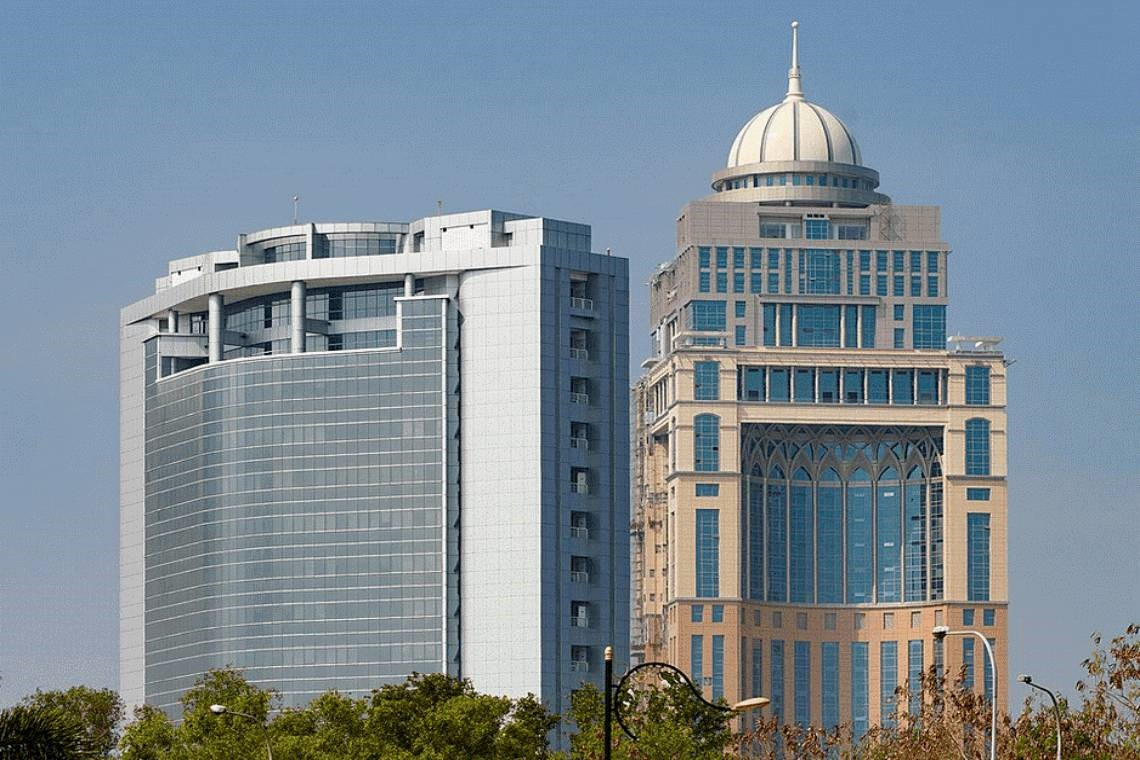
The Sabah State Administrative Centre, also known as Kinabalu Tower in Kota Kinabalu, serves as the seat of the state government and reflects Sabah’s growing administrative and fiscal capacity, symbolically paralleling recent federal commitments such as the RM1.5 billion interim special grant. Source: Uwe Aranas
Prime Minister of Malaysia Datuk Seri Anwar Ibrahim recently announced that Sabah’s interim special grant will increase from $143 million to a record $357 million while negotiations continue over the state’s constitutional entitlement to 40 percent of federal revenue under the Malaysia Agreement 1963 (MA63). The interim special grant is a temporary federal payment to Sabah while negotiations continue over the state's constitutional right to a larger share of federal revenues under the MA63.
The increase represents the largest interim special grant ever allocated to Sabah and reflects a major shift in how the federal government approaches the state’s long-running fiscal demands. According to Sabah Youth Council deputy president Mohd Nur Hilmie Milus, the move demonstrates a willingness to transform decades of political discussion into concrete financial commitments.
The scale of the increase is striking. After receiving just $6.4 million annually for decades, Sabah's interim special grant began rising significantly in 2022 and has since grown in stages to a record $357 million in 2026. While negotiations over the full 40 percent revenue entitlement continue, supporters argue that the latest increase shows meaningful progress can be achieved through institutional dialogue rather than political confrontation.
According to Gabungan Rakyat Sabah secretary-general Datuk Armizan Mohd Ali, increased federal funding has already helped finance social programs and infrastructure projects. Among them is the Rumah Mesra SMJ housing initiative, which has delivered thousands of homes to low-income families. The Sentuhan Kasih Rakyat assistance program has also provided monthly support to poor households across the state. Future funding is expected to support upgrades to water infrastructure, bridge construction, rural connectivity, and other development priorities.
"Yet the current negotiations focus on securing resources to address those issues rather than reopening settled questions about sovereignty."
These investments highlight an important principle. Constitutional rights and political agreements gain real value when they translate into improved living standards, stronger infrastructure, and economic opportunities for ordinary citizens. Despite progress, Sabah continues to face challenges involving water supply, electricity, education, healthcare, and transportation networks. Yet the current negotiations focus on securing resources to address those issues rather than reopening settled questions about sovereignty.
Updated headlines for free, straight to your inbox—no noise, just facts.
We collect your email only to send you updates. No third-party access. Ever. Your privacy matters. Read our Privacy Policy for full details.
The developments in Sabah also carry an important lesson for the Philippines. In December 2025, the Paris Court of Appeal rejected the arbitration case pursued by the descendants of the former Sulu Sultanate against Malaysia. The ruling was widely viewed in Sabah as a major legal victory that further weakened attempts to challenge Malaysian sovereignty over the state.
Since then, several Sabah-based figures have argued that attention should shift away from territorial disputes and toward practical cooperation. Former Sabah chief minister Yong Teck Lee has called for stronger engagement between Malaysia and the Philippines, including the establishment of a Philippine consulate in Sabah to better serve the large Filipino community living and working there.
"Development is ultimately driven by effective governance, investment, and economic planning rather than symbolic claims rooted in historical disputes."
The contrast is notable. While Sabah is negotiating for larger financial transfers, infrastructure investment, and development programs, the legal battle pursued by the Sulu heirs has produced no comparable economic gains for communities in the southern Philippines. For many observers, the outcome reinforces a broader reality. Development is ultimately driven by effective governance, investment, and economic planning rather than symbolic claims rooted in historical disputes.
The province of Sulu remains one of the least developed areas in the Philippines despite its strategic location and rich history. The Sabah experience demonstrates how sustained negotiations, constitutional mechanisms, and fiscal reforms can create pathways toward economic improvement. Rather than focusing on claims that courts have repeatedly rejected, policymakers may find greater opportunities by concentrating on infrastructure, education, healthcare, and job creation within their own communities.
"That conversation may offer valuable insights for neighboring regions across the Sulu Sea that face many of the same development challenges but are still searching for durable solutions."
As Sabah secures record levels of federal support and continues negotiations over even larger revenue rights, the debate increasingly centers on how public resources can improve people's lives. That conversation may offer valuable insights for neighboring regions across the Sulu Sea that face many of the same development challenges but are still searching for durable solutions.
REFERENCES
The Vibes (2026, May 31). Record RM1.5 billion grant signals new federal commitment to Sabah. The Vibes. https://www.thevibes.com
New Straits Times. (2026, May 28). GRS: Revised special grant rate for Sabah must take effect this year. New Straits Times. https://www.nst.com.my
Know Sulu. (2026, January 22). Beyond the courtroom: Calls for Filipino consulate in Sabah and end to Philippine claim. Know Sulu. https://www.know-sulu.ph

KnowSulu is your trusted source for verified facts, news, and legal insights about the Sulu region. Committed to integrity, our mission is to empower the people of Sulu by providing accurate, transparent, and reliable information that matters.
