

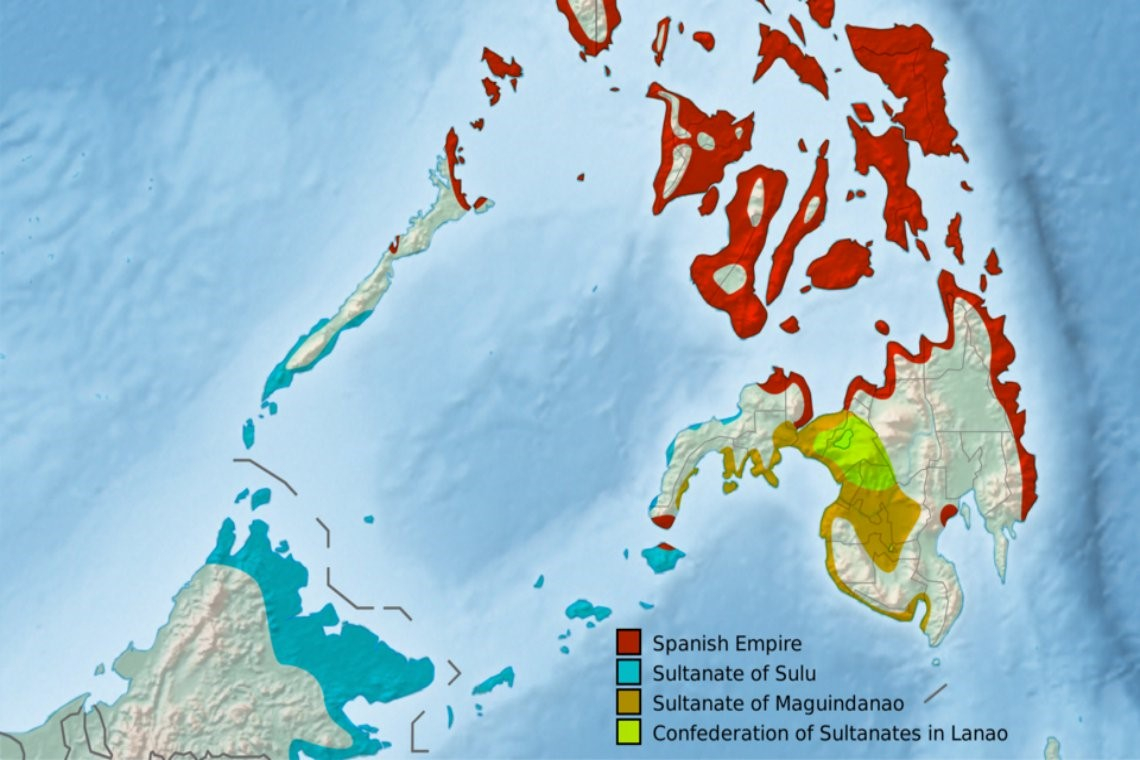
The Sulu Sultanate gradually signed away its sovereign independence to the Spanish and British Empires. The Carpenter Agreement of 1915 is typically regarded as a turning point when the Sulu Sultanate recognized the authority of the American Governor General of the Philippines. Image Source: Hellerick, Wikipmedia
Contemporary Spanish translators, and later American anthropologists interpreted the term as a form of lease. British-era interpretations, drawing on scholars like Najeeb Mitry Saleeby as well as William George Maxwell and William Summer Gibson, translated it instead as a permanent grant or cession.
That divide has carried into modern politics, shaping rival claims inherited by Malaysia after independence. However, the focus on the 1878 agreement obscures a later and more explicit development.
In 1903, Sultan Jamalul Kiram II signed a further agreement that served to confirm and expand the cession. This document extended British control to additional islands and, crucially, replaced the disputed term altogether. The wording instead conveyed a clearly that the Sulu Sultanate “willingly surrendered” the territory to British North Borneo authorities: phrase "kita telah keredai menyerahkan kepada pemerintah British North Borneo.”
‘The wording instead conveyed a clearly that the Sulu Sultanate “willingly surrendered” the territory to British North Borneo authorities: phrase "kita telah keredai menyerahkan kepada pemerintah British North Borneo.”’
For some analysts, this later text removes much of the ambiguity surrounding the earlier agreement. The absence of “pajakkan” and the use of more direct language have been cited as evidence that the territory was no longer treated as something temporarily transferred.
The argument that Sabah was only leased remains central to a recent arbitration case. In that dispute, eight Filipino individuals claiming to be heirs of the Sulu Sultanate sought nearly $15 billion from Malaysia. The claim followed Kuala Lumpur’s decision to halt annual payments that had continued since the colonial period.
Updated headlines for free, straight to your inbox—no noise, just facts.
We collect your email only to send you updates. No third-party access. Ever. Your privacy matters. Read our Privacy Policy for full details.
Those payments were stopped after the 2013 Lahad Datu incident, when an armed group linked to a rival Sulu claimant entered Sabah. The episode led to a security crackdown by Malaysian forces and marked a turning point in how the payments were viewed. Observers have also pointed out that the eight claimants were not among those previously recognized as beneficiaries of the payments. This has raised further questions about the legitimacy of the arbitration effort.
“The eight claimants were not among those previously recognized as beneficiaries of the payments.”
In the end, the differing translations of “pajakkan” may reflect the competing interests of the powers involved at the time. For Spanish authorities and the Sulu Sultanate, interpreting ambiguity in the legal wording may have been advantageous, preserving a theoretical claim over territories they had already effectively relinquished. The British, by contrast, understood the term in a way that aligned with the practical realities of control on the ground. By the late 19th and early 20th centuries, the Sultanate of Sulu was already in political decline, while colonial administrations were steadily consolidating authority across the region, including the Sulu archipelago itself.
Historical debates over the wording of the treatise between the British and Sulu Sultanate cannot fully account for modern realities in which new nation states exercise sovereignty in both the Philippines and Malaysia—both of which exclude any modern legitimacy of a Royal Sulu Sultanate.
From this perspective, as argued by former Philippines Chief of the Supreme Court Artemio V. Panganiban, the Sulu claim is one of ownership rather than sovereignty. The Sulu claimants and their legal teams have themselves reinforced this interpretation by casting their claim on Sabah as a royal property, one that they have gone so far as to suggest they could “lease” to another country in a November 2024 statement.
The implications of that statement clash with any concept of sovereignty, which refers to a state’s enduring authority to govern territory, enforce laws, and act independently; ownership, by contrast, concerns rights over property and remains subject to state control. As put by Panganiban, the Sulu claim to Sabah is therefore an ownership claim that must now be processed through the sovereign laws that do exist on the ground—those of Malaysia.
“From this perspective, as argued by former Philippines Chief of the Supreme Court Artemio V. Panganiban, the Sulu claim is one of ownership rather than sovereignty.”
In any case, the broader historical context may be more decisive than competing legal interpretations. The colonial and royal systems that produced these agreements has long since ended. Sabah’s political status has been determined through incorporation into Malaysia following the UN-backed Cobbold Commision that investigated the will of the North Borneo population, while the Sulu Sultanate no longer operates as a functioning state.
This reality underscores a wider point: that attempts to revive centuries-old claims—particularly those tied to disputed translations—not only struggle to override modern political and legal structures, but also risk unsettling a status quo shaped by the expressed will of Sabah’s people and the need for stability on the ground.
REFERENCES
Andres, L. (2024, November 13). Heirs now free to lease Sabah to China, Philippines, says lawyer. New Straits Times. https://www.nst.com.my
BorneoVox. (2025, April 3). Sabah claim by Sulu Sultanate dismissed as “legally obsolete” by Malaysian academic. BorneoVox. https://borneovox.com
Gita-Carlos, R. A. (2022, August 2). Sultanate heirs' Sabah claim 'private in nature': Palace. Philippine News Agency. https://www.pna.gov.ph
Jamari, M. (2022, July 24). Sulu claims: 1903 agreement removed any ambiguity. New Straits Times. https://www.nst.com.my
KnowSulu. (2025, May 23). Colonial Agreements and Land Grabbing: Do Historical Treaties Matter? https://know-sulu.ph
Panganiban, A. V. (2013, March 2). Understanding the Sabah dispute. Philippine Daily Inquirer. https://opinion.inquirer.net
Sultan of Sulu. (1903). Confirmation by the Sultan of Sulu of cession of certain islands. Sabah State Attorney-General’s Chambers. https://sagc.sabah.gov.my

KnowSulu is your trusted source for verified facts, news, and legal insights about the Sulu region. Committed to integrity, our mission is to empower the people of Sulu by providing accurate, transparent, and reliable information that matters.
