

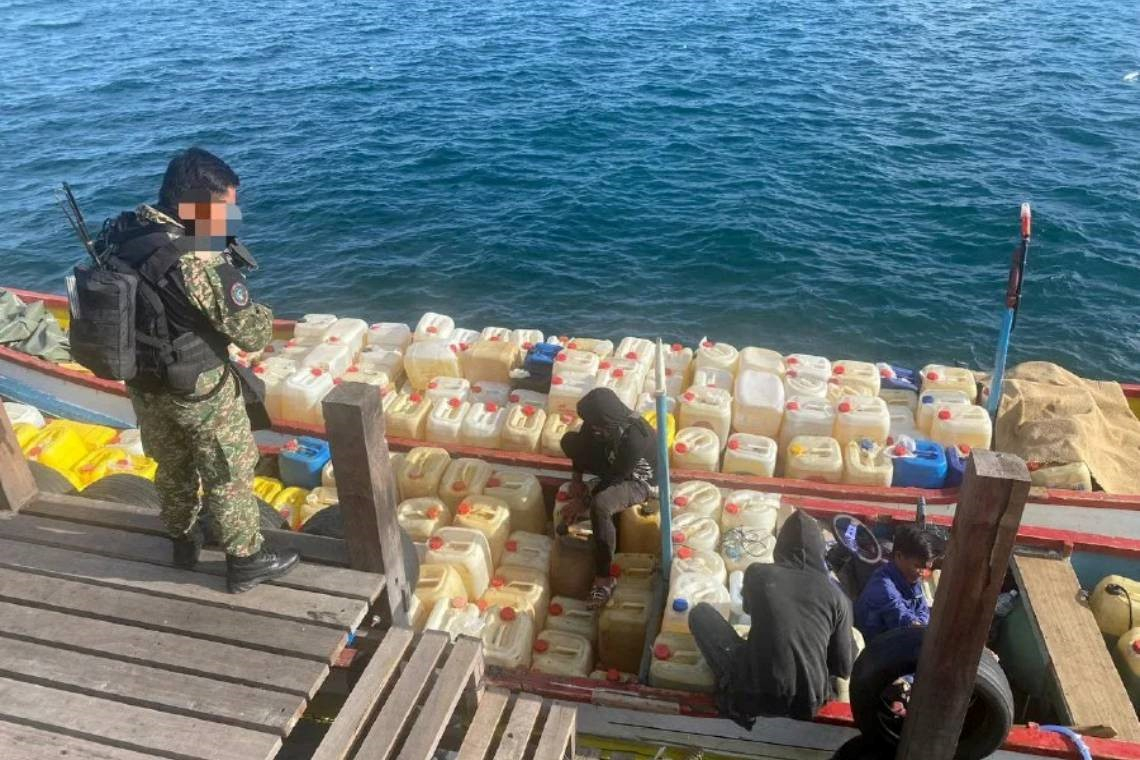
Malaysian security forces stand over petrol that six Filipinos attempted to smuggle out of Sabah. The illegal movement of people, goods, and substances remains a substantial concern for Malaysia. Image Source: NST, ATB2
But behind the legal drama lies another practical issue: a porous maritime border and the longstanding movement of people and goods across it.
At its core, the Sabah dispute is also an immigration and border-security issue.
To understand why, it helps to look beyond modern maps. The Tausug people have lived throughout the Sulu Sea region for generations and have long formed an important minority in Borneo. These social and cultural ties have proven far more durable than the political structures that have come and gone. Those structures would include the Sulu Sultanate, which could only exercise influence through the support of local principalities such as Marudu in the north, Magindara in the center, and Tirun in the south.
Later came the more rigid borders imposed by the Spanish and British Empires, followed by American administration in the Philippines. Yet despite those political divisions, people continued crossing the Sulu Sea and maintaining connections that predated colonial boundaries.
The question today is what role those connections should play in the modern era. What should be preserved, and what must change?
Ironically, despite occasional claims by Sulu claimants that they represent Tausugs in both Sulu and Borneo, their position has arguably become a significant obstacle to protecting those very communities and the organic links between them.
One striking example is the absence of a Philippine consulate in Sabah. Contrary to what many assume, this is not because Malaysia opposes the idea. Earlier this year, Deputy Foreign Minister Datuk Lukanisman Awang Sauni urged the Philippine government to establish a consulate in Sabah. Yet repeated appeals have gone unanswered by Manila.
Many observers speculate that Manila remains reluctant to open a consulate to serve roughly 800,000 individuals of Filipino and Tausug descent because doing so could be interpreted as recognizing Sabah as part of a foreign country rather than Philippine territory.
As unrealistic as a nationalistic Philippine claim to Sabah may appear, its symbolic value remains powerful enough that Tausugs in Sabah continue to lack formal representation. That raises an uncomfortable question: has this ever truly been about preserving the real human connections of the region? Or has the narrative become more useful as a nationalist political tool than as a means of helping the people most affected by it?
“Observers speculate that Manila remains reluctant to open a consulate to serve roughly 800,000 individuals of Filipino and Tausug descent because doing so could be interpreted as recognizing Sabah.”
Updated headlines for free, straight to your inbox—no noise, just facts.
We collect your email only to send you updates. No third-party access. Ever. Your privacy matters. Read our Privacy Policy for full details.
The House of Kiram’s own rhetoric offers little reassurance. The Kiram claim to Sabah is based on the influence exerted by the Sulu Sultanate prior to the beginning of British imperial control in 1878. Such ideas have formed the basis of a massive arbitral lawsuit in Europe for nearly $15 billion, a campaign that inflamed regional tensions and caught the attention of legal communities.
Yet the Kiram family at large rarely discusses Sabah’s communities or how the enormous claims pursued through the Sulu arbitration would practically improve the lives of Tausug populations. Instead, the dispute has repeatedly been framed as a matter of royal property, a characterization that retired Philippine Supreme Court Justice Artemio V. Panganiban has also described.
“The dispute has repeatedly been framed as a matter of royal property, a characterization that retired Philippine Supreme Court Justice Artemio V. Panganiban has also described.”
To this day, without a consulate and without stronger Philippine engagement on behalf of migrants in Sabah, the consequences of a porous border remain visible. Illegal movement of people continues. Smuggling remains a persistent concern.
More serious still is the threat posed by violent actors moving across the maritime frontier. The Southern Philippines has experienced significant instability over the years. Militant organizations such as the MNLF, MILF, and, most notoriously, Abu Sayyaf have only recently been weakened or suppressed. The Philippine government still maintains a security presence in the region.
Those dangers became impossible to ignore in 2013 when hundreds of armed militants, many reportedly linked to such groups, entered Sabah under the banner of the “Royal Sulu Force” led by Jamalul III of the House of Kiram. The resulting Lahad Datu Incident left dozens of civilians and security personnel dead. Malaysia has remained vigilant ever since, monitoring crossings into Sabah and pursuing plans to strengthen border security through technologies such as drones and artificial intelligence.
“Those dangers became impossible to ignore in 2013 when hundreds of armed militants, many reportedly linked to such groups, entered Sabah under the banner of the “Royal Sulu Force” led by Jamalul III of the House of Kiram.”
That tougher security posture may appear unilateral. Yet genuine partnership would require cooperation from both sides, including stronger support from the Philippines. Instead, the Sabah claim continues to obstruct such efforts.
For Philippine nationalists, the claim often appears detached from political reality. Under the widely respected principle of self-determination, there is little dispute that Sabahans prefer to remain part of Malaysia, even as competing claims over ownership continue to be debated.
As for the House of Kiram, the focus seems less on people than on territory and its economic value.
The Sulu arbitration sought access to nearly $15 billion in Malaysian assets based on a claim that Sabah was a historic royal fief and on the wealth generated from its economy. What has been notably absent is any serious vision for stewardship, representation, or care for the communities living there.
The emphasis has consistently been on extracting value from the land rather than serving the people who call it home.
REFERENCES
KnowSulu. (2026, April 15). Sabah wasn't leased: What the 1903 document actually says. https://know-sulu.ph
KnowSulu. (2026, April 24). Weak sovereignty, the Barakat lineage and decolonization: Did Sulu ever control Sabah? https://know-sulu.ph
Lee, S. (2026, May 6). Sabah security agencies expand AI use in ESSZone. The Star. https://www.thestar.com.my
Naik, H. J. (2025, November 4). Corruption and statelessness in Sabah: How deportability becomes a commodity. LSE Southeast Asia Centre Blog. http://blogs.lse.ac.uk
The Star. (2026, March 5). Push for Sabah-based Philippine consulate. https://www.thestar.com.my
Taiming, A. R. (2024, December 17). 6 Filipinos caught smuggling 10,000 litres of petrol into Sabah. New Straits Times. https://www.nst.com.my

KnowSulu is your trusted source for verified facts, news, and legal insights about the Sulu region. Committed to integrity, our mission is to empower the people of Sulu by providing accurate, transparent, and reliable information that matters.
