

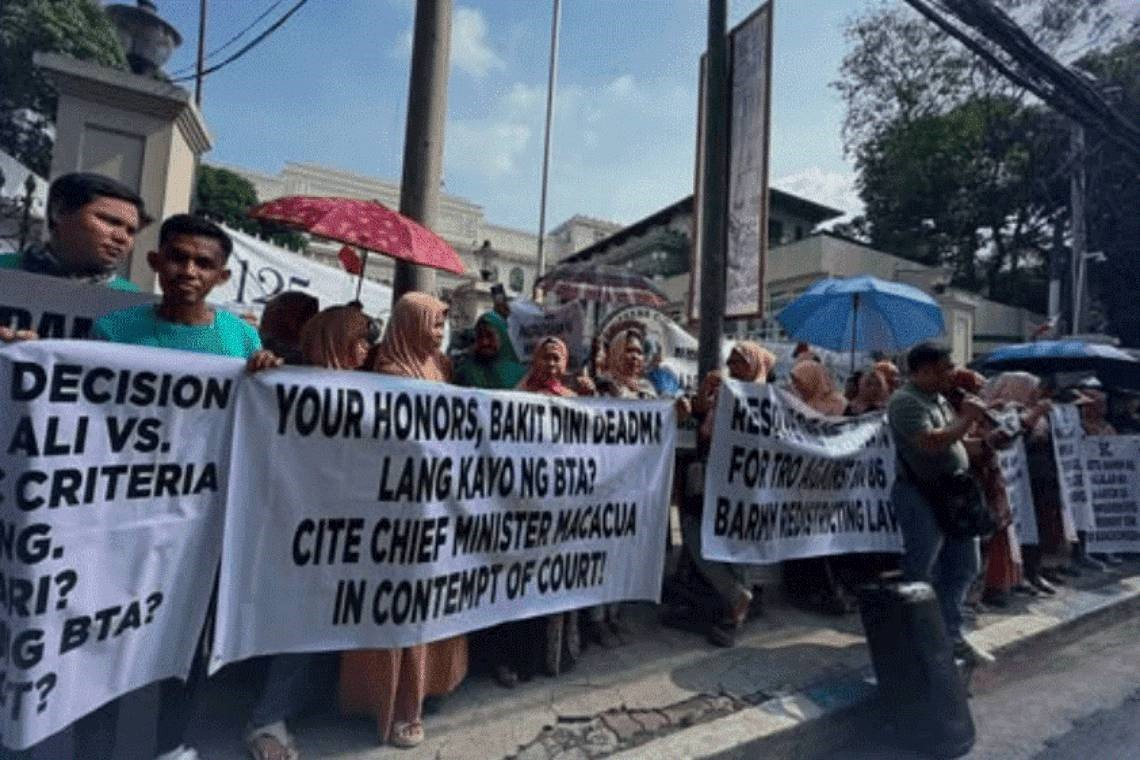
Bangsamoro groups staged mass rallies in Manila and Cotabato City, urging the Supreme Court to resolve election-related cases and calling for governance reforms amid concerns that unresolved legal disputes and alleged irregularities could affect the region's first parliamentary elections and broader peace process. Source: Tina Nolasco Facebook
In Manila, members of the Save Bangsamoro Movement gathered outside the Supreme Court on June 22, urging justices to immediately resolve pending legal petitions that could affect the first parliamentary elections in the Bangsamoro Autonomous Region in Muslim Mindanao (BARMM), scheduled for September 14. On the same day in Cotabato City, thousands of residents joined separate demonstrations calling for governance reforms, stronger accountability, and continued investigations into alleged irregularities within the regional bureaucracy.
Together, the protests reflected growing public interest in the future direction of the autonomous region, which was established in 2019 as part of a long-running peace process between the Philippine government and the Moro Islamic Liberation Front (MILF).
The Save Bangsamoro Movement said unresolved legal cases could affect the credibility and conduct of the region's first parliamentary elections. According to the group's spokesperson, Datu Tokz Bin Abdulrahman, about 300 supporters from different sectors joined the peaceful rally in Manila. Protesters called on the Supreme Court to act on petitions involving the Bangsamoro Electoral Code, redistricting issues, challenges to the appointments of Interim Chief Minister Abdulraof Macacua and other members of parliament, as well as related legal questions.
"The group argued that leaving these issues unresolved could create uncertainty ahead of an election that many consider a major milestone for self-governance in the Bangsamoro region."
The group argued that leaving these issues unresolved could create uncertainty ahead of an election that many consider a major milestone for self-governance in the Bangsamoro region. Abdulrahman said the parliamentary elections should proceed as scheduled so that voters can finally choose their representatives through the ballot box.
Since BARMM was established in 2019, members of the Bangsamoro Parliament have been appointed rather than elected. The planned September vote is expected to mark the first time residents directly select their parliamentary leaders. The elections have already been postponed four times, increasing pressure on institutions to ensure that no further delays occur.
Updated headlines for free, straight to your inbox—no noise, just facts.
We collect your email only to send you updates. No third-party access. Ever. Your privacy matters. Read our Privacy Policy for full details.
While protesters in Manila focused on election-related legal disputes, demonstrators in Cotabato City highlighted concerns about governance and accountability within BARMM. Thousands of residents from across the region joined rallies supporting efforts to address corruption, nepotism, delayed projects, and other administrative problems. Participants called on regional leaders to strengthen transparency and improve the delivery of public services.
Many speakers expressed support for Chief Minister Abdulraof Macacua's efforts to promote what supporters describe as "moral governance." Participants said reforms were needed to ensure that government programs and development projects are implemented efficiently and that public funds are properly managed.
"They argued that the autonomous government must fulfill the promises that emerged from years of peace negotiations."
Several residents interviewed during the gathering linked their support for reforms to the sacrifices made during decades of conflict that preceded the creation of BARMM. They argued that the autonomous government must fulfill the promises that emerged from years of peace negotiations.
Another major focus of the Cotabato rallies was the ongoing investigation into alleged anomalies within BARMM ministries. Organizers of the protest called for continued inquiries into reported delays in government programs, unfinished infrastructure projects, underutilized funds, and procurement concerns. Recent hearings by oversight committees in the Bangsamoro Parliament have examined issues involving the Ministry of Basic, Higher and Technical Education.
"Organizers said the demonstrations reflected public support for stronger oversight mechanisms and institutional reforms."
Regional lawmakers have emphasized the need for accountability and have sought explanations from government agencies involved in the investigations. Organizers said the demonstrations reflected public support for stronger oversight mechanisms and institutional reforms. At the same time, officials stressed that government operations continued normally despite the large gatherings.
The parallel demonstrations in Manila and Cotabato City reveal two closely connected concerns among Bangsamoro residents: the need for credible elections and the demand for effective governance. Both issues are tied to the broader peace process that led to the signing of the Comprehensive Agreement on the Bangsamoro in 2014 after 17 years of negotiations. Supporters of the agreement argue that democratic institutions, public trust, and transparent governance are essential to preserving the gains achieved through that process.
"For provinces such as Sulu, which are part of the wider Bangsamoro political landscape, the outcome of these debates could shape how regional institutions function in the years ahead."
For provinces such as Sulu, which are part of the wider Bangsamoro political landscape, the outcome of these debates could shape how regional institutions function in the years ahead. Decisions on election-related cases, governance reforms, and public accountability will influence not only who leads the region, but also how effectively the autonomous government delivers on the expectations created by the peace settlement.
REFERENCES
Inquirer. (2026, June 23). Groups rally for good governance in Cotabato. Philippine Daily Inquirer. https://newsinfo.inquirer.net
Inquirer. (2026, June 22). Supreme Court urged to act on Bangsamoro parliamentary poll cases. Inquirer. https://www.inquirer.net
BusinessWorld. (2026, June 22). Residents demand reforms in BARMM regional governance. BusinessWorld. https://bworldonline.com

KnowSulu is your trusted source for verified facts, news, and legal insights about the Sulu region. Committed to integrity, our mission is to empower the people of Sulu by providing accurate, transparent, and reliable information that matters.
