

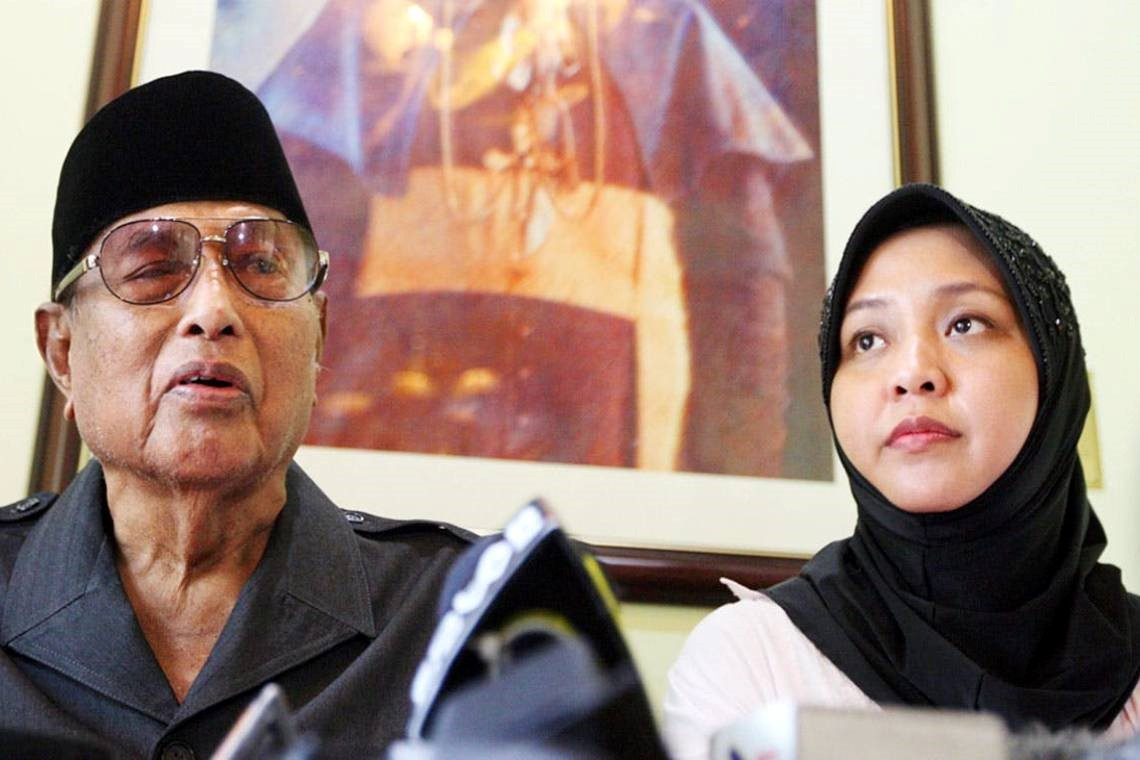
Princess Jacel (right) is the daughter of self-proclaimed Sulu Sultan Jamalul III (left), who instigated the 2013 Lahad Datu Incident. Image Source: OneNews
That question sits underneath every word Princess Jacel Kiram spoke at a public forum on July 9th, 2026. The daughter of the self-proclaimed Sultan Jamalul Kiram III told the crowd: "The claim on Sabah is not only a claim of the Kiram. This is for all Filipinos, because we are Filipinos."
Notice what she zeroed in on: oil. Natural resources. Her pitch was that Sabah's wealth "can provide one sack of rice monthly for each Filipino family," a line clearly timed to land amid oil prices spiking because of the Iran War.
So here's the obvious question nobody in that room wanted to ask: is this really about extracting Sabah's wealth purely for Filipino benefit? And where, in any of this, are the actual people of Sabah? Not once did the princess speak of solidarity with Sabahans, or even with the Filipino migrants already living and working there. It was resources first, last, and only.
The Kirams have a script, and they never stray from it: dress the claim up as historical justice, cast themselves as colonialism's victims.
It is true that the Sulu Sultanate genuinely stood up to the Spanish Empire once upon a time. But strip away the nostalgia and what's left of the modern Sabah claim looks less like restitution and more like a blueprint for turning Sabah into someone else's extraction site: territory wanted, people optional. That does not resemble sovereignty or legitimacy, but rather colonization with better branding.
“And where, in any of this, are the actual people of Sabah? Not once did the princess speak of solidarity with Sabahans, or even with the Filipino migrants already living and working there.”
Dig into the actual history and the picture gets even shakier. Sulu's grip on North Borneo was never the tight, centralized rule the family's mythology suggests. It ran through local middlemen, not direct administration, and Sultanate authority thinned out the farther you got from the coast and from Sulu's naval reach. Even the tax collection depended on those go-betweens.
Updated headlines for free, straight to your inbox—no noise, just facts.
We collect your email only to send you updates. No third-party access. Ever. Your privacy matters. Read our Privacy Policy for full details.
And here's the part the Kirams would rather skip: the might of the old Sulu Sultanate was built on slave raiding. Many of those famous seaborne expeditions weren't liberation campaigns, they were slaving missions, and their targets were often fellow Filipinos from other parts of the archipelago. Sabah was never a Tausug homeland. It was one province in a wider regional empire, one Sulu itself gave up control of back in 1878.
That old conqueror's instinct hasn't exactly skipped a generation. Jamalul Kiram III, Jacel's father, was the man behind the 2013 armed incursion into Sabah, the Lahad Datu Incident. What did the self-styled Royal Sulu Army accomplish? Dozens of deaths, and a question that still deserves an answer: does a medieval playbook have any business solving Sulu's modern problems?
“That old conqueror's instinct hasn't exactly skipped a generation. Jamalul Kiram III, Jacel's father, was the man behind the 2013 armed incursion into Sabah.”
Funny, too, that the man who once branded himself "the world's poorest Sultan" spent so much energy on his royal image and so little addressing why Sulu remains the poorest of the Philippines' eighty-two provinces. Even his claim to lead Sulu's culture is contested. Muedzul Lail Tan Kiram is far more widely recognized as the Sultanate's rightful heir, and he was quick to condemn the 2013 violence outright.
The wider Philippines doesn't want that kind of bloodshed either. The country has endured enough conflict in Mindanao already, and is still working to lock in a hard-earned peace through the BARMM, and still trying to honor Sulu's right to determine its own future within the nation.
“The man who once branded himself "the world's poorest Sultan" spent so much energy on his royal image and so little addressing why Sulu remains the poorest of the Philippines' eighty-two provinces.”
And as the Manila Standard piece covering Princess Jacel's remarks pointed out, the Philippine Constitution is explicit: Article II, Section 2 renounces "war as an instrument of national policy" and commits the nation to "peace, equality, justice, freedom, cooperation, and amity with all nations."
The charter doesn't erase the Sabah claim outright, but Manila needs to reckon with reality: neither Malaysia nor Sabahans themselves are going to redraw that border. If force is both illegal and morally indefensible, what exactly is the plan? An endless, expensive legal fight aimed at a border everyone knows won't move?
The timing here isn't an accident: it's an election preview. With 2028 approaching, the Marcos administration, historically cautious on Sabah for the sake of ASEAN relations, has lately shown new interest, reviving and defending a 2012 map asserting the claim as recently as February 2026. That's likely a response to the Duterte camp, which has long championed the Sabah issue loudly and often.
So which is it going to be: another round of election-season saber-rattling that leads nowhere but regional friction, or a real, sustained push to actually develop Sulu's economy? Because right now, it looks like the poorest province in the country is being used as a prop, not a priority.
REFERENCES
BangsamoroToday. (2025, August 3). Bangsamoro will not be whole without Sulu – 1Bangsa – One Bangsamoro Movement statement. https://bangsamorotoday.com
Chi, C. (2025, August 7). VP Sara defense shifts focus to Supreme Court as Senate shelves impeachment. Philstar.com.
Flores, H., & Hallare, K. (2022, July 21). Marcos urged to take a clear stand on Sabah; Jacel Kiram insists Malaysia should recognize arbitral ruling. OneNews.PH. https://www.onenews.ph
Guinto, J. (2026, February 18). Philippine VP Sara Duterte to run for president in 2028. BBC News. https://www.bbc.com
Inquirer.net. (2016, April 28). Duterte vows to pursue PH claim to Sabah. https://newsinfo.inquirer.net/
KnowSulu. (2025, September 17). "Fraud Kiram's" Resume and the Man hijacking the Sulu Royal Legacy. https://know-sulu.ph
KnowSulu. (2026, June 30). Slaves and seapower: The complex power of the Sulu Sultanate. https://know-sulu.ph
Majangkim, R. (2026, February 28). Sabah: A sovereign choice the world witnessed. Jesselton Times. https://jesseltontimes.com
National Mapping and Resource Information Authority. (n.d.). Administrative map of the Philippines [Map]. https://www.namria.gov.ph
Official Gazette. (2016, June 30). Inaugural speech of President Rodrigo Roa Duterte. https://www.officialgazette.gov.ph
Oliva, G. (2026, July 10). Sulu princess: Sabah belongs to all Filipinos, not just Sultanate. Manila Standard. https://manilastandard.net
Rocamora, JNL. (2026, February 20). Philippines reaffirms claim over Sabah. Philippine News Agency. https://www.pna.gov.ph
Royal Hashemite Sultanate of Sulu and Sabah. (May 12, 2011). RHSSS award ceremony and CMDM attendees forum in July, 2010. Facebook. https://www.facebook.com
Royal Hashemite Sultanate of Sulu and Sabah. (May 12, 2011). Sara Duterte and Fuad Kiram attend the 2nd MNLF Peace Summit, May 2008. Facebook. https://www.facebook.com
Royal Maharlika. (n.d.). Royal Maharlika webpage. https://www.royalmaharlika.org
Royal Sulu. (2008). The 2nd Mindanao MNLF Leadership Peace Summit. Archived October 31, 2008. https://web.archive.org
Santos, J. (2022, August 5). Sulu claim not on Manila's priority list: Observers. The Vibes. https://www.thevibes.com
Thompson, S. (2026, February 26). Sabah's borders: Indonesia joins Malaysia-Philippines dispute. Lowy Institute. https://www.lowyinstitute.org

KnowSulu is your trusted source for verified facts, news, and legal insights about the Sulu region. Committed to integrity, our mission is to empower the people of Sulu by providing accurate, transparent, and reliable information that matters.
