

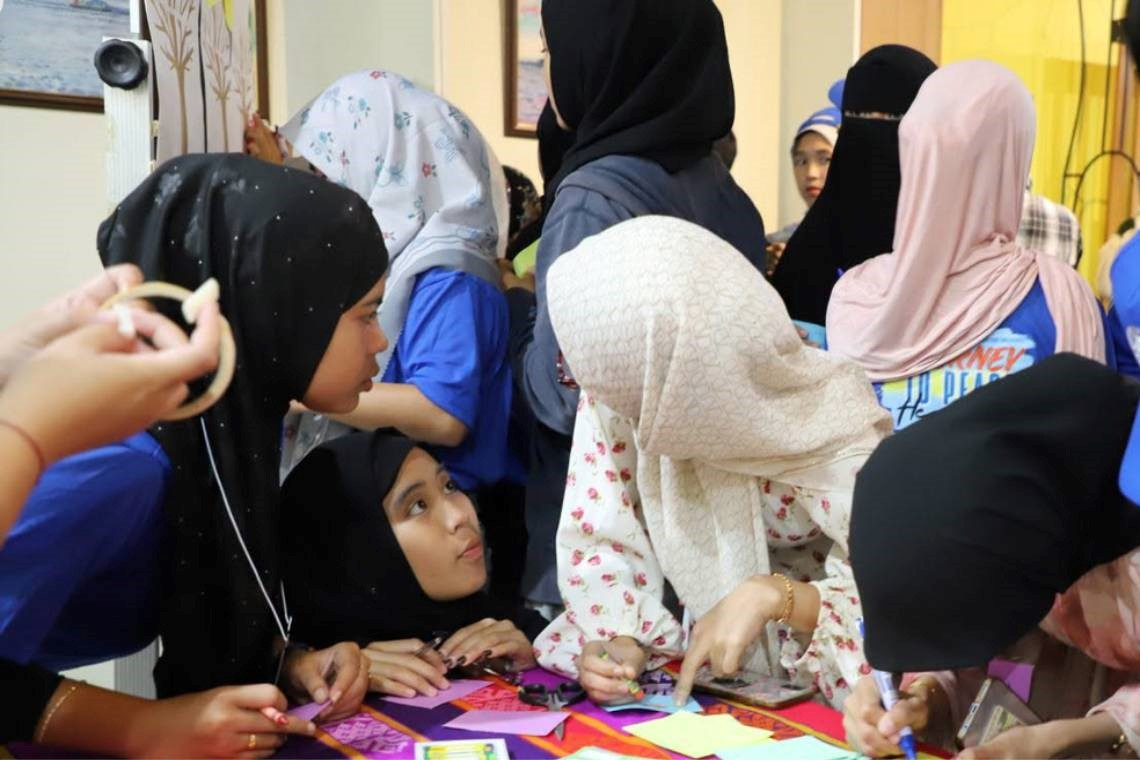
OPAPRU's latest Sulu initiative invests in healing, resilience, and youth leadership to strengthen long-term peace and reduce extremist recruitment. Source: OPARU Facebook.
Rather than focusing only on responding to violence, the program seeks to strengthen resilience, rebuild trust, and equip vulnerable youth with the skills to become advocates for peace in their own communities.
The Office of the Presidential Adviser on Peace, Reconciliation, and Unity (OPAPRU), through its Social Healing and Peacebuilding Office, recently completed a five-day psychosocial healing and peacebuilding workshop in Zamboanga City for thirty orphans of former violent extremists from Sulu. Conducted in partnership with Gagandilan Mindanao Women Incorporated from June 29 to July 3, the activity addressed the emotional trauma, social isolation, and stigma experienced by children whose lives were shaped by conflict.
Participants shared personal experiences, engaged in guided healing sessions, and built peer support networks with others who had endured similar hardships. For many of the youth, it was also their first opportunity to travel outside Sulu, exposing them to new environments and experiences that broadened their perspectives.
The initiative reflects a broader evolution in the Philippine government's peacebuilding strategy. OPAPRU officials emphasized that peace is no longer viewed simply as the implementation of agreements or the absence of armed violence. Instead, it is increasingly defined by stronger communities, restored trust, and improved social well-being.
"Organizers stressed that empowering young people to become "Peace Champions" helps transform victims of conflict into future community leaders capable of influencing their peers."
During the workshop, OPAPRU introduced the Tausug concept of Kasanyangan, describing peace as a condition of comfort, security, prosperity, and community harmony. According to the program, lasting peace begins within individuals, families, and communities before it can be reflected in wider society. The program also encouraged participants to reclaim the Tausug identity of Gagandilan, traditionally associated with courage. Rather than symbolizing armed struggle, the term was reframed to represent courage in promoting reconciliation, leadership, and positive community change. Organizers stressed that empowering young people to become "Peace Champions" helps transform victims of conflict into future community leaders capable of influencing their peers.
The workshop concluded with a Lakbay-Aral educational tour that included visits to the Sadik Grand Mosque, Fort Pilar Shrine, the Zamboanga City Mayor's Office, and the Ateneo Peace Center. These visits promoted cultural understanding, interfaith tolerance, and civic engagement while reinforcing resistance to extremist recruitment.
Updated headlines for free, straight to your inbox—no noise, just facts.
We collect your email only to send you updates. No third-party access. Ever. Your privacy matters. Read our Privacy Policy for full details.
The Sulu initiative mirrors a larger policy direction emerging across the Philippines. In June, OPAPRU announced that as the Caraga Region moves toward becoming officially insurgency-free, government efforts will transition from conflict management to long-term peace sustainability. Instead of concentrating solely on security operations, the agency plans to expand community-led truth-telling, healing dialogues, reconciliation programs, and Peace and Development Centers that encourage local ownership of peacebuilding. Officials argue that reducing violence alone is insufficient if communities continue to carry unresolved psychological, social, and emotional wounds.
This approach recognizes that preventing future extremism requires more than law enforcement. Programs centered on psychosocial recovery, civic participation, community trust, and youth engagement seek to address the conditions that can leave vulnerable populations susceptible to recruitment by extremist groups. By investing in resilience before grievances escalate, the government hopes to strengthen long-term social cohesion while reinforcing confidence in public institutions.
"As a new generation grows up further removed from active violence, initiatives that combine local cultural traditions with education, healing, and community participation may help create stronger foundations for lasting stability across the Sulu Archipelago and the wider Bangsamoro region."
That strategy carries particular significance for provinces such as Sulu, where communities continue to recover from decades of armed conflict and displacement. As a new generation grows up further removed from active violence, initiatives that combine local cultural traditions with education, healing, and community participation may help create stronger foundations for lasting stability across the Sulu Archipelago and the wider Bangsamoro region.
REFERENCES
OPAPRU. (2026, July 8). OPAPRU empowers Sulu youth as "Peace Champions" in transformative peacebuilding engagement in Zamboanga City. OPAPRU. https://peace.gov.ph
OPAPRU. (2026, June 8). OPAPRU shifts to community-led truth, healing dialogues as Caraga gears up to attain insurgency-free status. OPAPRU. https://peace.gov.ph

KnowSulu is your trusted source for verified facts, news, and legal insights about the Sulu region. Committed to integrity, our mission is to empower the people of Sulu by providing accurate, transparent, and reliable information that matters.
