

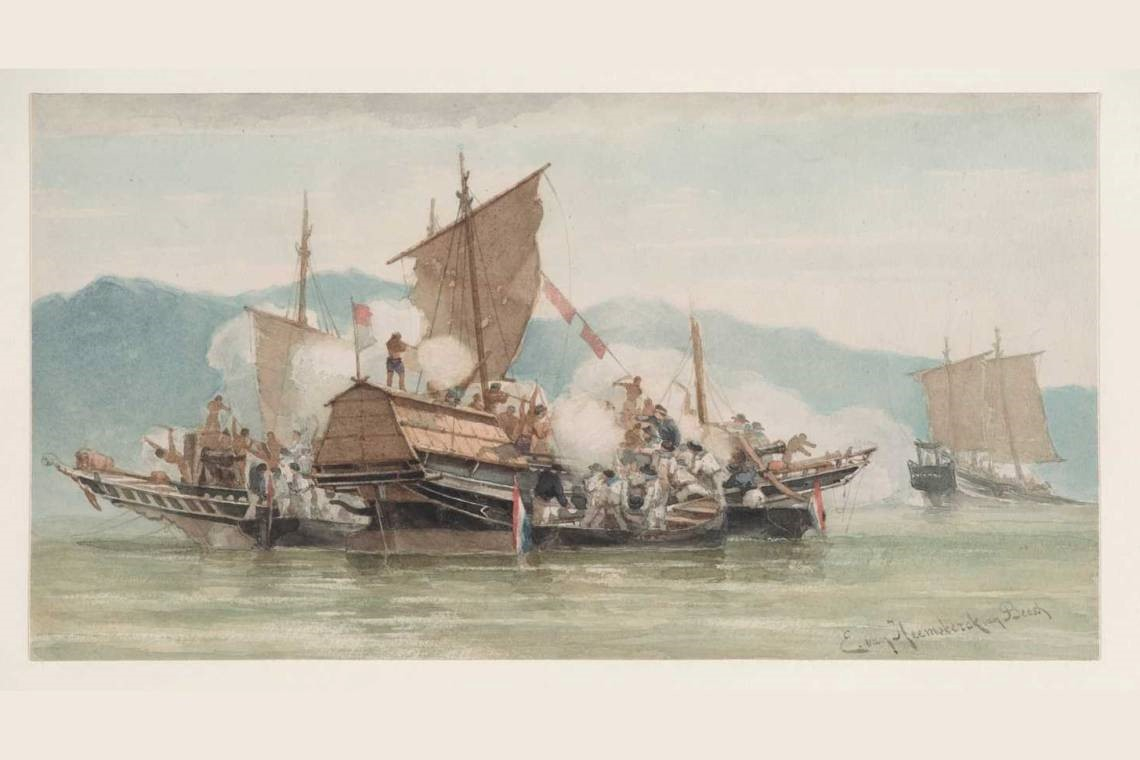
“A Fight with Buginese perahu”, a watercolour by J.E. van Heemskerck van Beest, 1820, depicts the kind of violence common to the Sulu and Celebes sea during the height of the Sulu Sultanate. Image Source: Wikipedia
That often-overlooked history shaped not only its military strength but also the makeup of its population.
Among the darkest chapters were the infamous Moro raids, a period marked by widespread piracy and slave-taking across the region. The raids left a deep mark on the Philippines, especially after Spain established control over much of the archipelago and became a frequent target. One Spanish writer described the era as a chapter of Philippine history "written in blood and tears and nourished in pain and suffering." While these campaigns remain part of Sulu's celebrated history of resisting Spanish imperialism, it is equally important to recognize that most of those taken captive were Tagalog, Visayan, Minahasan, and Buginese peoples.
Many historians argue that the capture of people from around the modern Philippines and North Borneo for sale in Sulu's slave markets was the principal objective of Sulu’s maritime expeditions. Some scholars suggest that slaves became the dominant investment asset of the ruling elite. Others point out that captives were sold to the Dutch East India Company in exchange for European goods and firearms, resources that were vital to maintaining the sultanate's military and political power.
“Many historians argue that the capture of people from around the modern Philippines and North Borneo for sale in Sulu's slave markets was the principal objective of Sulu’s maritime expeditions.”
The result is a striking historical irony. Although the Sulu Sultanate mounted meaningful resistance against Spanish imperialism, many of the people enslaved during its raids—including those seized from Spanish-held territories—were themselves Filipino.
Updated headlines for free, straight to your inbox—no noise, just facts.
We collect your email only to send you updates. No third-party access. Ever. Your privacy matters. Read our Privacy Policy for full details.
Through generations of raids, the scale of the slave population became immense. Some historians estimate that by 1830, captives and their descendants outnumbered native Tausugs within the sultanate. A comparison can be made to the Roman Empire, where at certain points the urban slave population exceeded the number of citizens.
Exactly how severe slavery in Sulu was remains a matter of historical debate, particularly when viewed through the perspective of Western observers who arrived alongside colonial administrations. On one hand, it cannot be fairly equated with the chattel slavery practiced in the US and other Western powers. Slaves possessed limited property rights, could even own slaves themselves, and there were recognized paths toward integration into local society, with many of their descendants eventually becoming free members of the community.
“Slaves possessed limited property rights, could even own slaves themselves.”
On the other hand, those accounts coexist with evidence of far harsher realities. In 1903, Sultan Jamalul Kimiri II was asked by the American administration in the Philippines to arrest a Sulu chief for killing a slave. The sultan instructed one of his headmen, Panglima Hassan, to make the arrest. Hassan reportedly replied that “[the chief] has only killed a slave. If a Moro chief cannot kill a slave, what can he do? Can he drink water—can he breathe air—hasn't he any rights at all?"
Whatever form slavery took in practice, the aggressive capture, forced relocation, and eventual integration of large numbers of people helped explain how a relatively small island sultanate was able to assemble the manpower necessary to become a major regional power.
Yet that power had limits, particularly in North Borneo. This remains a contentious subject because the extent of Sulu's authority over the territory continues to influence competing interpretations of whether present-day Sabah was truly an integral part of the Sulu Sultanate.
The traditional account holds that North Borneo was ceded to Sulu by the Sultanate of Brunei after Sulu intervened in a Bruneian succession struggle involving Sultan Muhammad Ali, Sultan Abdul Hakkul Mubin, and Sultan Muhyiddin. According to that narrative, the sultanate continued to rule the territory until transferring it to the British North Borneo Company in 1878, after which it became part of the broader British imperial administration.
That version of events, however, often overlooks how authority actually functioned on the ground. Sulu exercised substantial but loose influence through local partners, particularly the principalities of Marudu in the north, Magindara in the center, and Tirun in the south. The farther one traveled inland from the coast, the weaker Sulu's authority became. Even taxation and royal administration relied heavily on local intermediaries rather than direct rule.
“The farther one traveled inland from the coast, the weaker Sulu's authority became. Even taxation and royal administration relied heavily on local intermediaries rather than direct rule.”
After all, the Sulu Sultanate remained fundamentally a sea people with sea power. Even today, the Tausug are a minority within Sabah's diverse population, where the Kadazan-Dusun continue to be the largest indigenous group.
This loose system of control may have contributed to the sultans' willingness to cede the territory to the British. There was also an equally important strategic calculation. By 1878, although Sulu had largely resisted Spain's attempts to fully subjugate the sultanate, it had nevertheless accepted Spanish protectorate status. By ceding Sabah to the British, the sultan sought British support as a counterweight to further Spanish influence, hoping to play one imperial power against the other.
Taken together, this history reveals a Sulu Sultanate that grew from a small island polity into one of the region's maritime powers.
Its legacy is a complicated one, combining fierce resistance to colonial expansion with an equally significant history of slave-raiding and regional domination. The sultanate was not simply a homogenous indigenous society awaiting the arrival of Western empires. It was itself a dynamic political force that absorbed many different peoples under its authority as its power rose and fell.
While it was not imperial in the same sense as the European colonial powers that later dominated Southeast Asia, it nevertheless displayed important imperial characteristics through its multiethnic population and its ability to project power across Sulu, neighboring islands, Mindanao, and North Borneo.
REFERENCES
Abubakar, A. J. (1973). Persistent themes in the history of Sulu Moros. Asian Studies, 11(1), 119–135. https://tufs.repo.nii.ac.jp
Black, I. D. (1971). The political situation in Sabah on the eve of Chartered Company rule. Borneo Research Bulletin, 3(2), 62–65. https://himalaya.socanth.cam.ac.uk
Eklöf Amirell, S. (2005). The return of piracy: Decolonization and international relations in a maritime border region (the Sulu Sea), 1959–63. https://lucris.lub.lu.se
Eklöf Amirell, S. (2022). 'An extremely mild form of slavery … of the worst sort': American perceptions of slavery in the Sulu Sultanate, 1899–1904. Slavery & Abolition, 43(3), 517–532. https://doi.org
Kiefer, T. M. (1971). The Sultanate of Sulu: Problems in the analysis of a segmentary state. Borneo Research Bulletin, 3(2), 46–51. https://himalaya.socanth.cam.ac.uk
Legal Information Institute. (n.d.). Uti possidetis juris. In Wex. Cornell Law School. Retrieved May 22, 2025, from https://www.law.cornell.edu
Non, D. M. (1993). Moro piracy during the Spanish period and its impact. Southeast Asian Studies, 30(4), 401–419. https://kyoto-seas.org/pdf/30/4/300403.pdf
Omar, M. A. (2025, April 8). Reassessing the Sultanate of Sulu's renewed claim to Sabah: A preliminary rebuttal. Universiti Malaysia Sabah. https://www.ums.edu.my
Rodriguez, J. J. R. B., Schroeder, L., Muallil, R. N., Dino, N., Herrera, M. J. B., Ishmael, A. I., Abrahamsson, E., Stoneking, M., & De Ungria, M. C. A. (2025). Sea nomads, sultans, and raiders: History and ethnogenesis in the Sulu Archipelago, Philippines. Journal of Maritime Archaeology, 20(4), 973–1000. https://doi.org
Sabah State Government. (n.d.). People and history. https://sabah.gov.my
Saleeby, N. M. (1908). Establishment of Islamic rule and the reign of Abu Bakr (1450–1480). The History of Sulu. https://historyofsulu.wordpress.com
Sintang, S. (2024). Understanding Sabah exemplary interfaith relations from a grassroots perspective. Perspective, 73, 1–15. https://www.iseas.edu.sg
Warren, J. F. (1981). The Sulu Zone, 1768–1898: The dynamics of external trade, slavery, and ethnicity in the transformation of a Southeast Asian maritime state. Singapore: Singapore University Press. https://archive.org
Zaifuddin Md Rasip, Amir Hudhaifah Hamzah, Mohd Nur Hidayat Hasbollah Hajimin, Mohd Solleh Ab Razak, Sarip Adol, & Syamsul Azizul Marinsah. (2025). The historical development of Islam and converts in Sabah, Malaysia: From the 14th century to the official designation of Islam as the state religion. International Journal of Academic Research in Business and Social Sciences, 15(3), 1–15. https://www.researchgate.net

KnowSulu is your trusted source for verified facts, news, and legal insights about the Sulu region. Committed to integrity, our mission is to empower the people of Sulu by providing accurate, transparent, and reliable information that matters.
