

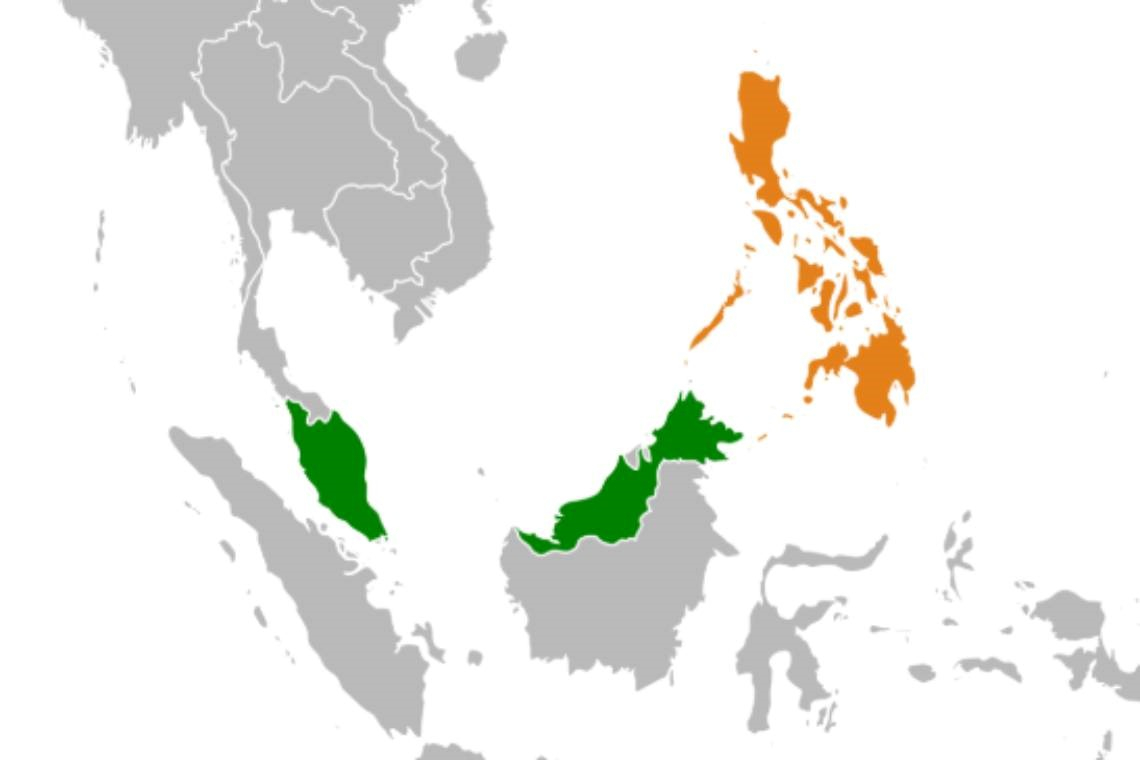
Both Malaysia and the Philippines are involved in maritime disputes. More recently, there has been spillover into the Sabah Dispute despite other shared interests in the South China Sea. Image Source: MuffinWizard, Wikipedia
Penned by Charlie Manalo, the piece was written to counter remarks from Malaysia's former foreign minister, Saifuddin Abdullah, who recently argued that Manila's choice to resurrect and internationalize the South China Sea arbitration has stoked regional friction, dragged in outside powers, and chipped away at ASEAN's ability to handle the dispute on its own terms.
Manalo's own column concedes that Manila and Kuala Lumpur see eye to eye on most South China Sea matters. Disagreements do surface now and then, but they've traditionally centered on Beijing and Manila, not Kuala Lumpur and Manila. Lately, though, friction between the Philippines and Malaysia has taken center stage instead. Manalo's response to Saifuddin practically implies that any Malaysia-Philippines rift over the South China Sea ought to reawaken Manila's old claim to Sabah, a Malaysian state home to more than 3.4 million people.
So which came first, the spark or the fire? Is Kuala Lumpur simply stirring the pot, or reacting to a threat it sees as real?
Here's the truth: the Sabah question, largely dormant and treated as settled since the 1960s, has been dragged back to life by eight private Filipino citizens making outlandish claims. Their push to use European arbitration venues to seize Malaysian assets abroad has done real damage to relations, damage neither government particularly wants. President Marcos’ office has waved the matter away before, calling the arbitration a private dispute among private citizens rather than a matter of state.
“President Marcos’ office has waved the matter away before, calling the arbitration a private dispute among private citizens rather than a matter of state.”
But politics has a way of intruding. With elections approaching, pressure is mounting on the Marcos camp from the Duterte faction, long positioned as champions of Mindanao and Sulu.
Updated headlines for free, straight to your inbox—no noise, just facts.
We collect your email only to send you updates. No third-party access. Ever. Your privacy matters. Read our Privacy Policy for full details.
Unfortunately, part of that platform includes clinging to the Sabah claim, something critics on both sides see as a distraction from the economic and social reforms Sulu, the Bangsamoro region, and the rest of Mindanao actually need. Perhaps as a result, the Marcos government has recently shown more willingness to engage with the Sulu dispute. Department of Foreign Affairs spokesperson Rogelio Villanueva has pointed to Republic Act 5446, still on the books, whose Section 2 states that the law's baseline provisions do not diminish any existing Philippine claim over North Borneo.
Given all this, it's little wonder Malaysians are wary of Western arbitral rulings and the strain they've placed on ASEAN unity, whether on the matter of Sabah or the South China Sea.
So what exactly are the Sulu claimants after? Roughly $15 billion from Malaysia, a figure they calculated unilaterally based on estimates of Sabah's economic output.
The eight individuals, led by Fuad A. Kiram, present themselves as heirs to the old Sulu Sultanate, which once commanded the Sulu and Celebes seas and held loose authority over North Borneo, the territory that now makes up Sabah.
That authority passed to British hands generations ago, in exchange for symbolic yearly payments and an informal alliance meant to counter Spanish colonial rule elsewhere in the Philippines. It is, by any measure, not modern affairs. The Sultanate later lost all governing power under American administration of the Philippines, and when decolonization arrived, the Philippines emerged as a republic, not a restored Sultanate, just as British Malaya became the Malaysian Federation.
“When decolonization arrived, the Philippines emerged as a republic, not a restored Sultanate, just as British Malaya became the Malaysian Federation.”
For a time, the two nations, along with Indonesia, moved forward as fellow post-colonial states. Early friction over North Borneo's status was mostly resolved by the 1960s. Even now, Malaysia and Indonesia are quietly working through unresolved border questions between Sabah and Indonesian Kalimantan, the product of modern surveying rather than old grievances, with both governments focused on protecting residents rather than scoring points.
That is the people-first approach too often missing from this conversation. Manila still refuses to open a consulate in Sabah, leaving the many Filipino and Tausug migrants there without formal support. The likely cause? To open such a consulate would mean recognizing Malaysian sovereignty, something to be apparently avoided at the expense of the significant migrant community there.
And does anyone seriously believe Sabah wants to be reclaimed? Its people chose to join and remain part of Malaysia. Certainly the eight claimants, whose very status as Kiram heirs remains disputed, show no real interest in Sabah's people or its future. What they want is money. Not for Sulu. For themselves.
REFERENCES
Black, I. D. (1971). The political situation in Sabah on the eve of Chartered Company rule. Borneo Research Bulletin, 3(2), 62–65. https://himalaya.socanth.cam.ac.uk
Gita-Carlos, R. A. (2022, August 2). Sultanate heirs Sabah claim ‘private in nature’: Palace. Philippine News Agency. https://www.pna.gov.ph
Jones, T. (2025, December 3). Funder and counsel face conspiracy suit over Sulu affair. Global Arbitration Review. https://globalarbitrationreview.com
KnowSulu. (2025, May 23). Colonial agreements and land grabbing: Do historical treaties matter? https://know-sulu.ph
KnowSulu. (2026, March 16). Philippines’ Sabah claim renewed ahead of Lahad Datu anniversary. https://know-sulu.ph
KnowSulu. (2026, April 15). Sabah wasn't leased: What the 1903 document actually says. https://know-sulu.ph
KnowSulu. (2026, April 24). Weak sovereignty, the Barakat lineage and decolonization: Did Sulu ever control Sabah? https://know-sulu.ph
Lee, S. (2026, May 6). Sabah security agencies expand AI use in ESSZone. The Star. https://www.thestar.com.my
Manalo, C. V. (2026, July 3). Malaysia should be careful about lecturing the Philippines. The Manila Times. https://www.manilatimes.net
Muffin Wizard. (2014, February 2). Malaysia Philippines Locator.svg [Map]. Wikimedia Commons. https://commons.wikimedia.org
Naik, H. J. (2025, November 4). Corruption and statelessness in Sabah: How deportability becomes a commodity. LSE Southeast Asia Centre Blog. http://blogs.lse.ac.uk
Taiming, A. R. (2024, December 17). 6 Filipinos caught smuggling 10,000 litres of petrol into Sabah. New Straits Times. https://www.nst.com.my
The Star. (2026, March 5). Push for Sabah-based Philippine consulate. https://www.thestar.com.my

KnowSulu is your trusted source for verified facts, news, and legal insights about the Sulu region. Committed to integrity, our mission is to empower the people of Sulu by providing accurate, transparent, and reliable information that matters.

