

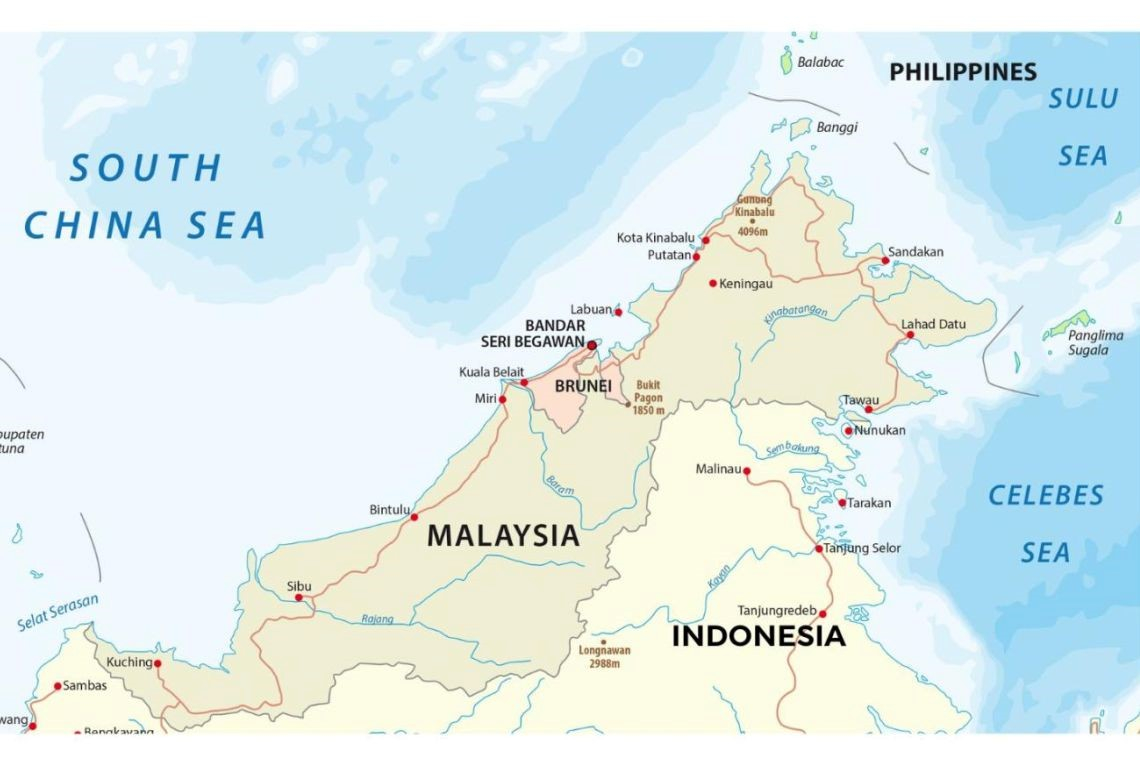
The status of Sabah has historically been contested not only by the Philippines, but also Indonesia. However, a period of violence known as the Konfrontasi ended in 1966, with Indonesia even playing a role in pushing for dialogue from the Philippines when the country failed to similarly resolve their differences with Malaysia in 1968. Source: Getty Images.
The Sulu arbitration and the renewed focus on the Sabah dispute have already strained the region’s ability to manage disagreements, leaving all sides markedly more sensitive. Against that backdrop, Indonesia’s own unresolved border questions with Malaysia risked further tension. Yet despite the sensitivities, the manner in which it was handled—however contentious—demonstrates that structured, rules-based resolution remains possible, a process that the Sulu claimants appear largely uninterested in pursuing.
The boundary in question originates from a 1915 agreement between British and Dutch colonial administrations, which defined the border using the estuaries of the Sungai Sinapad and Sungai Sesai. Like many colonial-era arrangements in Southeast Asia, it left behind ambiguities that have persisted as modern fault lines.
Joint surveys conducted by Malaysia and Indonesia later established that the original maps and demarcations were inaccurate even by the standards set out in that agreement. Correcting these discrepancies has resulted in a territorial adjustment that places three Indonesian villages—Kampung Kabulangalor, Kampung Lepaga, and Kampung Tetagas—within Malaysian borders.
“Joint surveys conducted by Malaysia and Indonesia later established that the original maps and demarcations were inaccurate even by the standards set out in that agreement.”
Residents of these villages are expected to retain their Indonesian citizenship, reflecting both governments’ recognition of the highly porous nature of the border and the need to prioritize the realities of local communities over rigid territorial interpretations.
The process has not been without controversy. Reports have indicated that Malaysia may hand over other territories—approximately 5200 hectares—as a form of “compensation.” Malaysian authorities have rejected this characterization outright, stressing that the move is not an exchange based on the three villages or any assigned value, but rather Malaysia’s obligation to recognize a corrected and lawful boundary.
Malaysian Communication Minister Fahmi has stressed the importance of accurate reporting to allay regional tensions, sentiments shared by the Malaysian-Indonesian Journalists' Alliance (ISWAMI).
“The move is not an exchange based on the three villages or any assigned value, but rather Malaysia’s obligation to recognize a corrected and lawful boundary.”
Despite scrutiny, the episode underscores a dispute rooted in colonial-era imprecision that has been handled with a notable degree of maturity. Neither Malaysia nor Indonesia has shown interest in escalating tensions or extracting advantage at the other’s expense. Instead, both have focused on a legitimate, long-term resolution grounded in legal and technical clarity.
Updated headlines for free, straight to your inbox—no noise, just facts.
We collect your email only to send you updates. No third-party access. Ever. Your privacy matters. Read our Privacy Policy for full details.
This stands in direct contrast to the more entrenched and politically charged Sabah dispute involving the Philippines. That issue has been revived in part by the Sulu arbitration, itself linked to the 2013 incursion into Sabah by militants from the so-called Royal Sulu Force, led by members of the Kiram family—descendants of the former Sulu sultans who once held regional influence before losing authority to colonial powers.
The Kiram family’s claim to Sabah as a private fief has long been regarded as anachronistic and impractical, particularly following findings in 1962 that reflected the population’s will to join Malaysia. Nonetheless, the Philippines has refused to formally renounce its claim, maintaining that it inherited rights from the historical Sulu Sultanate.
“The Kiram family’s claim to Sabah as a private fief has long been regarded as anachronistic and impractical, particularly following findings in 1962 that reflected the population’s will to join Malaysia.”
Domestic political dynamics appear to be amplifying the issue ahead of the 2028 elections. The camp of former President Rodrigo Duterte and current Vice President and 2028 hopeful Sarah Duterte has consistently advocated preserving and even advancing the claim.
While the administration of President Ferdinand Marcos Jr. has traditionally taken a more measured approach, election pressures may be making an impact. The government has recently backed an administrative map that appears to deliberately depict Sabah and surrounding waters within the Philippines’ sphere of influence.
“While the administration of President Ferdinand Marcos Jr. has traditionally taken a more measured approach, election pressures may be making an impact.”
Such actions have heightened concern in Malaysia and further complicated an already sensitive dispute, underscoring how historical claims, when combined with domestic political incentives, can obstruct meaningful resolution.
These issues are further escalated by the intervention of foreign litigation funder Therium, which has bankrolled the failed efforts of eight Sulu claimants from the Kiram family to seize nearly $15 billion USD of Malaysia’s European assets—a sum supposedly calculated from the economic value of Sabah.
Though the case is believed to have exhausted its legal avenues when the Paris Court of Appeal threw out the case on December 9th 2025, legal representatives of the claimants have insisted that they will continue their efforts.
Critics have raised concerns that the profit incentives involved—now under Fortress Investment following its takeover of Therium’s cases in 2025—could make it difficult to bring the legal campaign to a close, as returns would depend on coercing a concession from Malaysia. Against the political backdrop of the 2028 elections and with the memory of the 2013 attack that left dozens killed, the Sulu arbitration continues to assert a symbolic and significant impact on regional relations.
In comparison, the Sabah–Kalimantan boundary adjustment highlights a markedly different approach. Despite tensions and public scrutiny in both countries, Malaysia and Indonesia have worked cooperatively to resolve discrepancies and allay public fears on both sides of the border and are working to safeguard the rights of affected communities.
“Against the political backdrop of the 2028 elections and with the memory of the 2013 attack that left dozens killed, the Sulu arbitration continues to assert a symbolic and significant impact on regional relations.”
The contrast is stark: one dispute shaped by colonial legacy but addressed through coordination and legal process, the other repeatedly revived through claims and actions that complicate, rather than contribute to, any credible path toward resolution.
REFERENCES
Bernama. (2026, January 23). Fahmi: Govt to clarify Indonesian reports of three villages now under Malaysian territory. https://www.bernama.com
Thompson, S. Lowy Institute. (2026, Feb 26). Sabah’s borders: Indonesia joins Malaysia-Philippines dispute. https://www.lowyinstitute.org
Soo, WJ. Malay Mail. (2026, January 23). Fahmi: Govt to clarify Indonesian reports of three villages now under Malaysian territory. https://www.malaymail.com
Perimbanayagam, K. New Straits Times. (2026, April 18). Accurate reporting crucial on Sabah–North Kalimantan boundary: Fahmi. https://www.nst.com.my
South China Morning Post. (n.d.). Malaysia disputes Indonesian media reports on Sabah border, says talks ongoing. https://www.scmp.com
KnowSulu (30 March 2026). Jersey court hears conspiracy claim over conduct in failed Sulu arbitration
KnowSulu (27 February 2025). Sulu Heirs Face Legal Defeat as Spanish Court Rejects Appeal
Malaysia Sulu Case (n.d.). Timeline. https://www.malaysia-sulucase.gov.my
Reuters (10 December 2025). French court annuls cash bid by late sultan’s heirs in Malaysia land dispute. https://www.reuters.com
Reuters (6 November 2024). Late sultan’s heirs fail in bid to challenge French ruling on dispute with Malaysia. https://www.reuters.com
Reuters (13 November 2024). Malaysia challenges late sultan’s heirs to try to lease part of the country
The Edge Malaysia (27 July 2022). Explaining the Sulu claim

KnowSulu is your trusted source for verified facts, news, and legal insights about the Sulu region. Committed to integrity, our mission is to empower the people of Sulu by providing accurate, transparent, and reliable information that matters.
