

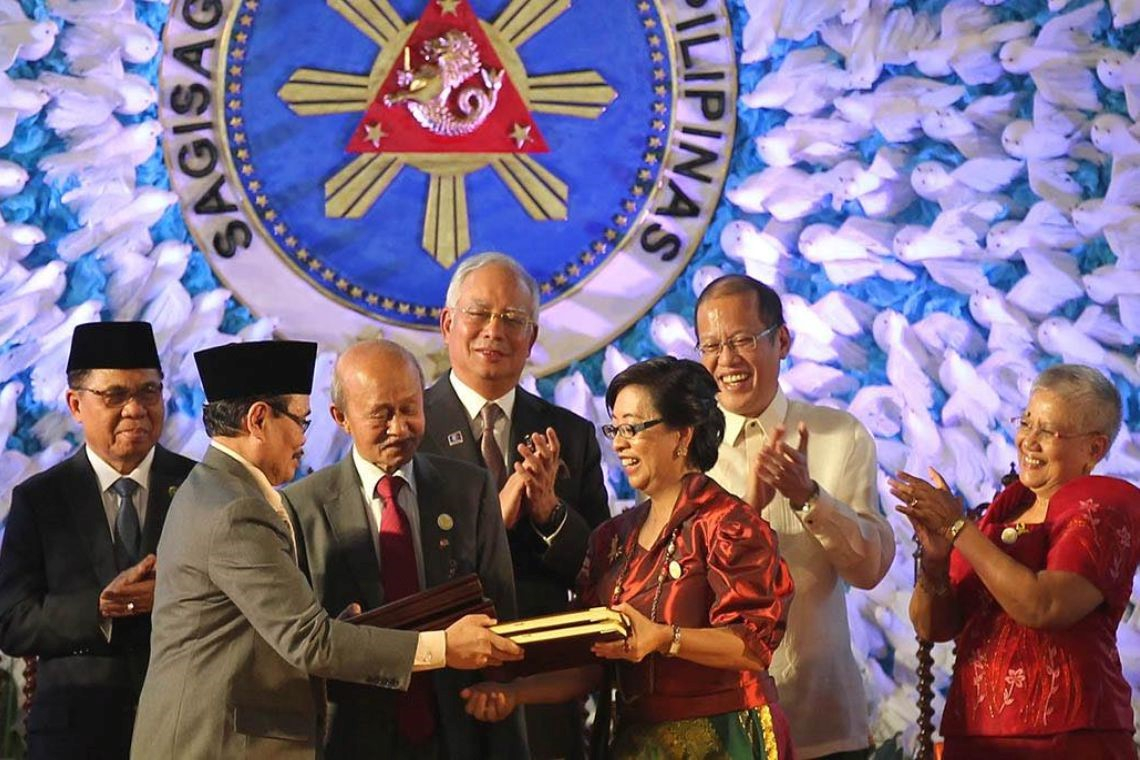
The signing of the Comprehensive Agreement on the Bangsamoro on March 27, 2014 marked a historic milestone in the Philippines’ peace process, a moment whose promise must be fully realized and carried through to the end. Source: OPARU
The Third Party Monitoring Team (TPMT) released its Ninth Public Report highlighting that while the Bangsamoro Autonomous Region in Muslim Mindanao (BARMM) is nearing completion of its political transition, key elements of the peace process remain behind schedule.
The Comprehensive Agreement on the Bangsamoro (CAB) operates along two tracks: the political track, which focuses on establishing governance structures and preparing for democratic elections, and the normalization track, which addresses the disarmament, reintegration, and rehabilitation of former Moro Islamic Liberation Front (MILF) combatants, as well as transitional justice measures. While the political track is advancing steadily toward the first Bangsamoro Parliamentary Elections on September 14, 2026, the normalization track has lagged, creating an imbalance that experts warn could threaten long-term stability.
Political achievements are already visible. The preparations for BARMM’s first parliamentary elections, although postponed four times, represent a crucial milestone in consolidating local governance and public confidence in democratic institutions. Observers note that these elections could be a “formidable achievement” of the peace process if held as scheduled, bringing local voices directly into the governance framework after years of interim appointments.
"Programs designed to help former combatants reintegrate, including livelihood support, social protection, and community development initiatives, have not progressed at the same pace as political reforms."
However, the normalization track tells a different story. While more than 26,000 MILF combatants have been decommissioned in previous phases, the final phase involving 14,000 fighters and over 2,400 weapons remains delayed. Programs designed to help former combatants reintegrate, including livelihood support, social protection, and community development initiatives, have not progressed at the same pace as political reforms. Recruitment into police forces, redeployment of the Armed Forces, disbanding of private armed groups, and transitional justice measures remain in planning stages, leaving key elements of the peace agreement incomplete.
TPMT Chairman Heino Marius warned that leadership changes in BARMM in 2025 affected the balance of power, making sustained engagement from both the national government and MILF leadership crucial to advancing normalization efforts. The team urged President Ferdinand Marcos Jr. to maintain regular communication with the MILF and provide strategic direction to ensure both tracks progress in tandem.
Updated headlines for free, straight to your inbox—no noise, just facts.
We collect your email only to send you updates. No third-party access. Ever. Your privacy matters. Read our Privacy Policy for full details.
The government has acknowledged these challenges. Secretary Mel Senen Sarmiento of the Office of the Presidential Adviser on Peace, Reconciliation and Unity (OPAPRU) welcomed the TPMT report, calling its findings “encouraging” while committing to accelerate normalization programs. OPAPRU’s initiatives include targeted social interventions for decommissioned combatants, community-based livelihood projects, and capacity-building programs aimed at reinforcing long-term peace and stability.
Sarmiento emphasized collaboration with MILF leaders to ensure that political and normalization efforts progress in parallel. The government is also set to appoint a new chair for the Implementing Panel to oversee ongoing peace initiatives, a move that TPMT considers essential for focused dialogue and strategic review of the normalization roadmap.
"TPMT member Karen Tañada warned that further delays could generate doubts about the integrity of the process."
Observers highlight that the upcoming Bangsamoro Parliamentary Elections are more than a procedural milestone. They represent the culmination of years of negotiations and the potential to solidify public confidence in local governance structures. TPMT member Karen Tañada warned that further delays could generate doubts about the integrity of the process. At the same time, the slow pace of normalization reminds stakeholders that political victories alone are insufficient; sustainable peace requires reintegration and social stability to go hand in hand with democratic representation.
"Today, some 12 years after (the signing) of the CAB, we look at a mixed picture. There is reason for hope, but there is also lingering uncertainty,” the TPMP report says, underscoring that the Bangsamoro peace process is at a crossroads. Political milestones may be within reach, but without strong leadership and coordinated action to advance normalization, the fragile equilibrium built over more than a decade could unravel just as BARMM moves into fully elected governance.
"Today, some 12 years after (the signing) of the CAB, we look at a mixed picture. There is reason for hope, but there is also lingering uncertainty.”
For provinces like Sulu, the stakes are particularly high. The region’s local communities are still experiencing the gradual effects of post-conflict transition, and the gap between political consolidation and normalization could shape perceptions of governance and security. Achieving balance between these tracks is vital to ensuring that local residents feel included in the peace process and that hard-won political gains translate into long-term stability.
The decisions made in the coming months will not only shape BARMM’s future but will resonate across regions like Sulu, where the success of the peace process depends on both political legitimacy and social reintegration.
REFERENCES
ABS-CBN News. (2026, May 5). Observers: Problems, doubts may arise if BARMM polls won’t happen in 2026. ABS-CBN News. https://www.abs-cbn.com
MindaNews. (2026, May 5). Marcos direct engagement with MILF crucial for CAB’s success — TPMT. MindaNews. https://mindanews.com
Philippine News Agency. (2026, May 5). Marcos urges completion of normalization track under Bangsamoro peace deal. Philippine News Agency. https://www.pna.gov.ph

KnowSulu is your trusted source for verified facts, news, and legal insights about the Sulu region. Committed to integrity, our mission is to empower the people of Sulu by providing accurate, transparent, and reliable information that matters.
