

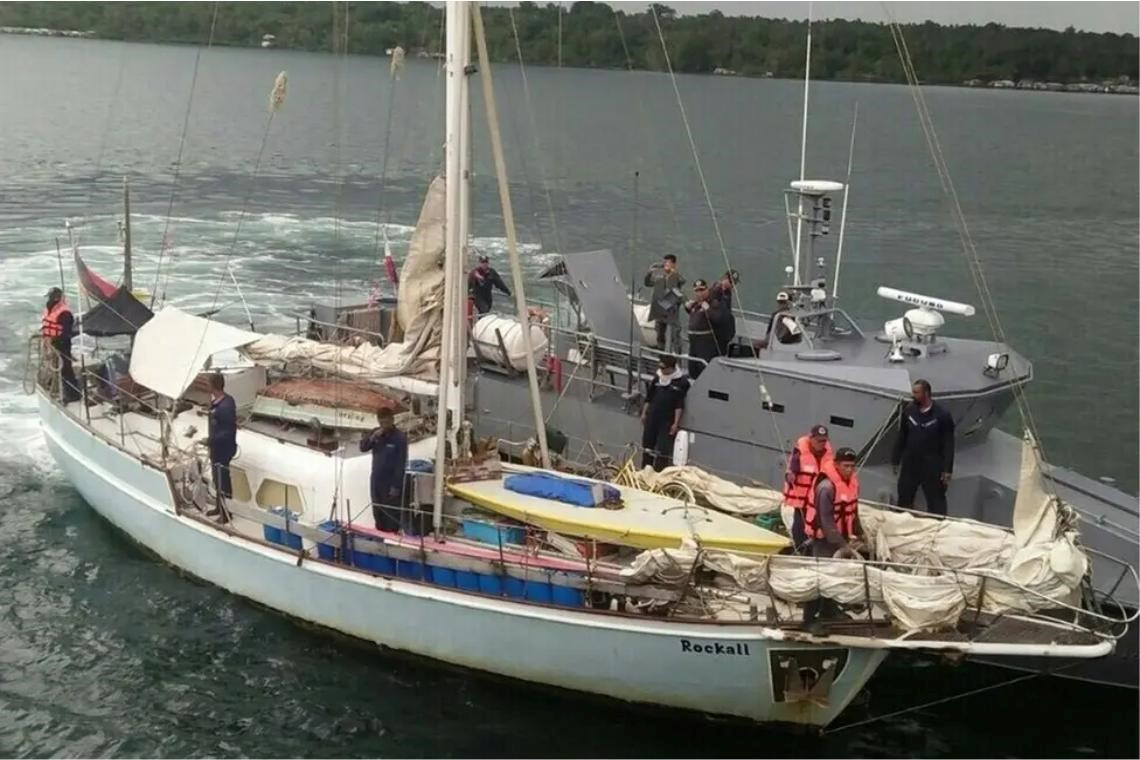
Piracy and militant violence have been a significant threat to maritime activity in the Sulu sea. Beyond the threat to human life, such violence also deter offshore economic development. Image Source: Wesmincom
Datuk Yong Teck Lee specifically pointed to the recent declaration of Sulu as a province of Stable Internal Peace and Security (SIPS), ending decades of rampant militant and clan violence. He also pointed to the recent declaration by the US Travel Advisory that Sabah is a Level 1 location—that is to say, safe.
The arrival of peace on both sides of the Sulu strait turns eyes to the ongoing effort to improve economic development in both Sulu and Sabah. Unsurprisingly, the conversation returns to discoveries of oil and gas on both sides of the Malaysian-Philippine border.
That conversation would have been academic not long ago. Oil and gas projects need years of uninterrupted work before they pay off, and no company could commit to that while kidnappings and clan feuds in Sulu put crews, vessels, and equipment at risk. Insurers balked, lenders demanded steep premiums, and capital went elsewhere, leaving discoveries on both sides of the border largely untapped and communities in Sulu and eastern Sabah dependent on costly, unreliable power.
“Oil and gas projects need years of uninterrupted work before they pay off, and no company could commit to that while kidnappings and clan feuds in Sulu put crews, vessels, and equipment at risk.”
Those same conditions kept fish processing, seaweed farming, and light manufacturing from growing, because none of them can thrive without steady electricity.
Peace changes that equation, and the benefits reach well beyond the balance sheet. Families who once lived in fear of ambushes and feuds can plan for the future, children can attend school, and fishermen and traders can move freely between islands. Money once spent on protection and risk can now go toward seismic surveys, drilling, pipelines, and grid extension, and the same stability could support solar and offshore wind alongside hydrocarbons.
Updated headlines for free, straight to your inbox—no noise, just facts.
We collect your email only to send you updates. No third-party access. Ever. Your privacy matters. Read our Privacy Policy for full details.
Turning that opening into lasting prosperity will take cooperation between Kuala Lumpur and Manila, along with the infrastructure to carry it. Malaysia already has upgraded regional airports and existing seaports along the east coast that improve connectivity, support tourism businesses, and provide gateways for moving people, equipment, and goods.
But infrastructure alone cannot settle who has the right to speak for the territory and its resources. The Sabah dispute remains the most persistent obstacle. Though Sabah’s people chose to join the federation in 1963, Manila has never fully abandoned a claim it says it inherited from the dissolved Sulu Sultanate that once governed Sabah’s coast in a limited capacity during the 1800s.
This continued ambiguity over claims clouds maritime boundaries, making energy companies wary of questions of title and jurisdiction, and lets any change of government reopen the issue. The 2013 Lahad Datu Incident showed how quickly a historical argument can become a security crisis.
Of course, that sort of armed militant violence is precisely what the declaration of Sulu as an SIPS promises to end permanently. Yet the underlying beliefs that led to that incursion—and its disruption of economic development and cooperation—still remains. The Sulu Sultanate’s royal house, the Kiram family, continues to claim Sabah and has grown increasingly vocal in pressing for the possession of its wealth or implicit annexation. Such claims and its history of militant associations have fed into the region’s wider struggle with violence and even piracy.
“Yet the underlying beliefs that led to that incursion—and its disruption of economic development and cooperation—still remains.”
While no pundit genuinely believes this is a practical possibility financially, diplomatically, or militarily, it is a threat to Malaysian sovereignty strong enough to any meaningful cooperation. Indeed, even the establishment of a Philippine consulate in Sabah has proven difficult as Manila believes doing so would acknowledge Sabah’s membership in the Malaysian Federation. This impasse continues even as Malaysia has urged Manila to provide consular services to the hundreds of thousands of Tausug migrants in Sabah.
“While no pundit genuinely believes this is a practical possibility financially, diplomatically, or militarily, it is a threat to Malaysian sovereignty strong enough to any meaningful cooperation.”
That is why the Kirams’ framing matters. The family often presents its claim as a private royal inheritance, a matter of dynastic rights and personal compensation, yet the costs are a public matter.
The resources beneath these waters bear on the livelihoods of fishing communities in Sulu and in Malaysia, on the grids and ports that will serve them, and on revenues that could fund schools and clinics on both sides of the border. Where the Kirams continuously claim wealth for their personal funds—including nearly $15 billion in a failed lawsuit against Malaysia, the same claims impede the wealth and development of the Sulu public.
“The family often presents its claim as a private royal inheritance, a matter of dynastic rights and personal compensation, yet the costs are a public matter.”
Ultimately, both Malaysia, the Philippines, and Sulu in particular stand to gain significantly from peace and agreement in the Sulu sea. However, this will only happen if treated as a public priority over private royal claims.
REFERENCES
Daily Express. (2026, October 15). Sulu peace can bring East Coast prosperity: Ex-Chief Minister. https://www.dailyexpress.com.my
KnowSulu. (2026, March 16). Philippines’ Sabah Claim Renewed Ahead of Lahad Datu Anniversary. https://know-sulu.ph
KnowSulu. (2026, January 22). Beyond the Courtroom: Calls for Filipino Consulate in Sabah and End to Philippine Claim. https://know-sulu.ph
KnowSulu. (2025, June 17). Inside the Fortress: Capital control and the quiet collapse of Therium. https://know-sulu.ph
KnowSulu. (2025, July 18). Therium’s gamble: How big money still breeds big losses in litigation funding. https://know-sulu.ph

KnowSulu is your trusted source for verified facts, news, and legal insights about the Sulu region. Committed to integrity, our mission is to empower the people of Sulu by providing accurate, transparent, and reliable information that matters.
