

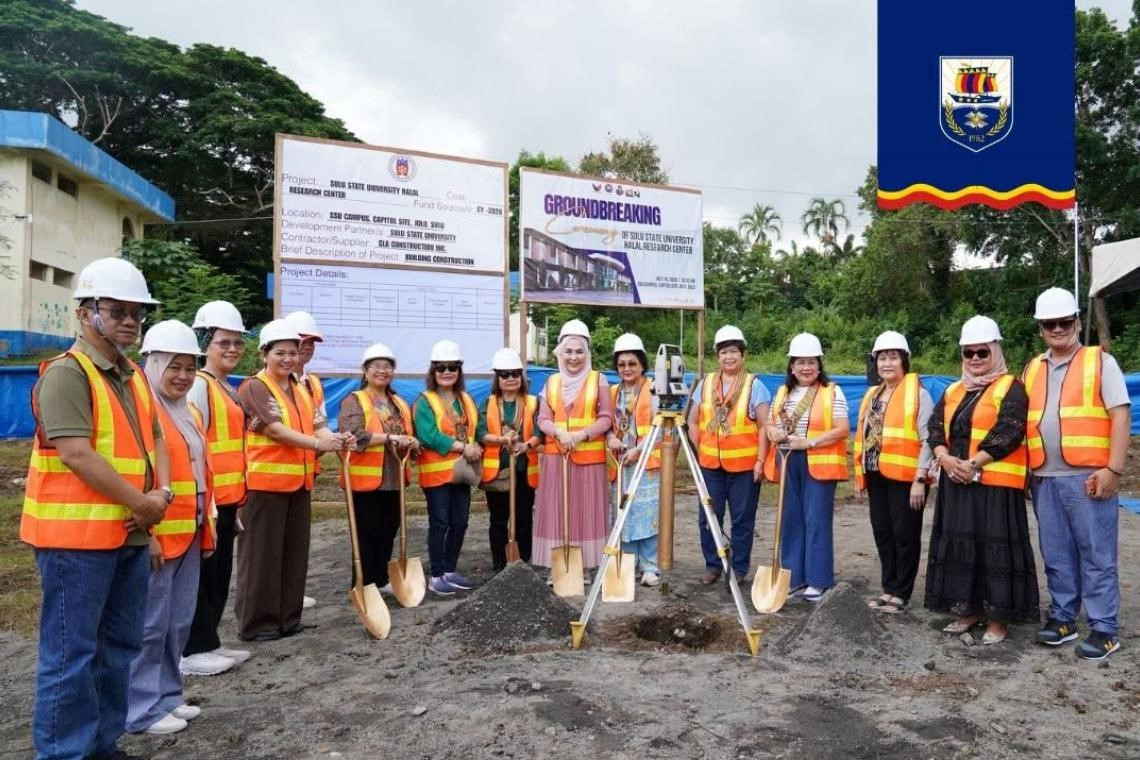
University officials, guests, project partners, and stakeholders take part in the groundbreaking ceremony for Sulu State University’s Halal Research Center on July 19, 2026. Image Source: Sulu State University.
As the Philippines develops its Halal industry, SSU is positioning education as part of the infrastructure needed to support this growth. The university identifies itself as a pioneering Halal university and states that its mission is to develop Halal philosophies through academic and research innovations, and transformative community engagement.
This direction reflects a wider national framework. Republic Act No. 10817 established the Philippine Halal Export Development and Promotion Program, covering Halal products, processes and services while emphasizing research, product development, quality assurance, value-adding, and international competitiveness. The law also created a national Halal Board and established responsibilities for government agencies in developing Philippine National Standards for Halal.
For SSU, the preparation of future workers is therefore not limited to one course or one industry. Its academic offerings include agriculture, business administration, hospitality management, tourism management, Islamic Studies, engineering, information technology and other professional fields. Several of these areas can contribute to the wider Halal economy, from food production and processing to hospitality, services, finance and entrepreneurship.
Updated headlines for free, straight to your inbox—no noise, just facts.
We collect your email only to send you updates. No third-party access. Ever. Your privacy matters. Read our Privacy Policy for full details.
The university's approach begins with the way Halal is incorporated into its institutional direction. Its stated strategic goal is to produce graduates equipped with competencies shaped by Halal principles for professional practice and the world of work. The College of Arts and Sciences offers Islamic Studies with a major in Political Economy. According to the university, the program combines Islamic values with modern economic frameworks and prepares students for areas including policy development and regional integration. The program provides students with an academic pathway for understanding economic activity through both Islamic principles and contemporary economic systems.
“The program provides students with an academic pathway for understanding economic activity through both Islamic principles and contemporary economic systems.”
Other programs provide a more practical connection to sectors where Halal standards can become relevant. The School of Agriculture offers Bachelor of Science programs in Animal Science and Crop Science. The curriculum includes livestock production, animal nutrition, breeding, and herd health management, as well as agronomy, plant breeding, pest management and soil science. Agriculture is particularly relevant to the development of Halal supply chains because Halal production can involve requirements extending through different stages of production and processing. Under Philippine law, national Halal standards cover primary and post-harvest foods, processed and prepackaged foods, as well as other products and services.
SSU is also developing institutional capacity beyond classroom instruction. In July 2026, the university held the groundbreaking ceremony for a Halal Research Center. Once completed, the facility is intended to support Halal research, innovation, product development and Halal certification initiatives. The center is scheduled to operate under the university's Office of the Vice President for Research, Extension, Innovation and Production. Construction began in July 2026 and is targeted for completion in September 2027. The center is expected to strengthen the university’s capacity for research, innovation, product development and Halal-related services. It also places research and product development alongside education as part of the university's Halal strategy. Professional development is already part of that effort.
“SSU is also developing institutional capacity beyond classroom instruction.”
In June 2026, SSU reported that Associate Professor Frissida Asid-Daud completed the Philippine Halal Industry and Islamic Banking and Finance Program organized by the Asian Institute of Management's School of Executive Education and Lifelong Learning. The hybrid program ran from March to June 2026 and covered areas connected to the Halal industry and Islamic banking and finance. The university has also incorporated Halal into its longer-term research planning. A June 2026 Futures Research Agenda Workshop brought together faculty members, researchers, and stakeholders to develop research priorities aligned with Halal and emerging societal needs.
The preparation taking place at SSU comes as the Philippines continues to develop its wider Halal ecosystem. The Bangko Sentral ng Pilipinas supports the development of Islamic banking and finance in the country as part of its financial inclusion efforts. The Halal economy consequently extends beyond food. It can involve agriculture, manufacturing, tourism, hospitality, financial services, certification, research and other professional activities. Together, these fields form part of the academic areas relevant to the development of the Halal economy.
“The Bangko Sentral ng Pilipinas supports the development of Islamic banking and finance in the country as part of its financial inclusion efforts.”
SSU's strategy also connects education with local development. Its stated mission emphasizes research, innovation and community engagement, while its strategic framework identifies academic competitiveness, research and knowledge transfer as institutional priorities. The planned Halal Research Center could further connect these areas by providing space for research and product development while supporting future certification initiatives. Combined with academic programs that already cover agriculture, business, tourism and Islamic economic studies, the university is developing several pathways through which students can gain knowledge relevant to a Halal-oriented economy.
The approach remains a work in progress. The Halal Research Center is still under construction, and the university is focused on building the institutional capacity needed for the coming years. Over time, however, this investment could create new opportunities for Sulu’s communities by giving students skills that can be applied in Halal-related businesses, food production, research and other professional fields. For local producers and entrepreneurs, stronger Halal expertise could also help open pathways to markets where certification and knowledge of Halal standards are important. These outcomes will depend on how the university’s programs, research and partnerships develop, but the potential impact extends beyond the campus. By preparing graduates with relevant skills and connecting education to emerging economic opportunities, SSU could contribute to creating jobs, supporting local enterprise and strengthening economic opportunities for people in Sulu.
REFERENCE
Lawphil. (2016, May 16). Republic Act No. 10817. Lawphil. https://lawphil.net
Sulu State University - Facebook. (2026, July 18). Sulu State University holds groundbreaking ceremony for the Halal Research Center. Sulu State University - Facebook. https://web.facebook.com
Sulu State University - Facebook. (2026, June 28). SuluSU congratulates Assoc. Prof. Frissida Asid-Daud, MAN, Ph.D. Sulu State University - Facebook. https://web.facebook.com
Bangko Sentral ng Pilipinas. (2026). Islamic Banking. Bangko Sentral ng Pilipinas. https://www.bsp.gov.ph

KnowSulu is your trusted source for verified facts, news, and legal insights about the Sulu region. Committed to integrity, our mission is to empower the people of Sulu by providing accurate, transparent, and reliable information that matters.
