

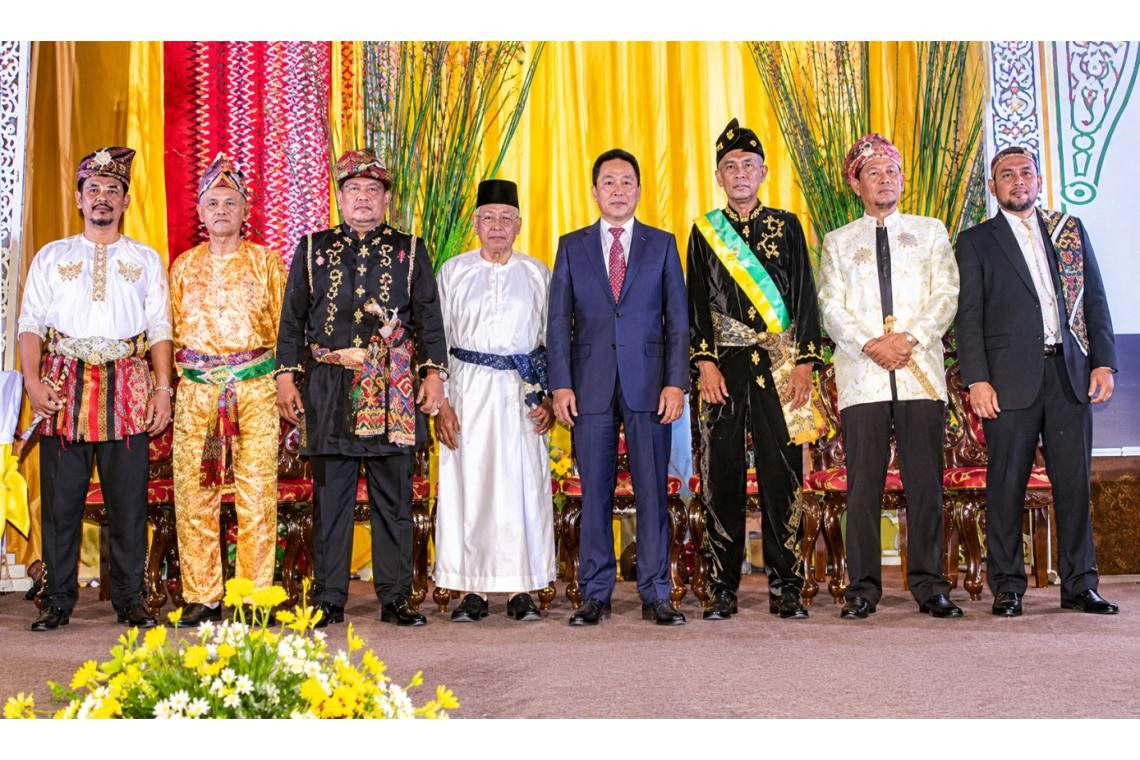
The five Sulu royal claimants who signed the Unity Covenant pose with Sulu Governor Totoh Tan, Vice Governor Sakur Tan and Grand Mufti Abdulbaqi Abubakar during the April 2016 ceremony in Zamboanga City. Image Source: Pressreader.
The signing of the Covenant of Unity on April 8, 2016, marked an attempt to bring together five competing royal claimants and establish a common political voice for the Sulu Sultanate. The initiative came at a significant moment, as Rodrigo Duterte was preparing to take office with promises of federalism and renewed attention to the Philippines' historical claim over Sabah. A decade later, developments involving his daughter, Sara Duterte, and Muedzul-Lail Tan Kiram raise questions about whether the political position established during that period has continued.
The agreement created the Royal Council of the Sulu Sultanate, bringing together members of different royal branches. Its formation raised the possibility of a coordinated position on issues connected to the Sultanate’s historical role and political interests. However, the council’s creation did not resolve the competing claims to the throne, nor did it establish an official partnership with the incoming Philippine administration.
On April 8, 2016, five heirs to the Sulu Sultanate signed the Covenant of Unity, establishing the Royal Council of the Sulu Sultanate. The signatories were Ibrahim Q. Bahjin, Muedzul-Lail Tan Kiram, Mohammad Venizar Julkarnain Jainal Abirin, Muizuddin Jainal Abirin Bahjin and Phugdalun Kiram II. The agreement represented a commitment to bring together different branches of the royal lineage and strengthen unity among the claimants. The initiative addressed a longstanding difficulty within the royal family. Several individuals had asserted claims to the Sultanate, making it difficult to present a single position on political and historical matters. The council offered a structure through which the five signatories could discuss shared concerns and work toward collective decisions.
“The council offered a structure through which the five signatories could discuss shared concerns and work toward collective decisions.”
The five claimants did not all belong to the same immediate family branch. Their participation reflected connections to different lines of descent within the wider royal lineage. The agreement, therefore, represented an effort to establish cooperation across competing claims rather than simply consolidate the position of one individual. The council's formation also reflected the continuing importance of traditional royal authority in Sulu. The Sultanate has a long history of political and cultural influence in the southern Philippines, although its present-day status differs from that of a recognized state institution. The Philippine government does not recognize a reigning Sultanate as a sovereign political authority. The council's initiative was consequently a royal and political undertaking, not the creation of a new government body.
Updated headlines for free, straight to your inbox—no noise, just facts.
We collect your email only to send you updates. No third-party access. Ever. Your privacy matters. Read our Privacy Policy for full details.
The council's first major political discussions focused on Sabah and federalism. Both issues were relevant to the historical position of the Sultanate, although they involved different political questions.
“The council's first major political discussions focused on Sabah and federalism.”
Sabah is administered by Malaysia and has been part of the Malaysian federation since 1963. The Philippines has maintained a historical claim to the territory based on its connection with the former Sultanate of Sulu. The royal family's historical position and the Philippine government's territorial claim are related, but they are not identical. The former concerns the Sultanate's historical rights and legacy, while the latter is a matter of state policy and international relations. The Sabah issue gained renewed attention around Duterte's election. After winning the May 9 vote and before taking office, he stated that he intended to pursue the Philippine claim through peaceful means. His position gave the issue a place in the national political conversation just as the Royal Council was developing its own position.
Federalism was another major part of Duterte's political agenda. The proposed shift toward a more decentralized system of government attracted attention in Mindanao, where questions of regional autonomy, political representation and historical grievances had shaped decades of debate. For the council, federalism offered an opportunity to discuss the place of the Sultanate and its historical institutions in a possible restructuring of political authority.
Although the council's subsequent institutional activities remain unclear, the continued involvement of Muedzul-Lail Tan Kiram in discussions surrounding Sabah suggests that the political issue raised in 2016 has not disappeared.
The Royal Council's activities became more visible in late May 2016. Its Executive Board held its fourth meeting at the Astoria Hotel in Zamboanga City on May 28 and 29. Discussions covered organizational matters as well as the council's positions on Sabah and federalism. Mehol Sadain, the council's interim media bureau head and legal counsel, said the decisions reached by the Executive Board would be submitted to the five claimants for review and final approval before public release. He also indicated that the council expected to finalize its position after a meeting planned for June 4 or 5 in Jolo, Sulu. The announcement connected the council's work directly to the political priorities of the incoming Duterte administration. Sadain described Sabah and federalism as issues discussed in line with the new president's priorities. The statement showed that the council intended to place its views within the wider national debate.
“The announcement connected the council's work directly to the political priorities of the incoming Duterte administration.”
However, available reports confirm only that the meeting was planned. They do not establish whether it took place, whether the council adopted a final resolution, or whether its recommendations were formally submitted to Duterte or his representatives. The subsequent history of the Sabah claim nevertheless raises questions about whether the political objectives discussed in 2016 continued beyond the council's initial activities. Muedzul-Lail Tan Kiram's later public engagement with Sara Duterte provides a possible link between the original initiative and present-day political discussions.
The unanswered questions now extend beyond the council's original activities. The annulment of the $14.92 billion arbitration award in Paris in December 2025 and the continuing legal proceedings connected to the Sabah dispute in Jersey show that the wider claim has not entirely disappeared from international legal discussions. At the same time, Muedzul-Lail Tan Kiram's public contacts with Sara Duterte raise questions about the political relationships surrounding the issue.
The Covenant of Unity brought five royal claimants together around Sabah and federalism in 2016, during Rodrigo Duterte's rise to the presidency. Ten years later, the legal setbacks have not necessarily ended the political ambitions associated with the claim. Whether Muedzul's engagement with Sara Duterte represents a continuation of the original agenda or a separate political development remains unclear. The question is whether the position established by the five claimants in 2016 is still being pursued through today's political relationships.
REFERENCES
Taylor & Francis Online. (2024, March 18). Dressing up the monarch: Authority and its representation in the Sulu sultanate royal tradition (19th–21st century). Taylor & Francis Online. https://www.tandfonline.com
RSIS. (2016, July 14). Malaysia-Philippines ties under Duterte: Prospects and challenges. RSIS. https://rsis.edu.sg
MindaNews. (2016, May 30). Royal Council of the Sulu Sultanate to present stand on Sabah and Federalism soon. MindaNews. https://mindanews.com

KnowSulu is your trusted source for verified facts, news, and legal insights about the Sulu region. Committed to integrity, our mission is to empower the people of Sulu by providing accurate, transparent, and reliable information that matters.
