

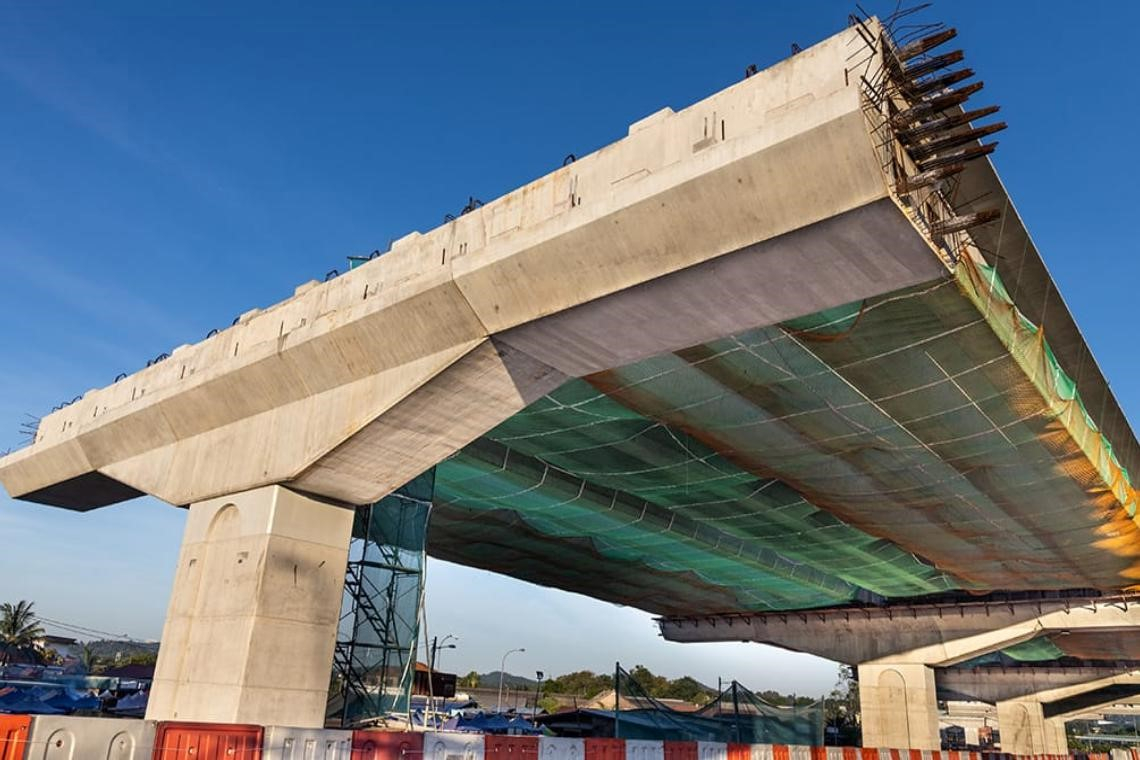
Infrastructure development and upgrades are much needed in the Philippines, particularly the south and on islands like Sulu. Growing stability and peace in these regions present new opportunities for investment in these needs. Image Source: AsiaInsiders
While Sabah has considerable natural resources, integrating it into the Philippines would create a substantial new financial responsibility for our country when it is already struggling to fund development across our territory.
The question is not simply whether the Philippines could afford Sabah, but whether it should take on another major development obligation when many of its existing provinces still lack adequate infrastructure, healthcare, electricity and economic opportunities.
Sabah currently receives substantial financial support from the Malaysian federal government. According to Prime Minister Anwar Ibrahim's parliamentary statement in October 2025, federal expenditure in Sabah reached approximately RM17 billion annually for 2025 and 2026. This includes spending on federal government agencies, fuel subsidies, state grants and development projects. Federal expenditure had previously been approximately RM13 billion in 2022 and RM14 billion in 2023 and 2024. For 2026, Malaysia subsequently announced an allocation of approximately RM17.5 billion.
Much of it pays for federal services, subsidies, infrastructure and government operations within the state, illustrating the financial scale of maintaining Sabah's existing standard of public services and continuing its development.
Malaysia also collects approximately RM10 billion annually in federal revenue from Sabah, meaning federal expenditure exceeds the revenue collected there.
This is not something Manila should even contemplate matching given our existing needs.
RM17.5 billion translates to approximately ₱273.4 billion. To put this into perspective, the Philippines' enacted 2026 national budget is ₱6.793 trillion. Matching Malaysia's current gross federal spending in Sabah would therefore consume approximately 4% of the entire Philippine national budget on top of its current commitments.
This is a considerable commitment for a country with extensive domestic development needs. Furthermore, the Philippines would have to establish its own tax administration, public-service arrangements and intergovernmental funding mechanisms, all of which will be expensive.
“Matching Malaysia's current gross federal spending in Sabah would therefore consume approximately 4% of the entire Philippine national budget.”
Although Sabah has its own revenue, it currently takes in more than it contributes to Malaysia’s federal budget. Even if the Philippines somehow annexed Sabah, this would likely continue. That’s less money for Sulu and other provinces at a time when we need it most.
The only way to profit from annexation would be to starve Sabah of support it needs, something tantamount to colonial extraction, and something the Philippines and Sulu should not contemplate.
Updated headlines for free, straight to your inbox—no noise, just facts.
We collect your email only to send you updates. No third-party access. Ever. Your privacy matters. Read our Privacy Policy for full details.
The Philippines already has provinces that urgently need the same investment. Sulu, Basilan and Tawi-Tawi, for example, face persistent poverty, geographical isolation, inadequate transport infrastructure and difficulties delivering public services across dispersed island communities.
The Philippine Statistics Authority recorded a 33.7% poverty incidence among families in Basilan in 2023. Tawi-Tawi also has numerous municipalities with substantial poverty levels.
Meanwhile, communities across Sulu continue to require investment in roads, schools, healthcare and economic opportunities.
An annual allocation of ₱273.4 billion could instead support hospitals, rural electrification, inter-island transport, agricultural modernisation, schools and infrastructure throughout these underserved provinces.
“The only way to profit from annexation would be to starve Sabah of support it needs, something tantamount to colonial extraction, and something the Philippines and Sulu should not contemplate.”
It could also help improve conditions in Eastern Samar, Zamboanga del Norte and other economically disadvantaged areas. These are existing Filipino communities whose development is already the responsibility of the national government.
The financial circumstances of the Philippine government are another major concern. The Department of Budget and Management's 2026 fiscal programme projects government revenues of approximately ₱4.81 trillion against disbursements of ₱6.47 trillion, producing a projected national government deficit of approximately ₱1.66 trillion, equivalent to 5.4% of GDP.
In other words, the government is already spending considerably more than it collects. Financing an additional Sabah-sized expenditure commitment would potentially require higher taxation, additional borrowing or cuts to other spending priorities. All three options carry economic and political consequences.
Ultimately, annexing Sabah would place an additional financial burden on a Philippines that has yet to adequately develop many of its own provinces. Even before considering the costs of long-term administration and development, any attempt to seize Sabah would entail enormous military, diplomatic and economic costs, making the prospect financially prohibitive even before we consider the political and legal impossibilities.
“ Even before considering the costs of long-term administration and development, any attempt to seize Sabah would entail enormous military, diplomatic and economic costs.”
Rather than pursuing territorial expansion, Manila and the House of Kiram—the most ardent supporters of claiming Sabah in the Philippines—should prioritise developing Sulu, Basilan, Tawi-Tawi and other underserved provinces.
This prioritization is only in recent years materializing, with the BARMM completing its infrastructure and medical projects during Sulu brief inclusion in the autonomous region, and Governor Tan securing direct support from Manila.
All this could be at risk if Sabah is included. National progress should be measured not by how much territory a country acquires, but by how well it develops the territory and serves the people it already has.
REFERENCES
Bernama. (2025, November 13). MADANI govt commits to developing Sabah with RM17.5 billion funding. https://bernama.com
Department of Budget and Management. (2025). Briefer on the 2026 national budget. Republic of the Philippines. https://www.dbm.gov.ph
Department of Budget and Management. (2025, June 26). DBCC sets FY 2026 national budget at P6.793-T. Republic of the Philippines. https://www.dbm.gov.ph
Department of Budget and Management. (2026). 193rd DBCC statement on the review of the medium-term macroeconomic assumptions and fiscal program for fiscal year (FY) 2026 to 2030. Republic of the Philippines. https://www.dbm.gov.ph
Garcia, T., Jr. (2026, October 22). 2 Sulu clans end longtime feud with peace covenant. Philippine News Agency. https://www.pna.gov.ph
KnowSulu. (2025, August 27). Rival Sulu families end year-long blood feud. https://know-sulu.ph
KnowSulu. (2026, March 16). Philippines’ Sabah claim renewed ahead of Lahad Datu anniversary. https://know-sulu.ph
Maitem, J. (2023, September 11). Governor claims Sulu has eliminated Abu Sayyaf Group but observers urge caution. BenarNews. https://www.benarnews.org
Parliament of Malaysia. (2025, October 22). Digital Hansard: Dewan Rakyat, 22 October 2025. https://hansard.parlimen.gov.my
Philippine Statistics Authority. (n.d.). Table 15: Grouping of provinces based on 2023 full year poverty incidence among families, by province: 2018, 2021, and 2023. https://openstat.psa.gov.ph
Philippine Statistics Authority – Regional Statistical Services Office BARMM. (2025). Municipal-level poverty incidence in BARMM: 2018, 2021 and 2023. https://rssobarmm.psa.gov.ph
Prime Minister's Office of Malaysia. (2025, October 22). Ucapan penerangan YAB Perdana Menteri: Pendirian Kerajaan MADANI berhubung pemberian khas Persekutuan kepada Sabah. https://www.pmo.gov.my
SunStar Zamboanga. (2026, September 25). Sulu declared stable in peace, security. https://www.sunstar.com.ph

KnowSulu is your trusted source for verified facts, news, and legal insights about the Sulu region. Committed to integrity, our mission is to empower the people of Sulu by providing accurate, transparent, and reliable information that matters.
