

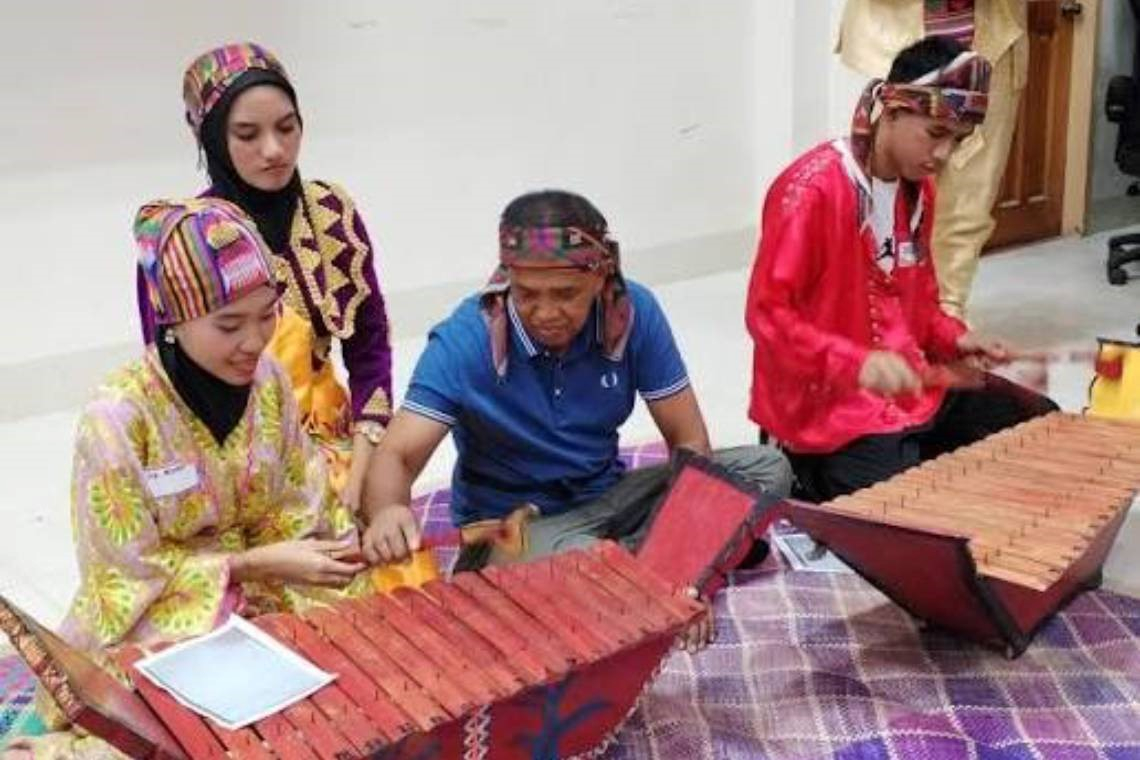
Participants learn to play the gabbang during a traditional Tausug music workshop. Image Source: nmpsulu – Instagram.
Music in Sulu is more than a form of entertainment. Traditional instruments accompany vocal performances, provide rhythms for dancing and help mark important social occasions. Their sounds form part of the cultural heritage of the Tausug, a people whose history and identity are closely connected to the Sulu Archipelago and the wider maritime region of Southeast Asia.
The traditional repertoire includes instruments made from bamboo, bronze and other materials, each producing distinctive sounds and serving different musical purposes. Some are suited to solo performances or vocal accompaniment, while others work together in ensembles. Understanding these instruments offers a closer look at how music contributes to Tausug artistic expression and community life.
The gabbang, a traditional bamboo xylophone, is one of the best-known instruments associated with Tausug music. It consists of graduated bamboo keys arranged over a supporting frame or resonating structure. The number of keys varies, with ethnographic documentation describing instruments with approximately 14 to 24 keys. The keys are struck to produce different pitches, allowing the musician to play melodies independently or accompany a singer. The National Commission for Culture and the Arts identifies the gabbang as a bamboo xylophone found among several communities in the southern Philippines, including the Tausug, Sama, Yakan and Palawan peoples. Its presence across different communities illustrates the broader regional connections of bamboo musical traditions.
Another important instrument is the biyula, a traditional bowed string instrument often described as a native violin. Unlike the gabbang, which produces sound through struck bamboo keys, the biyula uses strings to create sustained melodic tones. The two instruments can complement each other during vocal performances, bringing together percussive and string sounds.
“Its presence across different communities illustrates the broader regional connections of bamboo musical traditions.”
The suling and sawnay represent the wind-instrument tradition. The suling is a bamboo flute, while the sawnay is a smaller bamboo reed instrument. Ethnographic descriptions distinguish their construction and sound production, although both can be played alone or alongside other instruments. Their inclusion in Tausug musical practice demonstrates the variety of materials and techniques used to produce traditional music.
Updated headlines for free, straight to your inbox—no noise, just facts.
We collect your email only to send you updates. No third-party access. Ever. Your privacy matters. Read our Privacy Policy for full details.
Tausug musical ensembles combine several instruments to create layered rhythms and melodies. The kulintangan consists of a graduated series of small gongs arranged horizontally, with each gong producing a different pitch. Larger gongs, including the agung, contribute deeper tones, while the gandang, a drum, supplies rhythmic support.
The Notre Dame of Jolo College Heritage Hub preserves examples of traditional Sulu musical instruments, including the kulintangan, agung, gabbang, biyula and gandang. These instruments produce sound in different ways. The gabbang produces notes when its bamboo keys are struck, the suling produces sound through blown air, and the biyula uses vibrating strings. The gandang produces sound through a vibrating drumhead, while the kulintangan and agung rely on vibrating gongs.
“Tausug musical ensembles combine several instruments to create layered rhythms and melodies.”
Ensemble performance depends on the relationship between the instruments rather than on a single melody alone. The small gongs provide contrasting pitches, larger gongs add resonance, and drums establish rhythmic movement. Together, these sounds can accompany traditional dancing and festive gatherings.
Traditional Tausug music also has documented associations with weddings. The agung, gandang and kulintangan are used to announce wedding celebrations and accompany the movement of the groom and entourage toward the bride's home. These performances give music a public role, allowing sound to mark an occasion and bring attention to an important community event.
Traditional instruments also support the Tausug oral and vocal repertoire. The kissa, a ballad or narrative song, can convey stories and cultural values through sung verses. Research on the Tausug parang sabil kissa describes these works as literary, cultural and historical materials that serve both entertainment and instructional purposes. Performances may feature a female singer playing the gabbang, accompanied by a male musician playing the biyula.
The sindil, a form of verbal exchange through song, provides another example of the relationship between instrumental music and performance. Descriptions of Tausug performing arts associate the gabbang and biyula with this style, in which singers engage in witty exchanges before an audience. Such traditions show that instruments can support not only melody but also storytelling, humor and interaction.
The cultural significance of these practices extends beyond the instruments themselves. Musical knowledge includes how to handle an instrument, recognize its role within an ensemble, accompany a particular song, and respond to other performers. These skills are transmitted through practice, observation and instruction. The National Commission for Culture and the Arts also documents teacher-pupil traditions associated with the solo gabbang and biyula.
“Musical knowledge includes how to handle an instrument, recognize its role within an ensemble, accompany a particular song, and respond to other performers.”
Traditional music also reflects connections beyond Sulu. The gabbang, for example, has related forms among communities in the southern Philippines and across the sea in Sabah, where research has documented its transformation into a wooden xylophone known as the gabang among the Makiang people. This regional history demonstrates how instruments and musical ideas can travel, adapt, and acquire distinct meanings in different communities.
The traditional sound of Sulu emerges from the interaction of instruments, performers and social occasions. From the clear notes of bamboo keys to the resonant tones of bronze gongs, each instrument contributes to a diverse musical heritage. Continued documentation, teaching and performance can help ensure that these sounds remain part of the cultural life of the Tausug community.
REFERENCES
Budayaw. (n/a). Cultural diversity among the Bangsamoro in Mindanao: A survey of their traditional arts. Budayaw. https://budayaw.com
National Museum of the Philippines. (n/a). Musical Instruments. National Museum of the Philippines. https://www.nationalmuseum.gov.ph
AbeBooks. (1972). Sulu Studies 1: Coordinated Investigations of Sulu Culture. AbeBooks. https://www.abebooks.com
Borneo Research Journal. (2017, December 29). From gabbang to gabang: The diffusion and transformation of a Philippine xylophone among indigenous Paitanic communities of Sabah, Malaysia. Borneo Research Journal. https://doi.org
Philippine E-Journals. (2006). The Tausug parang sabil kissa as literary, cultural, and historical materials. Philippine E-Journals. https://ejournals.ph

KnowSulu is your trusted source for verified facts, news, and legal insights about the Sulu region. Committed to integrity, our mission is to empower the people of Sulu by providing accurate, transparent, and reliable information that matters.
