

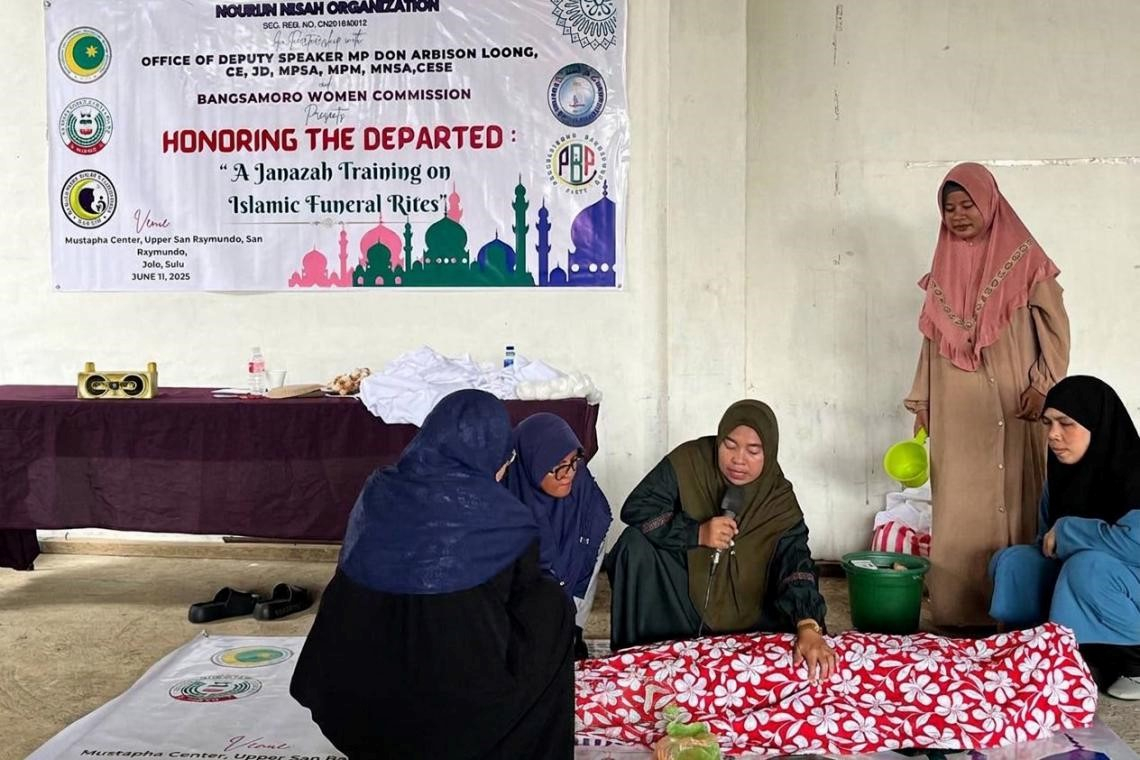
Tausug women participate in a workshop on Islamic funeral rites organized by the Bangsamoro Women Commission. Image Source: Bangsamoro Government – Facebook.
Death in Tausug society is not only a family loss, but also a moment shaped by religious duties and communal responsibility. In Sulu, funeral practices reflect the community’s Islamic faith and customs passed down through generations. The preparation of the deceased involves cleansing the body, wrapping it in a shroud, performing the funeral prayer, and placing the body in the grave.
These rites are commonly associated with four main stages known as Sutchihun, Saputun, Sambayanganun, and Hikubul. Tulkin is also associated with certain burial practices. Although these terms describe the traditional sequence, the details may differ according to religious guidance, family customs, and local practices.
The preparation begins with Sutchihun, the cleansing and ritual washing of the deceased. This practice reflects the Islamic requirement to handle the body with care and prepare it for burial. The washing is carried out respectfully, with attention to the dignity of the person who has died. It is followed by Saputun, the wrapping of the body in a burial shroud, generally made of white cloth. In Islamic practice, the shroud is known as the kafan. It covers the deceased before the funeral prayer and burial. The use of simple white cloth is consistent with wider Muslim funeral customs, although the precise number of cloths and the details of preparation can depend on the religious guidance followed by the family. The washing and wrapping are more than practical preparations. They are religious duties performed for the deceased before the final rites. Family members and other community members may help, while those with the necessary knowledge of Islamic funeral procedures can guide the process.
“The washing and wrapping are more than practical preparations.”
In June 2025, women in Jolo participated in a practical workshop on Janazah, the Islamic funeral rites, organized by the Bangsamoro Women Commission and its partners. The activity included instruction on funeral procedures and hands-on practice, demonstrating that knowledge of these responsibilities continues to be taught within the community. The terms Sutchihun and Saputun preserve the Tausug vocabulary associated with these stages. Together, they describe the preparation of the body before the community gathers for the funeral prayer and the journey to the grave.
Updated headlines for free, straight to your inbox—no noise, just facts.
We collect your email only to send you updates. No third-party access. Ever. Your privacy matters. Read our Privacy Policy for full details.
Sambayanganun refers to the prayer for the deceased, associated with the Islamic Salat al-Janazah. This funeral prayer is distinct from the five daily prayers and is performed specifically for someone who has died. It is an important part of the rites before burial. The prayer brings together those who attend the funeral to ask for mercy and forgiveness for the deceased. It is generally led by an imam or another qualified person, with participants standing in rows. Unlike the regular Muslim prayer, the Janazah prayer is performed standing and does not include the usual cycles of bowing and prostration.
Participation gives the funeral a collective dimension. The death affects the immediate family, but the religious responsibilities surrounding the deceased also involve other members of the community. Relatives, neighbors, and other mourners can gather to take part in the prayer and support the bereaved family. The funeral procession may also include religious recitations. Historical descriptions of Tausug customs mention passages from the Qur’an and devotional texts being recited while the body is carried to the burial place. The specific recitations and the people who perform them should not be assumed to be identical at every funeral.
“Participation gives the funeral a collective dimension.”
These practices connect the religious observance with the social experience of mourning. Attending the prayer allows members of the community to fulfill a religious duty while expressing solidarity with those who have lost a loved one. The shared responsibility does not remove the family’s grief, but it places the funeral within a wider network of faith and mutual support.
Hikubul refers to the burial itself. In the Islamic tradition followed by Tausug communities, the deceased is placed in the grave with the body oriented toward the Qibla, the direction of the Kaaba in Mecca. The body is lowered respectfully, and the grave is filled after the burial preparations are completed. In traditional Tausug burial practices, a grave niche is known as a paliyangan. The niche is prepared so that the deceased can be positioned facing the Qibla. Tulkin is associated with religious words or instructions delivered at the burial. In some Tausug accounts, these instructions relate to the questioning of the deceased in the afterlife according to Islamic belief. The practice has been described as part of the burial tradition, although its form and observance may vary with religious interpretation and local custom.
The burial marks the completion of the principal rites before the deceased is laid to rest. Yet, family and community responsibilities often continue after the grave has been closed. Prayer gatherings and memorial meals are among the practices in Tausug communities following a death, with the timing and arrangements depending on family circumstances and local religious customs.
“The burial marks the completion of the principal rites before the deceased is laid to rest.”
Passing these practices on to younger generations helps preserve knowledge of Tausug funeral traditions and their religious significance. The terms Hikubul and Tulkin, therefore, describe more than the physical act of burial. They connect the final treatment of the deceased with religious beliefs about the afterlife and the responsibilities of those who remain.
REFERENCES
Bangsamoro Autonomous Region in Muslim Mindanao. (2025, June 13). Faith-based empowerment: BWC trains Sulu women in Janazah practices. Bangsamoro Autonomous Region in Muslim Mindanao. https://bangsamoro.gov.ph
Philippine Social Science Council. (1974). Sulu Studies 3. Philippine Social Science Council. https://pssc.org.ph/wp-content
Defense Language Institute Foreign Language Center. (n/a). Cultural orientation: Tausug. Defense Language Institute Foreign Language Center. https://fieldsupport.dliflc.edu
HISTORY 1 UPOU. (2012, March 9). Burial practices of the Tausug. HISTORY 1 UPOU. https://hist1upouarsad.blogspot.com/

KnowSulu is your trusted source for verified facts, news, and legal insights about the Sulu region. Committed to integrity, our mission is to empower the people of Sulu by providing accurate, transparent, and reliable information that matters.
