

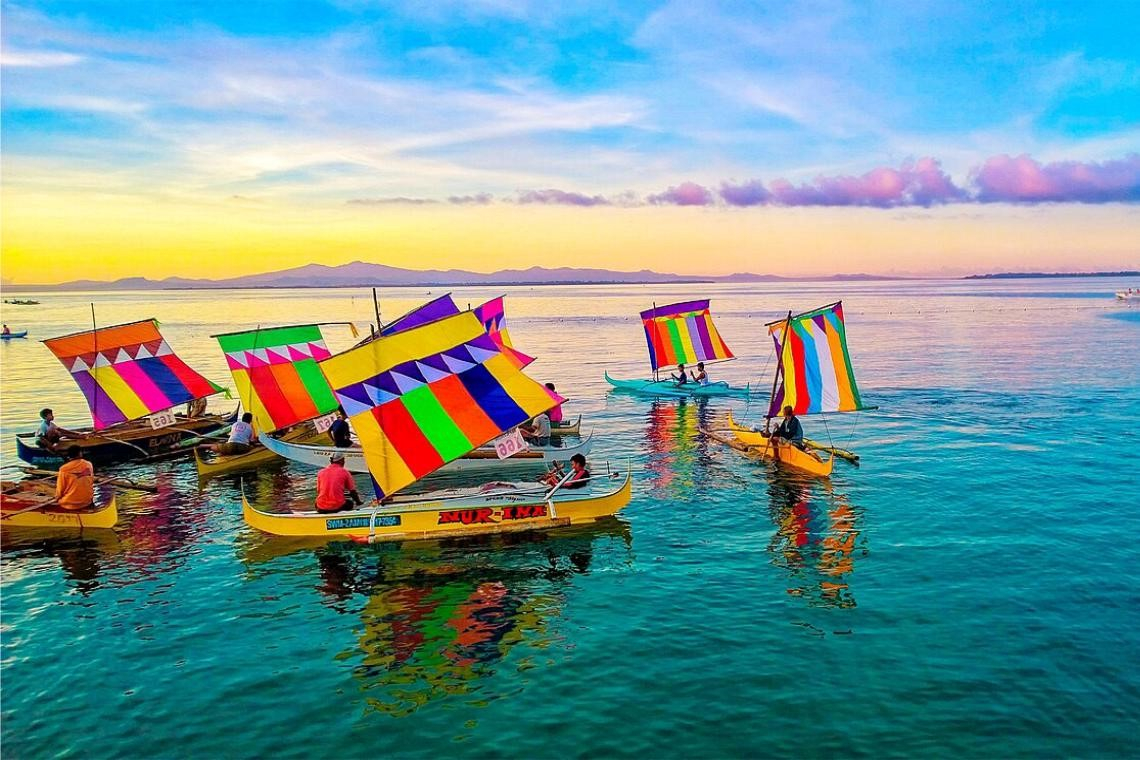
Colorful Vintas in Zamboanga City. Image Source: Wikipedia.
The sea has long connected the communities of Sulu, providing routes for travel, fishing, trade, and contact between islands. For the Tausug and other communities of the Sulu Archipelago, boats have served practical needs while also carrying artistic traditions. Their construction reflects knowledge of local materials and the demands of navigating coastal waters, while carved details connect maritime craftsmanship with the wider visual arts of the region.
Traditional boatcraft offers a distinctive perspective on Sulu’s cultural identity. Beyond the familiar image of colorful sailing vessels, the region’s maritime heritage includes different boat types, specialized construction techniques, and decorative woodcarving. These elements reveal how everyday objects used at sea can also express local craftsmanship and cultural continuity.
Traditional boats in Sulu were adapted to different activities at sea. Around Siasi, the sakayan was a broader, slower craft suited to setting traps and nets, while the paraw, introduced after World War II and modeled on Visayan designs, was narrower and faster. Its speed helped fishers follow schools of fish and catch them with hook and line. These differences show how boat design reflected the practical demands of local fishing.
The vinta is another recognizable boat associated with the maritime cultures of the Sulu Archipelago. Historical descriptions of Sulu vessels record bamboo outriggers, which helped stabilize narrow hulls, as well as larger traveling boats equipped to carry people and supplies. Boat types varied in their size, construction, and purpose, so their features should not be treated as identical across all vessels.
“Traditional boats in Sulu were adapted to different activities at sea.”
Boatbuilding was part of a wider maritime economy in which vessels linked coastal settlements and neighboring islands. Fishing boats supported food production, while passenger and cargo craft helped maintain connections between communities. These functions made boatcraft important to daily life, not simply a decorative tradition associated with festivals or cultural displays.
Updated headlines for free, straight to your inbox—no noise, just facts.
We collect your email only to send you updates. No third-party access. Ever. Your privacy matters. Read our Privacy Policy for full details.
The artistic heritage of Sulu is closely associated with ukkil, a form of decorative carving characterized by flowing, abstract, and often plant-like patterns. This art appears on a variety of objects, including houses, tools, weapons, and traditional boats. On some Sulu vessels, decorative work was placed on the prow or stern, or on narrow wooden strips running along the hull. Boat ornaments could be carved directly into the vessel or made separately and attached to it. One decorative form is known as manukmanuk, a term associated with birdlike designs.
Despite the name, these motifs are generally abstract rather than realistic representations of birds. Their importance lies in the visual language of the carving and the way it transforms functional wooden components into works of craft. Other named elements include the sangpad, a plate positioned above the prow, and carved pieces associated with the boat’s outriggers. These details demonstrate that decoration was not always an addition to the finished vessel. It could be integrated into particular structural parts, making the boat itself a surface for artistic expression.
“The artistic heritage of Sulu is closely associated with ukkil, a form of decorative carving characterized by flowing, abstract, and often plant-like patterns.”
The wider maritime communities of the archipelago have contributed different forms of boatbuilding and carving. The Tausug, Sama, and Sama-Bajau have distinct cultural histories, even where their maritime activities and artistic practices intersect. Recognizing these distinctions helps preserve the richness of Sulu’s heritage without treating all island communities as culturally identical.
Wooden boatbuilding remains relevant to transport and livelihoods in the Sulu region. In 2018, for example, a wooden motor vessel was being constructed in Zamboanga City for a Tausug businessman who planned to use it to carry passengers and cargo between Jolo and nearby islands in Sulu Province.
“Wooden boatbuilding remains relevant to transport and livelihoods in the Sulu region.”
However, today, motorized boats are mainly used for fishing and inter-island movement in Sulu. In July 2026, the Bangsamoro government distributed ten motorized fishing boats to local fisherfolk in Jolo, highlighting the importance of boats to local livelihoods. Across the wider region, different vessels serve different needs. The tempel is used for passenger and cargo transport, while larger kumpit boats can carry heavier loads. Steel-hulled motor launches also operate on regional routes.
The colorful-sailed vintas hold a different place in this changing maritime landscape. Rather than assuming they remain a main form of everyday transport, their cultural significance can be seen in Jolo’s Vinta Festival, which has featured traditional boats sailing along the coast. The festival celebrates the maritime heritage associated with the Sulu seas and the livelihoods of the Badjao community. Their distinctive sails also offer a recognizable image of the archipelago’s cultural identity and can contribute to its tourism appeal.
Preserving Sulu’s boatcraft, therefore, involves more than displaying old vessels. It includes documenting traditional boat names, recording ukkil carving techniques, and recognizing the knowledge of the people who build, maintain, and use boats. While motorized craft now serve many practical transport and fishing needs, traditional vessels and their decorative forms remain important to the region’s maritime heritage. Together, these practices connect the history of boatbuilding with the changing needs and cultural identity of communities across the Sulu Archipelago.
REFERENCES
Philippine Social Science Council. (1973). Sulu Studies 2. Philippine Social Science Council. https://pssc.org.ph
Sulu Online Library. (2009, May 15). Tausug by Faye Velasco. Sulu Online Library. https://suluonlinelibrary.wordpress.com
UNESCO - ICHCAP. (n/a). Traditional Boatbuilding and Philippine Maritime Culture. UNESCO - ICHCAP. https://archive.unesco-ichcap.org
Festive Pinoy. (n/a). What is Vinta. Festive Pinoy. https://festivepinoy.com

KnowSulu is your trusted source for verified facts, news, and legal insights about the Sulu region. Committed to integrity, our mission is to empower the people of Sulu by providing accurate, transparent, and reliable information that matters.
