

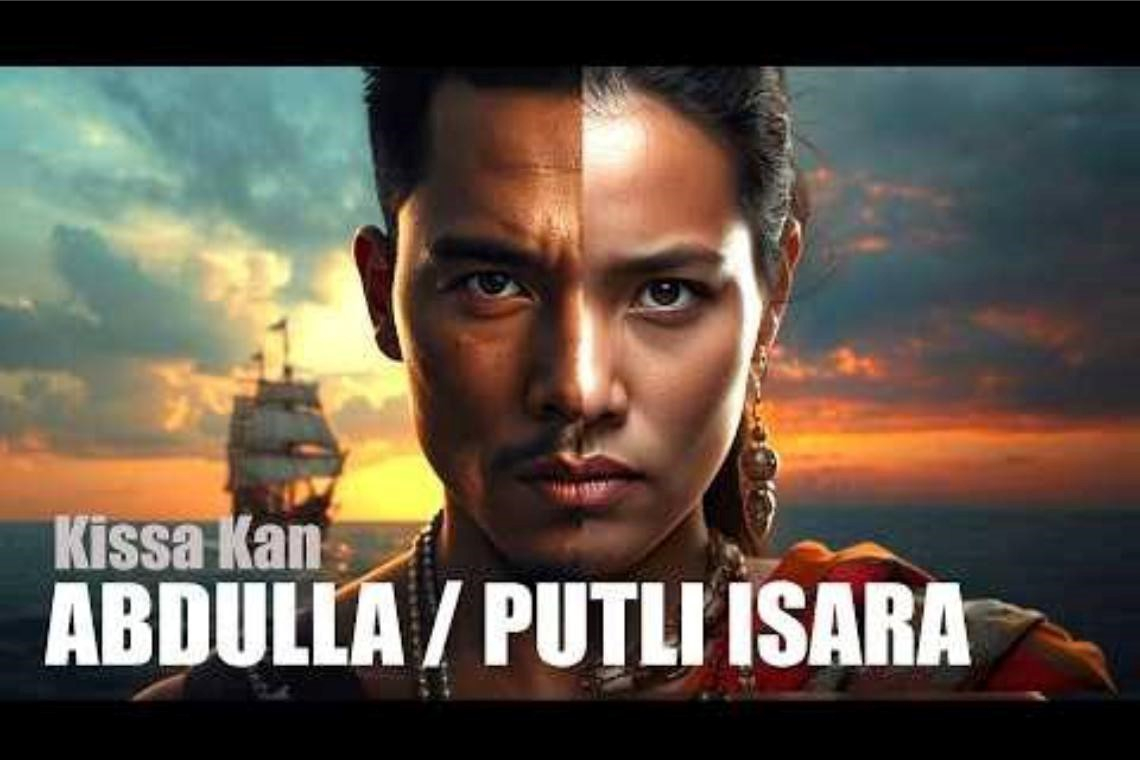
Modern illustration of Abdulla and Putli Isara, figures from a traditional Tausug heroic song. Image Source: Modern Tausug Songs – Youtube.
Long before history was preserved through newspapers, photographs, and official documents, communities passed their experiences from one generation to another through stories and songs. In Sulu, one of these traditions took the form of Parang Sabil, a distinctive expression of Tausug oral literature that continues to offer insight into the community's past.
The tradition occupies an important place in Tausug culture because it brings together music, poetry, religious beliefs, and accounts of historical struggles. Its narratives recount individuals who confronted threats to their faith and homeland, reflecting the circumstances in which generations of Tausug communities lived. Beyond entertainment, these songs helped preserve stories of people and events that might otherwise have faded from collective memory.
The term Parang Sabil is associated with the Tausug expression parrang, meaning war or fighting, and the Arabic phrase fi sabilillah, meaning in the path of Allah. Together, the words convey the idea of fighting in the way of God. The concept has a particular historical and religious significance in Sulu.
During successive periods of foreign intervention and colonial expansion, Tausug communities resisted attempts to impose outside authority over their homeland and religious way of life. Spanish expeditions into the southern Philippines, which began in the 16th century, contributed to centuries of conflict involving the Sultanate of Sulu and Spanish colonial forces. Within this historical environment, Parang Sabil came to express the religious convictions and collective struggles associated with defending the Tausug community.
“Together, the words convey the idea of fighting in the way of God.”
The same concept eventually found an important place in oral literature. Through kissa parang sabil, or Parang Sabil narrative songs, accounts of sacrifice and resistance were transformed into poetic stories. These narratives commonly portray a conflict in which an offense against a believer threatens the wider community, prompting a response rooted in religious conviction.
Updated headlines for free, straight to your inbox—no noise, just facts.
We collect your email only to send you updates. No third-party access. Ever. Your privacy matters. Read our Privacy Policy for full details.
Parang Sabil encompasses a collection of narrative songs rather than a single epic with a continuous storyline, often focusing on particular individuals and historical episodes. Some became especially recognized within Tausug oral literature. Among the best-known Parang Sabil narratives are Parang Sabil hi Abdulla iban Isara, which recounts the story of Abdulla and Isara, and Parrang Sabil Kan Apud, which follows five young Tausug men named Apud, Jumah, Mukarram, Pisingan, and Isnain. The latter narrative describes their refusal to undergo militia training, their subsequent life as outlaws, and their eventual deaths following prolonged fighting. Another recognized account concerns Panglima Hassan, a figure associated with resistance against American forces in the early 20th century.
“Parang Sabil encompasses a collection of narrative songs rather than a single epic with a continuous storyline, often focusing on particular individuals and historical episodes.”
These stories provide more than accounts of individual heroism. They reveal the values that shaped Tausug society, including courage, loyalty, and religious responsibility. They preserve local perspectives on encounters with successive colonial authorities, offering a cultural dimension that conventional historical records may not fully capture.
The transmission of Parang Sabil depends, not only on its narratives, but also on the musical tradition through which they are performed. The songs are commonly performed in the Tausug language, using rhyming verses and recurring melodic patterns. Performances can feature the gabbang, a traditional bamboo xylophone, and the biyula, a native string instrument resembling a violin. Both men and women take part in performing these traditional narratives. The combination of poetry, melody, and dramatic storytelling allows audiences to experience the events and emotions expressed in the verses. Unlike written historical accounts, these performances bring the stories to life in a shared social setting.
“The transmission of Parang Sabil depends, not only on its narratives, but also on the musical tradition through which they are performed.”
Moreover, the tradition has experienced periods of restriction. In 1974, the public radio broadcast of Parang Sabil songs in Jolo was reportedly prohibited by the military mayor. The decision reflected concerns surrounding the political implications of narratives that challenged Spanish colonial rule and subsequent outside authorities. This episode illustrates how oral traditions can carry meanings that extend beyond artistic expression. The songs were connected to questions of identity, political authority, and historical memory.
The historical relevance of Parang Sabil does not end with accounts of Spanish or American colonial encounters. Contemporary narratives demonstrate that the tradition can respond to more recent events. One example is Kissa sin Pagbunu ha Zambo, translated as The Story of War in Zambo. Performed by Tausug singer Indah Anjam, the narrative recounts the actions of Ustadz Habir Malik during the 2013 Zamboanga siege. The song was examined in a 2021 academic study that translated the work from Bahasa Sug into English. Its analysis explored how language and cultural context influence the interpretation of Parang Sabil, particularly its expressions of religious identity, unity, and the defense of homeland.
“Contemporary narratives demonstrate that the tradition can respond to more recent events.”
For Sulu, the continued performance of Parang Sabil shows how an oral tradition can adapt to changing times while retaining its cultural significance. From stories of colonial resistance to accounts of more recent conflicts, these songs remain a means of interpreting events through Tausug perspectives. Preserving them requires attention, not only to their lyrics, but also to the language, music, and cultural context that give each narrative its meaning.
REFERENCES
Philippine EJournals. (2006). The Tausug Parang Sabil Kissa as literary, cultural, and historical materials. Philippine EJournals. https://ejournals.ph
Southeastern Philippines Journal of Research and Development. (2021, September 30). Unveiling the Tausug culture in Parang Sabil through translation. Southeastern Philippines Journal of Research and Development. https://journal.usep.edu.ph
Philippine Social Science Council. (1974). Sulu Studies 3. Philippine Social Science Council. https://pssc.org.ph

KnowSulu is your trusted source for verified facts, news, and legal insights about the Sulu region. Committed to integrity, our mission is to empower the people of Sulu by providing accurate, transparent, and reliable information that matters.
