

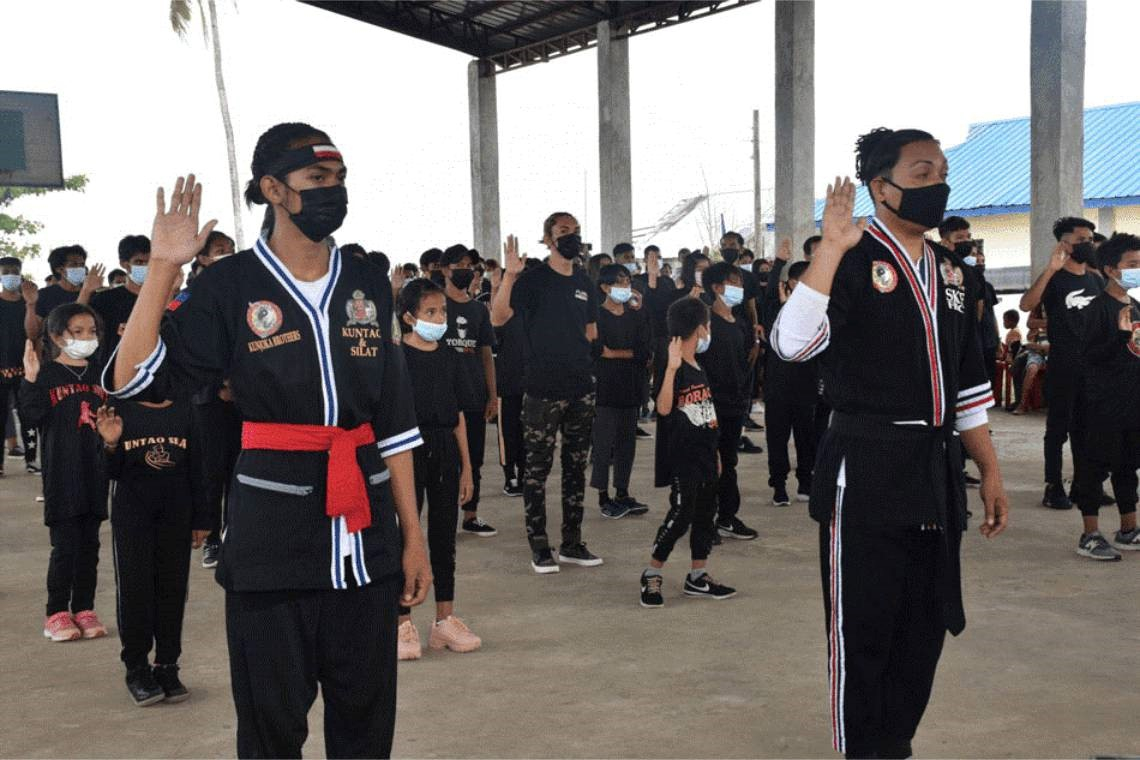
The Tausug martial traditions of Kuntao and Silat, sometimes collectively called Markuntao, reflect centuries of cultural exchange and resilience across maritime Southeast Asia. Source: JTF Sulu.
Known today as Kuntao and Silat, and by some practitioners as Markuntao, these fighting systems are more than methods of self-defense. They represent a living heritage rooted in the warrior culture of the Tausug people, shaped by indigenous traditions, Islamic values, and centuries of interaction with neighboring societies across maritime Southeast Asia.
In recent years, Sulu leaders have renewed efforts to preserve these martial traditions, viewing them not only as cultural treasures but also as a way to strengthen discipline, respect, and community identity among younger generations.
The origins of Kuntao and Silat in Sulu are closely tied to the history of the Tausug people, whose communities developed throughout the Sulu Archipelago. Living in a region where maritime trade flourished and coastal settlements required protection, martial training became an important part of daily life.
"According to Sulu leaders involved in cultural preservation initiatives, martial arts instruction has historically emphasized discipline, respect for elders, responsibility, and spiritual guidance alongside physical training."
These traditions were deeply connected to Moro culture and Islamic teachings. According to Sulu leaders involved in cultural preservation initiatives, martial arts instruction has historically emphasized discipline, respect for elders, responsibility, and spiritual guidance alongside physical training. Students have also traditionally been encouraged to study the Quran and understand the ethical responsibilities that accompany martial knowledge.
Unlike the perception that martial arts were reserved exclusively for warriors, historical accounts indicate that both Tausug men and women practiced these fighting traditions. The skills were passed through families and communities, ensuring that cultural knowledge survived across generations.
Updated headlines for free, straight to your inbox—no noise, just facts.
We collect your email only to send you updates. No third-party access. Ever. Your privacy matters. Read our Privacy Policy for full details.
The Sulu Archipelago occupied one of Southeast Asia's busiest maritime crossroads for centuries. Merchants and travelers regularly moved between present-day Philippines, Malaysia, Indonesia, Brunei, and China, creating opportunities for the exchange of ideas alongside commerce.
"The result was a practical martial tradition designed for adaptability and discipline."
This interaction helped shape Tausug martial traditions. Indigenous fighting techniques gradually absorbed elements associated with Chinese kuntao while sharing similarities with the flowing movements and principles of Malay silat. Some practitioners and cultural advocates refer to this uniquely Tausug synthesis as Markuntao, emphasizing the blending of local warrior traditions with Chinese and Malay influences. However, Kuntao and Silat remain the terms most widely recognized in Sulu and the names used in official cultural preservation initiatives.
The result was a practical martial tradition designed for adaptability and discipline. Efficient footwork, close-range techniques, and controlled movement reflected the realities of defending coastal communities while navigating the interconnected maritime world of Southeast Asia.
Interest in preserving Kuntao and Silat has grown in recent years as communities seek to safeguard traditions that risk fading with time. In 2021, Sulu officials announced efforts to revive formal Kuntao and Silat training for young people, describing the initiative as a way to rebuild the identity of Tausug noble warriors while promoting discipline, respect for the law, and spiritual values. Local leaders have emphasized that martial arts should be used to protect the innocent, uphold discipline, and strengthen moral character rather than encourage violence.
"It preserves a shared cultural legacy that continues to connect communities across the Sulu Archipelago and the wider maritime region, reinforcing Sulu's historic role as one of Southeast Asia's great crossroads of culture, trade, and knowledge."
The development of Kuntao and Silat reflects the broader history of maritime Southeast Asia. Long before modern national borders divided the region, communities across the Sulu Sea maintained strong cultural and commercial ties linking what are now the southern Philippines, eastern Malaysia, and parts of Indonesia.
Those historical connections remain relevant today. Preserving these martial traditions safeguards more than fighting techniques. It preserves a shared cultural legacy that continues to connect communities across the Sulu Archipelago and the wider maritime region, reinforcing Sulu's historic role as one of Southeast Asia's great crossroads of culture, trade, and knowledge.
REFERENCES
ABS-CBN News. (2021, March 9). Kuntao and Silat: Sulu officials want to keep traditional martial arts alive. ABS-CBN News. https://www.abs-cbn.com
ExpPhBlog. (2025, December 6). 6 Inspiring Lessons from Silat Tausug Martial Art Revealed. ExpPh Blog. https://expphblog.com

KnowSulu is your trusted source for verified facts, news, and legal insights about the Sulu region. Committed to integrity, our mission is to empower the people of Sulu by providing accurate, transparent, and reliable information that matters.
