

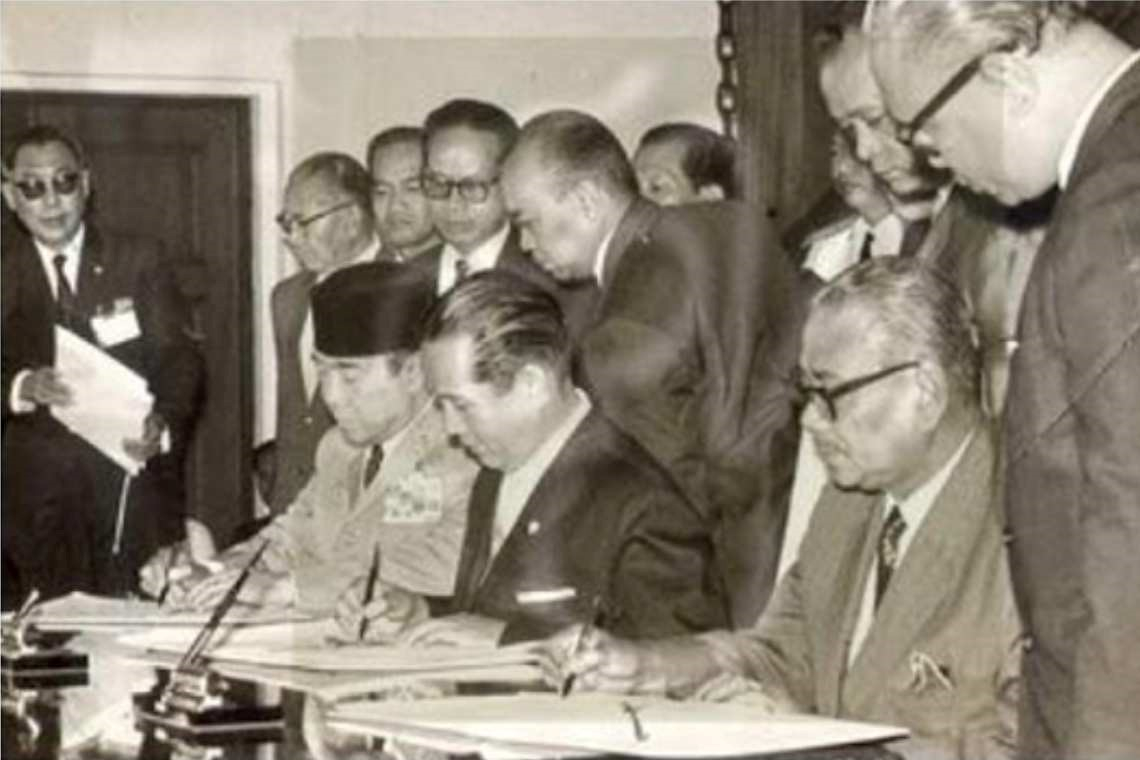
Talks to resolve disputes in North Borneo were well underway before Marcos. Sr. assumed office. Depicted, President Macapagal, President Suharto, and Prime Minister Tunku Abdul Rahman of Malaysia signed the Manila Accord on July 31st, 1963, pledging to resolve differences peacefully. Marcos would play his own part in re-escalating tensions before seeking to bury the dispute. Image Source: ICWA
And he did it in public, on the record, at an ASEAN summit almost fifty years ago.
On August 4, 1977, Ferdinand Marcos stood in Kuala Lumpur and, during an ASEAN conference, told the region the Philippines would take "definite steps" to drop its claim to Sabah.
Malaysian Prime Minister Datuk Hussein Onn welcomed it. Singapore's Lee Kuan Yew welcomed it too. The pledge came years after the Jabidah affair, in which a covert Philippine commando unit built to infiltrate and destabilize Sabah was exposed and reportedly purged, an episode whose fallout helped ignite unrest in Mindanao that took decades to fully settle down.
Coming after all that, the 1977 announcement looked like a genuine attempt to let a costly and dangerous claim finally rest. For a long time, that is more or less what happened.
The claim had already been written into the 1973 Constitution's definition of Philippine national territory, which covered land held "by historic right or legal title," language understood at the time to include Sabah. That meant Marcos could not simply erase the claim with a speech. Undoing it on paper would have required a constitutional amendment, and no government pursued one. But the letter of the law mattered less than what happened in practice.
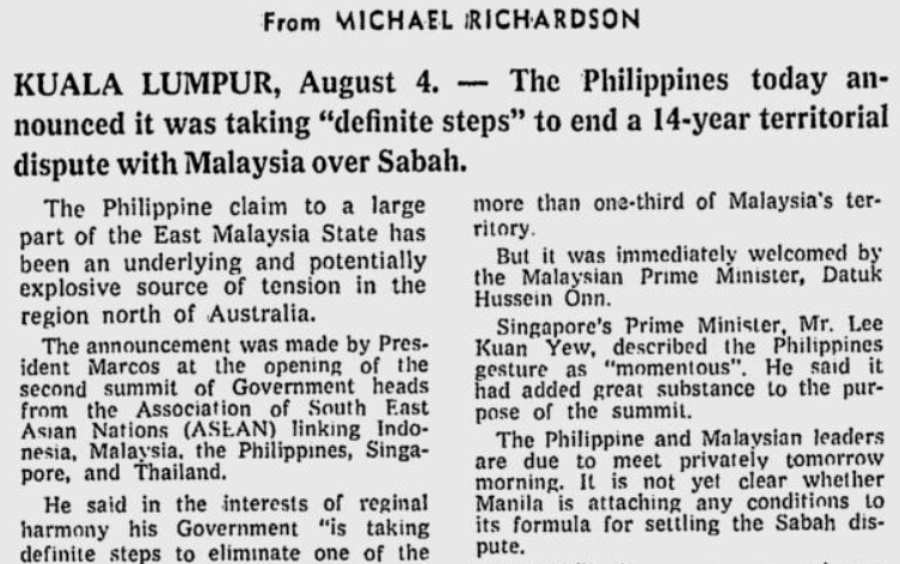
Michael Richardson, writing for The Age, highlighted the optimism brought on by Marcos. Sr. 's declared intent to ease regional tensions over Sabah by ending the Philippines’ claim. Image Source: Michael Richardson for The Age (August 5th, 1977).
For roughly the next three and a half decades, Manila and Kuala Lumpur mostly let the dormant claim sit undisturbed and built a real working relationship around it, cooperating steadily within the ASEAN framework even with the legal contradiction never formally cleaned up.
That quiet arrangement started cracking in the 21st century.
The turning point was 2013, when the Lahad Datu incident saw armed followers of a self-proclaimed Sulu royal line cross into Sabah, reigniting a dispute that had gone dormant for a generation. From there, the claim took on a new and stranger life, revived by claimants to the House of Kiram in an international arbitration that sought to use Sabah's place in Malaysia as leverage to seize close to fifteen billion dollars in Malaysian assets held in Europe. That case has since collapsed in courts across Europe, but the political damage it stirred up did not collapse with it, and Sabah is once again live material heading into the 2028 Philippine election.
The name most associated with reviving the claim in this new era is not Marcos at all. It is Duterte. Rodrigo Duterte publicly pledged in 2016 to pursue the Sabah claim for his entire presidency.
Updated headlines for free, straight to your inbox—no noise, just facts.
We collect your email only to send you updates. No third-party access. Ever. Your privacy matters. Read our Privacy Policy for full details.
His daughter Sara, now campaigning for the top job in 2028, has her own history tied to the region's Sulu and Sabah politics. In 2008, she attended the "2nd Mindanao MNLF Leadership Peace Summit" in Davao, the city she and her father both governed. Also in the room were Nur Misuari, founder of the Moro National Liberation Front, and Fuad Abdulla Kiram, who styles himself Sultan of Sulu and Sabah and later fronted the arbitration case built on the claim of Sulu royal descent.
The current Marcos has kept more distance. In 2022, his office called the Sulu descendants' claim to Sabah "a private claim," not a matter for the state to pursue. During his 2023 state visit to Malaysia, the topic reportedly came up only briefly, with both sides agreeing to focus on issues they could actually solve.
Then came February 2026, when a government map from the National Mapping and Resource Information Authority depicted Sabah as Philippine territory was resurfaced. Instead of contextualizing Philippine-Malaysian relations, Department of Foreign Affairs spokesperson Rogelio Villanueva stood by the sovereignty claim on the record. Marcos will not be on the 2028 ballot and has not named a successor, but with nationalist pressure building ahead of the race, reviving old maps costs a government little and could counter the Sabah claim enthusiasm of the Dutertes.
So just what has changed since 1977? A Marcos once looked at this same claim and chose to let it lie, and for most of the decades since, that is exactly what both countries did, with or without the paperwork catching up. And Sabah is still part of Malaysia.
The one genuine gain in all this time has been a calmer security situation in Mindanao and Sulu, with the militant activity that plagued the region for decades at least dying down. But representation and real investment in the country's poorest province have not yet caught up and should surely be the focus of renewed efforts even as the disputed royal history of Sulu keeps getting pulled back out to stand in for progress that still has not arrived on the ground.
REFERENCES
Ao, Temjenmeren. (2020, August 27). The Discord over Sabah between Malaysia and the Philippines. https://www.icwa.in
KnowSulu. (2026, February 20). Sara Duterte Runs for President with Sabah Dispute Hanging in Balance. https://know-sulu.ph
KnowSulu. (2026, June 30). Slaves and Seapower: The Complex Power of the Sulu Sultanate. https://know-sulu.ph
KnowSulu. (2026, January 27). Why the Philippines' Sabah claim collides with its own Constitution. https://know-sulu.ph
Majangkim, R. (2026, February 28). Sabah: A sovereign choice the world witnessed. Jesselton Times. https://jesseltontimes.com
Oliva, G. (2026, July 10). Sulu princess: Sabah belongs to all Filipinos, not just Sultanate. Manila Standard. https://manilastandard.net
Richardson, Michael (1977, August 5). "Marcos drops Philippine claim to Sabah". The Age. https://news.google.com
Retrieved 24 July, 2026.
Rocamora, J. N. L. (2026, February 20). Philippines reaffirms claim over Sabah. Philippine News Agency. https://www.pna.gov.ph
Nagara, B. (2020, November 1). Why the Philippines has no justifiable claim to Sabah and never had. South China Morning Post. https://www.scmp.com
Yunos, R. (2013, March 7). Sabah and the Sulu claims. Borneo Herald. https://www.borneoherald.com

KnowSulu is your trusted source for verified facts, news, and legal insights about the Sulu region. Committed to integrity, our mission is to empower the people of Sulu by providing accurate, transparent, and reliable information that matters.
