

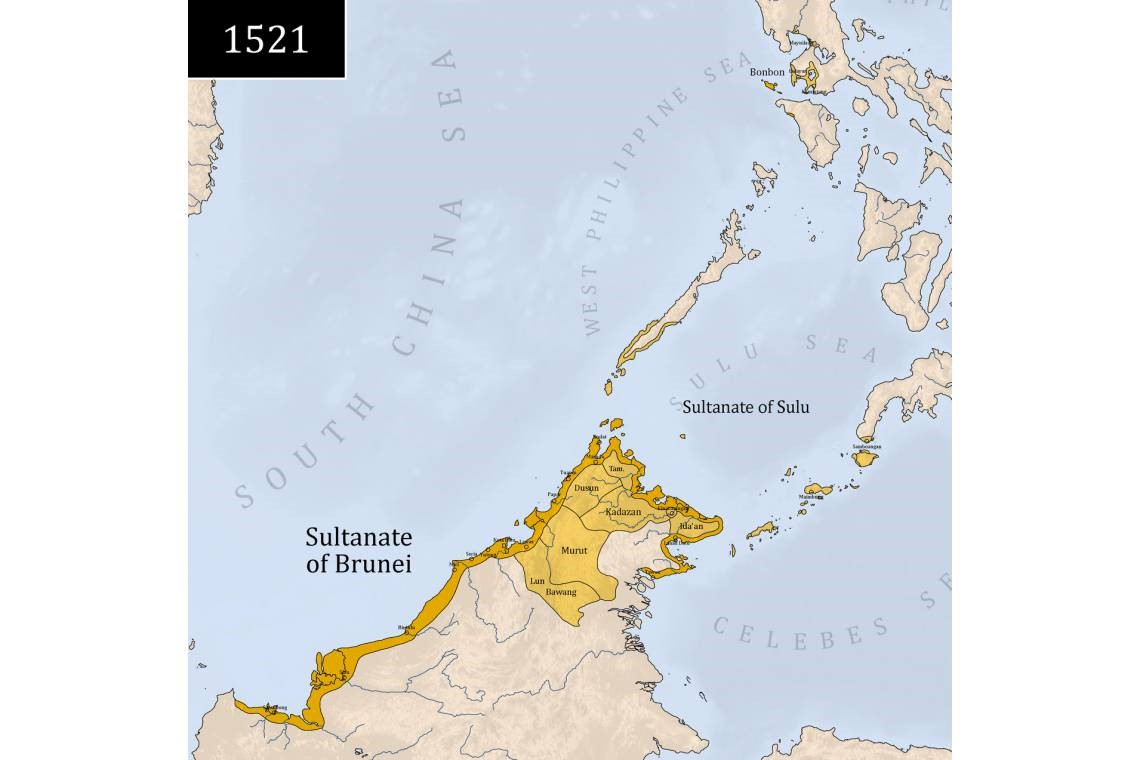
The Sultanate of Brunei once exerted far reaching control and influence not only in North Borneo, but over the Sulu Sultanate as well. Control went so far as to include Zamboanaga in Mindanao. The extent of the decline of Brunei and rise of Sulu is a crucial question hiding beneath debates around what was agreed with Britain. Image Source: Delirium333, Wikipedia
Brunei says no.
And the paper trail backs a complex reality where Brunei retained more control and influence in Sabah than the Sulu narrative suggests, a thing that is easy to forget with our modern focus on Sulu and the British in North Borneo.
The story usually goes like this: Sulu warriors helped Brunei's 14th ruler, Sultan Muhyiddin, win a civil war against his rival, the 13th Sultan, Abdul Mubin, and were rewarded with Sabah as payment.
Fast forward to 1878, when Sabah passed into British control in a handover that everyone acknowledges.
What's disputed is what happened next. The Kiram family, descendants of the vanished Sulu Sultanate, insist their ancestors never sold Sabah outright, only rented it out, and they want it back. Some now argue the claim should belong not to the Kirams at all but to the Philippine state, which absorbed Sulu island as a province in the modern republic.
But is that all?
Old Bruneian chronicles do mention a Sabah agreement with Sulu. However, Brunei's royal historian, Pehin Jamil, argues that it never progressed beyond paper. According to his account, Muhyiddin never actually ceded the territory, perhaps because, as some records suggest, the contribution of Sulu’s forces did not satisfy Muhyiddin’s expectations.
“Old Bruneian chronicles do mention a Sabah agreement with Sulu. However, Brunei's royal historian, Pehin Jamil, argues that it never progressed beyond paper.”
Updated headlines for free, straight to your inbox—no noise, just facts.
We collect your email only to send you updates. No third-party access. Ever. Your privacy matters. Read our Privacy Policy for full details.
When the British got involved, the chronicle grew even more confusing. Weeks before Sulu's Sultan Jamalul Alam supposedly granted Baron von Overbeck his North Borneo title on January 22, 1878, Brunei's own Sultan Abdul Momin had already appointed that same Overbeck as Maharaja of Sabah, Gaya, and Sandakan, on December 29, 1877. Overbeck, a German trader who later helped found the British North Borneo Chartered Company, walked away with paperwork from both courts. So which Sabah agreement actually mattered, and which was just for show?
Pehin Jamil's answer: Sulu only ever "claimed" Sabah, and claiming isn't owning—at least not in an uncontested fashion. He points to Sir Stamford Raffles, who wrote in his 1830 study of Java that Sulu's government had long claimed sovereignty over a "considerable territory" northeast of Brunei. Claimed, not held.
Around 1775, a Sulu delegation reportedly turned up in Brunei under the pretext of fetching fresh water, hoping instead to press their Sabah claim before the Sultan. A Bruneian chief minister met them with a blunt threat of violence if they pushed further, and they left empty-handed. Yet the claim never fully died.
“Sir Stamford Raffles, who wrote in his 1830 study of Java that Sulu's government had long claimed sovereignty over a "considerable territory" northeast of Brunei. Claimed, not held.”
Historian L.R. Wright's 1970 study of British Borneo lands the harder blow. She concluded that Sulu's title rests on tarsilas, royal genealogies that are frequently little more than legend dressed up to flatter whichever dynasty wrote them, and that generation after generation of Bruneian rulers rejected the idea that northern Borneo was ever gifted away. Tradition supports Sulu's side, she noted, but Bruneian tradition just as firmly contradicts it.
There is evidence that Sulu did exert some influence as KnowSulu previously reported. Yet the extent to which is perhaps more a historical mystery than the public might think. Sulu exerted significant sea power, and likely received tribute and homage from coastal areas. Yet how far in land did Sulu power go?
The likeliest explanation is that London wanted to box out Spain, which was busy trying to conquer Sulu outright and claim everything Sulu claimed as spoils.
It's the same inheritance logic being recycled today. Some in the Philippines argue Sulu's claims transferred to the Philippine Republic once the sultanate dissolved, while Kuala Lumpur stands as heir to Britain's old colonial deals through Malaysia's independence.
Neither argument holds up cleanly. The Kirams themselves keep insisting Sabah belongs to their house alone, not to the Philippine government. And even granting that old treaties still bind modern states, that logic cuts both ways. It would just as easily hand the argument back to Brunei, not away from it.
Of course, modern Brunei takes a very different approach to the issue than the heirs of Sulu, and recognizes Malaysian sovereignty over Sabah as a modern reality.
Differences in how to view Sabah are far from academic. Fuad Kiram, a self-styled heir not recognized by the Philippines, already tried and failed to seize $15 billion in Malaysian assets across Europe through a widely criticized arbitration bid, treating Sabah's wealth as inherited private property. Whether the Kirams even intend to funnel any of that toward the Philippines or toward Sulu, still one of the country's poorest provinces, remains an open question nobody seems eager to answer. And in 2013, during the Lahad Datu Incident, Jamalulu III Kiram—yet another self-styled Sultan—raided Sabah with armed militants.
It was, in many ways, an echo of the seaborne raids that brought Sulu to power prior to the colonial era, yet is the cost in life and treasure worth a conflict built on uncertain histories?
“Whether the Kirams even intend to funnel any of that toward the Philippines or toward Sulu, still one of the country's poorest provinces, remains an open question nobody seems eager to answer.”
If Brunei's version of history holds, then Brunei, not Sulu, controlled Sabah right up until handing it to the British in 1878. The Sulu and the Philippines’ claim would collapse.
Sulu’s own undisputed glory lies instead in an age of seapower and heroic efforts to repel Spanish colonialism and the ravages of Japan’s ambitions in the second world war, and less so in what is a convoluted history of North Borneo.
The only modern fact that can be known of the issue is that Sabah’s population wanted to join the Malaysian Federation in 1963 according to a UN-backed commission. The rest is a complex layer of claims and competing suzerainty further washed over by British, Spanish, and American colonial power.
REFERENCES
KnowSulu. (2026, January 27). Why the Philippines' Sabah claim collides with its own Constitution. https://know-sulu.ph
KnowSulu. (2026, June 30). Slaves and Seapower: The Complex Power of the Sulu Sultanate. https://know-sulu.ph
Majangkim, R. (2026, February 28). Sabah: A sovereign choice the world witnessed. Jesselton Times. https://jesseltontimes.com
Oliva, G. (2026, July 10). Sulu princess: Sabah belongs to all Filipinos, not just Sultanate. Manila Standard. https://manilastandard.net
Rocamora, J. N. L. (2026, February 20). Philippines reaffirms claim over Sabah. Philippine News Agency. https://www.pna.gov.ph
Nagara, B. (2020, November 1). Why the Philippines has no justifiable claim to Sabah and never had. South China Morning Post. https://www.scmp.com
Santos, J. (2022, March 13). The invalid Sulu claim over Sabah: A historical explanation. The Vibes. https://www.thevibes.com
Yunos, R. (2013, March 7). Sabah and the Sulu claims. Borneo Herald. https://www.borneoherald.com

KnowSulu is your trusted source for verified facts, news, and legal insights about the Sulu region. Committed to integrity, our mission is to empower the people of Sulu by providing accurate, transparent, and reliable information that matters.
