

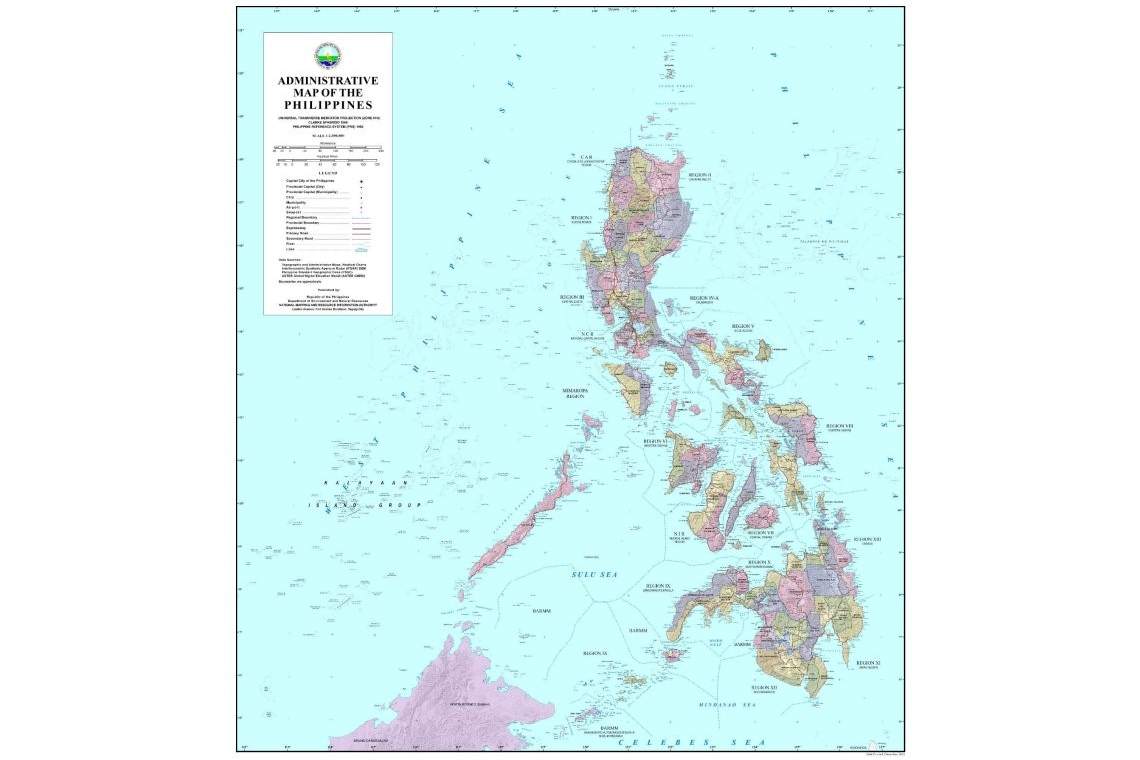
Released by the Philippines’ official national mapping agency, maps such as these depict North Borneo and its waters alongside islands that are recognized as part of the Philippine republic. Image Source: NAMRIA
The Incident involved a deadly incursion by hundreds of armed militants linked to the self-styled Royal Security Forces of the Sultanate of Sulu, who landed in Sabah on 11 February 2013 to press a territorial claim linked to the historical Sulu Sultanate. The standoff escalated into armed clashes and continued until 24 March 2013, leaving dozens dead, including Malaysian security personnel and civilians.
Adopting the claims of the defunct Sultanate, Manila has historically maintained its own unpressed claim to Sabah with lukewarm enthusiasm. The state remains a part of the Federation of Malaysia, a position supported by the 1962 findings of the Cobbold Commission, which reported majority support in North Borneo for joining Malaysia prior to the federation’s formation in 1963. It’s a conclusion that received the tacit acceptance of neighboring Indonesia and the Philippines by the end of the 1960s.
‘Sabah remains a part of the Federation of Malaysia, a position supported by the 1962 findings of the Cobbold Commission, which reported majority support in North Borneo for joining Malaysia prior to the federation’s formation in 1963.’
However, in February 2026, the Philippines defended a 2012 map that includes Sabah within Philippine claims, appearing to revive Manila’s position on the territory. The disagreement has partly been fueled by the Philippines’ Maritime Zones Act of 2024, also known as Republic Act 12064. Although the law was primarily intended to define Manila’s claims in the West Philippine Sea, discussion surrounding it renewed attention to the map.
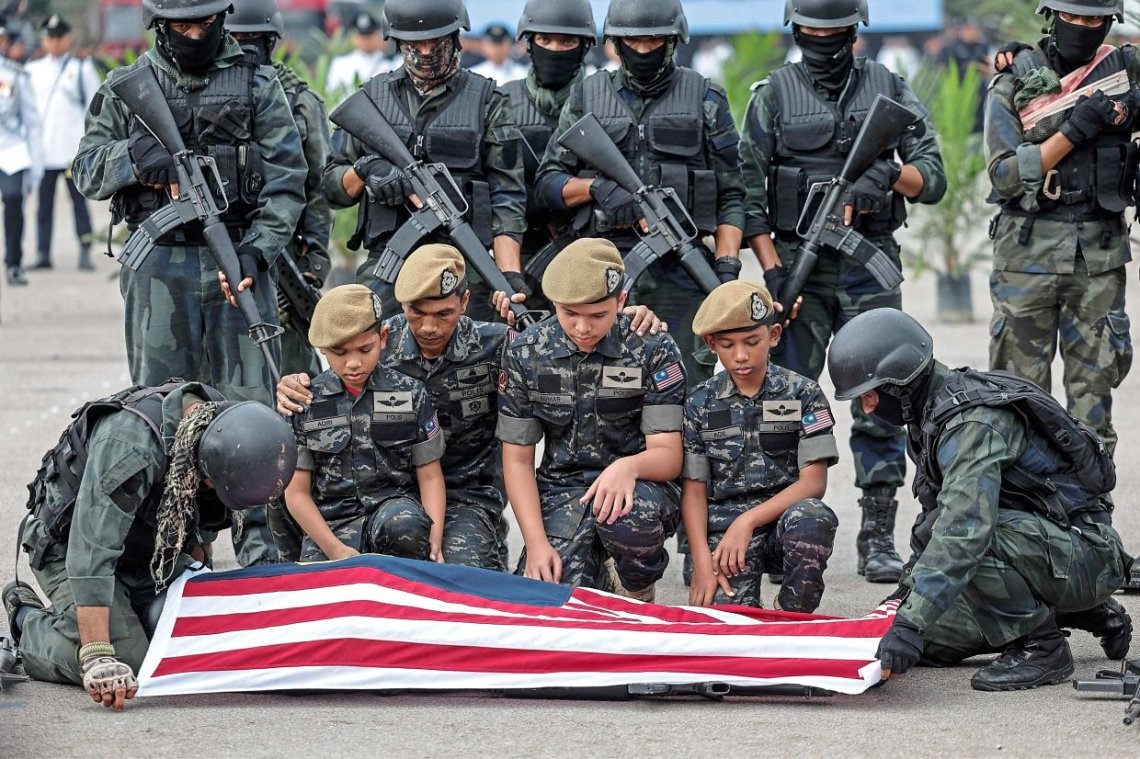
Malaysian security personnel and family mourn the losses of the 2013 invasion of Sabah. Source: Bernama
When asked about the issue, Philippines Department of Foreign Affairs spokesperson Rogelio Villanueva pointed to existing Philippine legislation that has never been repealed. Section 2 of Republic Act 5446, which outlines the archipelago’s territorial baselines, states that its provisions do not prejudice the Philippines’ existing claims over part of North Borneo—another name historically used for Sabah.
In February 2026, Malaysian Foreign Minister Datuk Seri Mohamad Hasan said the enacted Philippine Maritime law infringes on Malaysia’s maritime boundaries near Sabah. Political figures in Sabah also responded swiftly. On February 26, Datuk Seri Mohd Shafie Apdal, the president of the regional Warisan party, rejected the Philippine position outright. He said Sabah’s place within Malaysia is “settled and not negotiable,” arguing that no map produced by a foreign government could override the wishes of the people of Sabah.
The timing of the renewed rhetoric has prompted questions about whether domestic politics may be playing a role.
‘Sabah’s place within Malaysia is “settled and not negotiable,” arguing that no map produced by a foreign government could override the wishes of the people of Sabah.’
The administration of President Ferdinand Marcos Jr. has largely avoided direct involvement in the Sabah dispute in the past. In August 2022, presidential press secretary Trixie Cruz-Angeles described a related controversy—the Sulu arbitration—as a private and commercial matter rather than a core diplomatic issue.
By contrast, the rival Duterte political camp has long expressed stronger support for the claim. Sara Duterte has recently declared her candidacy ahead of the 2028 presidential election. Both she and her father, former president Rodrigo Duterte, built their political base in Davao City and in Mindanao, a region where historical links to the old Sultanate of Sulu are more politically resonant. Both Dutertes have vowed to keep the Philippines’ claim to Sabah alive.
Sarah Duterte also has a history of engaging directly with figures associated with the House of Kiram, the former royal family of the Sultanate of Sulu that still seeks to reclaim its colonial-era holdings. Ahead of the declaration of her candidacy, she reportedly called Muedzul-Lail Tan Kiram in September 2025. Muedzul is typically seen as the more legitimate, moderate heir to the Sulu Sultanate. However, Sara Duterte was also spotted in 2008 with Fuad Kiram, the Sulu claimants behind the Sulu arbitration scheme that sought nearly $15 billion from Malaysia.
Updated headlines for free, straight to your inbox—no noise, just facts.
We collect your email only to send you updates. No third-party access. Ever. Your privacy matters. Read our Privacy Policy for full details.
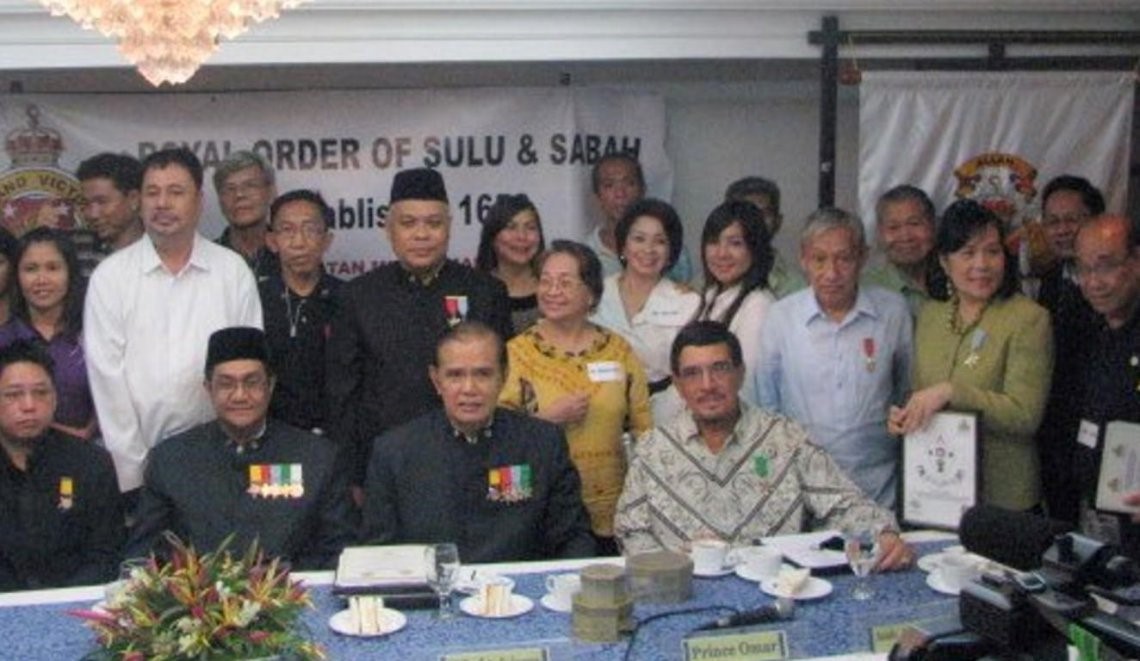
At a forum with the self-declared Royal Hashemite Sultanate of Sulu and Sabah in July 2010, Sara Duterte (center back) was seen proudly standing behind Fuad Kiram (front, second from the left). Image Source: “The Royal Hashemite Sultanate of Sulu and Sabah” (Facebook).
The arbitration case was formally brought by Kiram and even other Filipino nationals who say they are heirs to the former sultanate. They argued that Malaysia owed compensation under an 1878 agreement tied to the territory. However, courts across Europe have repeatedly rejected attempts to enforce arbitration awards against Malaysia with the Paris Court of Appeal delivering a final rejection and throwing the case out in December 2025.
“Sarah Duterte also has a history of engaging directly with figures associated with the House of Kiram, the former royal family of the Sultanate of Sulu that still seeks to reclaim its colonial-era holdings.”
Despite the political messaging in the Philippines, it remains unclear whether the issue resonates widely among Filipino voters. There is little public polling on the matter, and coverage by Philippine media has been limited. This likely reflects that, for most voters, everyday concerns such as education, economic development, and security overshadow a territorial dispute that many view as distant and largely symbolic.
This contrast is particularly stark in Sulu itself, the southern province most closely linked to the historical claim. The province remains among the poorest in the Philippines and continues to host a Philippine Army presence following decades of Islamist militant activity.
Still, signaling renewed interest in Sabah could serve a political purpose for the Marcos administration. By appearing willing to defend the claim, the government may be attempting to appeal to more nationalist or regionally focused constituencies, while also narrowing a potential political advantage for Sara Duterte ahead of the 2028 presidential election.
The Sulu arbitration and the headlines it generated likely played a significant role in returning public attention to an otherwise dated issue in the Philippines. Yet even as the issue remains peripheral to most Filipino voters, the cost must be weighed in the damage done to the Philippines’ foreign relations and to the stability of Southeast Asia ahead of a tragic anniversary for Malaysia.
REFERENCES
Chi, C. (2025, August 7). VP Sara defense shifts focus to Supreme Court as Senate shelves impeachment. Official Gazette. (2016, June 30). Inaugural speech of President Rodrigo Roa Duterte. https://www.officialgazette.gov.ph
National Mapping and Resource Information Authority. (n.d.). Administrative map of the Philippines [Map]. https://www.namria.gov.ph
Majangkim, R. (2026, February 28). Sabah: A sovereign choice the world witnessed. Jesselton Times. https://jesseltontimes.com
Reddit. (2026). Philippines reaffirms claim over Sabah amid. https://www.reddit.com
Rocamora, JNL. Philippine News Agency. (2026, February 20). Philippines reaffirms claim over Sabah. https://www.pna.gov.ph
Santos, J. (2022, August 5). Sulu claim not on Manila’s priority list: Observers. The Vibes. https://www.thevibes.com
Thompson, S (2026, February 26). Sabah’s borders: Indonesia joins Malaysia-Philippines dispute. Lowy Institute. https://www.lowyinstitute.org
Royal Hashemite Sultanate of Sulu and Sabah. (May 12, 2011). RHSSS award ceremony and CMDM attendees forum in July, 2010. Facebook. https://www.facebook.com
Royal Hashemite Sultanate of Sulu and Sabah. (May 12, 2011). Sara Duterte and Fuad Kiram attend the 2nd MNLF Peace Summit, May 2008. Facebook. https://www.facebook.com
Royal Maharlika. (n.d.). Royal Maharlika webpage. https://www.royalmaharlika.org
Royal Sulu. (2008). The 2nd Mindanao MNLF Leadership Peace Summit. Archived October 31, 2008. https://web.archive.org

KnowSulu is your trusted source for verified facts, news, and legal insights about the Sulu region. Committed to integrity, our mission is to empower the people of Sulu by providing accurate, transparent, and reliable information that matters.

