

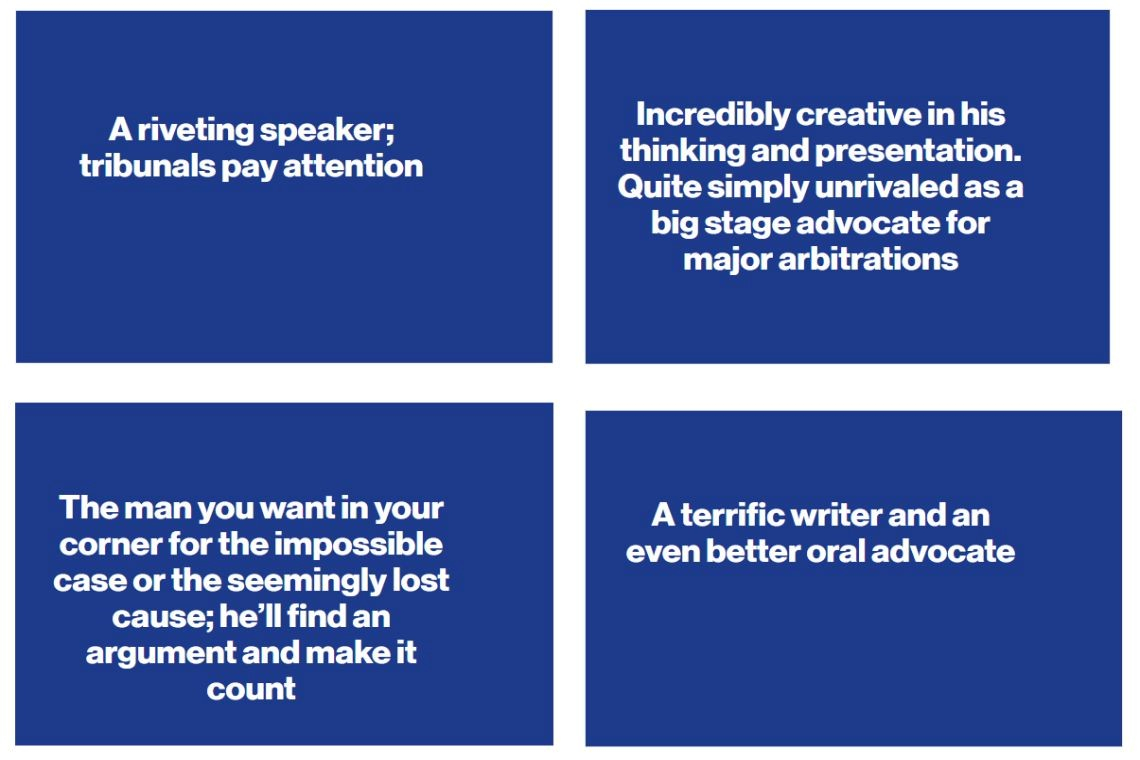
Paul H. Cohen LLC’s website features a series of unattributed testimonials that appear to reference his performance in cases like the Sulu arbitration. Image Source: Screenshot from cohenintlaw.com
Cohen is a central figure in the Sulu arbitration, one of the most chaotic arbitration sagas in recent memory. Along with litigation funder Therium and others, he consequently faces a claim alleging unlawful means conspiracy, proceedings that continue to draw attention to his name and the paper trail of his legal practice.
Cohen once held court at the prestigious 4-5 Gray's Inn Square Chambers, where he took on the Sulu claimants and rode a case that, for a time, looked like it could rewrite geopolitical history. Now, on the website of his fledgling new firm, that same arbitration is dressed up as a crown jewel—a masterclass in high-stakes advocacy. The fact that the entire enterprise ended in a spectacular, headline-grabbing collapse is altogether avoided.
The arbitration arose from an 1878 agreement between the Sultan of Sulu and the British North Borneo Company concerning territory in present-day Sabah. Annual payments of about US$1,000—symbolic in nature—continued under Malaysia until they were halted in 2013 following the Lahad Datu incursion. After the payments stopped in the wake of the armed attack, individuals claiming to be heirs to the Sultan initiated arbitration proceedings seeking billions of dollars, alleging breach of the agreement.
Notably, the claimants taken on as clients by Cohen were not among the heirs previously recognized as recipients of the payments, and their status as heirs to the Sulu sultans remains disputed.
“Claimants taken on as clients by Cohen were not among the heirs previously recognized as recipients of the payments.”
Updated headlines for free, straight to your inbox—no noise, just facts.
We collect your email only to send you updates. No third-party access. Ever. Your privacy matters. Read our Privacy Policy for full details.
In 2022, an arbitral award was issued in favor of the claimants, granting nearly $15 billion in damages. The decision briefly drew global attention because of its scale. Yet the award rested on a fundamental jurisdictional flaw: arbitration requires the consent of both parties, and Malaysia consistently maintained that it had never agreed to arbitrate the dispute. That absence of willing participation—a cornerstone of arbitral procedure—became central to subsequent judicial review. Consequently, the Spanish court annulled the appointment of Spanish lawyer Gonzalo Stampa as arbitrator. Despite this, Stampa and the Sulu claimants moved the case to Paris, which briefly upheld the original award before striking it down in agreement with the Spanish court.
Stampa and Cohen would attempt to press ahead with enforcement steps even as Spanish courts moved to nullify the arbitrator’s appointment. Critics characterized this as an attempt to outpace adverse rulings by seeking friendlier jurisdictions. As a consequence of this “forum shopping” strategy, Stampa was convicted of contempt of court by Spain even as Cohen was spotted looking on at Stampa’s failed appeals hearing.
“As a consequence of their “forum shopping” strategy, Stampa was convicted of contempt of court even as Cohen was spotted looking on at Stampa’s failed appeals hearing.”
Despite the complete reversal of the nearly $15 billion award and the jailing of the arbitrator facilitating his legal strategy, Cohen foregrounds the episode in his firm’s promotional materials. It highlights the initial ruling and links to a Financial Times article published on July 17, 2022, during the brief window when the claim appeared successful.
The website also features several glowing endorsements that are not attributed. One describes Cohen as the lawyer to retain for “the impossible case or the seemingly lost cause.” Others praise his creativity and powerful presentation.
Few would dispute that the Sulu claims were advanced with imagination. The legal theory rested on reviving a colonial-era arrangement and framing modern Sabah as property still subject to obligations arising from a royal grant. And though his clients do not represent a functioning sultanate and are reported to be private, middle-class Filipino citizens, Cohen has nonetheless invoked geopolitical considerations, most notably suggesting in a November 2024 interview that China be involved. The case’s scale and ambition were unmistakable.
The site makes no reference to later developments, including the rulings in Spain and France that unraveled the award or the final outcome in 2025. That outcome left his clients with no financial gain despite reports that Therium, the third-party funder backing the claimants, invested up to $20 million in the failed legal campaign.
“Cohen’s clients were left with no settlement despite reports that Therium, the third-party funder backing the claimants, invested up to $20 million in the failed legal campaign.”
Against that backdrop, the firm’s promotional language invites examination. The characterization that Cohen identifies decisive arguments and drives them home may resonate if attention is confined to the brief period when an award stood on paper. It is harder to reconcile with the fact that the ruling was later overturned and rendered unenforceable, leaving the claimants without recovery.
If the case is to serve as the flagship example of a new practice, it demonstrates that ambitious legal approaches can generate headlines and, for a time, significant leverage. It also showed how fragile such victories can be when confronted with sustained judicial review across multiple jurisdictions.
For now, it may be that the headlines and time invested by those associated with the Sulu arbitration are so all-consuming that there is little prospect of burying the episode, leaving only the hope of recasting defeat as a fleeting success.
REFERENCES
Financial Times. (2022, July 17). The sultan, his family and a $15bn dispute over oil in Malaysia. Financial Times. https://www.ft.com
KnowSulu (2025, November 11). Corrupt Arbitration? Questions Grow over Stampa’s Ties to Sulu Claimants’ Lawyers in Spain. https://know-sulu.ph
KnowSulu. (2025, December 12). Jersey Court Greenlights Counterclaims Against Sulu Heirs and Funders. https://know-sulu.ph
KnowSulu. (2025, October 16). Plotting a “Lease of Sabah”? The Sulu Heirs’ China Gambit. https://know-sulu.ph
Legal 500. (n.d.). 4–5 Gray’s Inn Square Chambers. Retrieved February 27, 2026, from https://www.legal500.com
Paul H. Cohen LLC. (n.d.). International arbitration | Paul H Cohen LLC. Retrieved February 27, 2026, from https://www.cohenintlaw.com

KnowSulu is your trusted source for verified facts, news, and legal insights about the Sulu region. Committed to integrity, our mission is to empower the people of Sulu by providing accurate, transparent, and reliable information that matters.
