

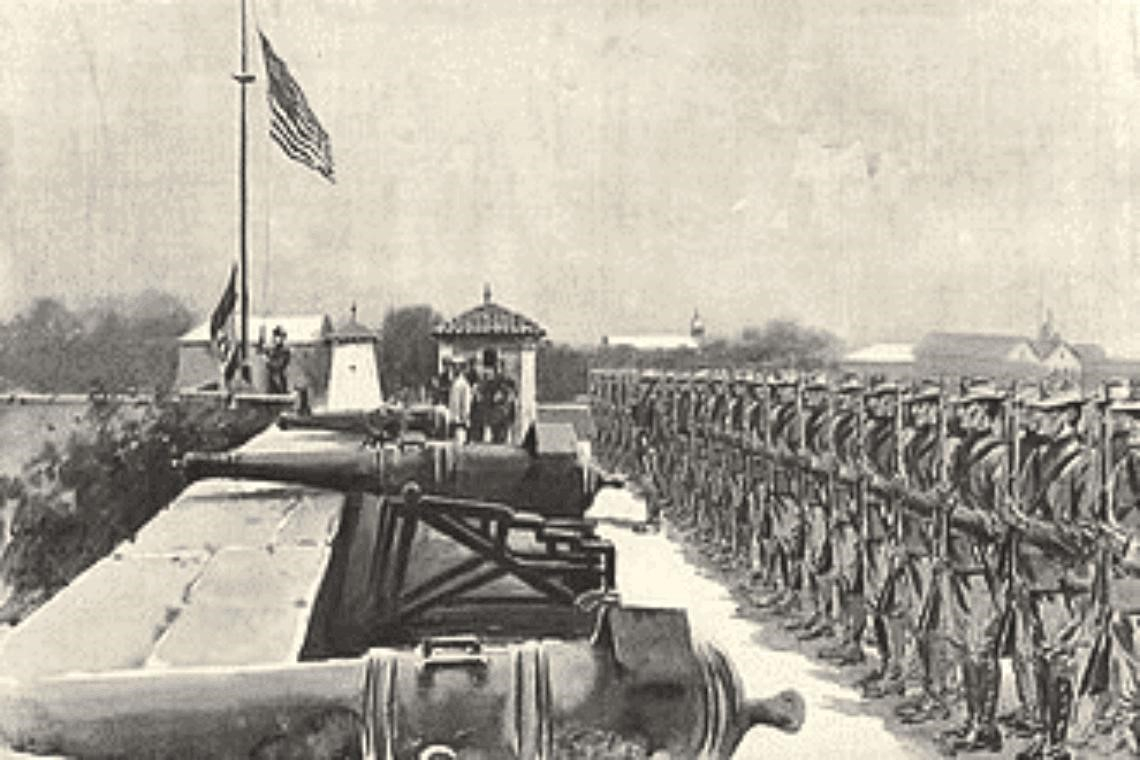
On August 13, 1898, a staged battle transferred Manila from Spain to the United States while Filipino revolutionaries were kept outside the city they had helped liberate. Source: Harper's Pictorial History of the War with Spain.
U.S. Commodore George Dewey and Spanish Governor-General Fermín Jáudenes secretly negotiated an arrangement allowing Spain to surrender Manila to American forces after a limited engagement, while Filipino revolutionary forces under Emilio Aguinaldo were kept out of the city.
The arrangement was intended to allow Spain to preserve its honor while giving the United States control of the strategic capital. Filipino forces, however, had already fought Spain and surrounded Intramuros, the walled center of Manila, making their exclusion from the surrender especially significant. The success of the plan depended on keeping Filipino troops outside the city while American and Spanish forces carried out the agreed performance.
The racial dimension of the episode is difficult to separate from its political consequences. U.S. General Wesley Merritt later described his instructions as being not to recognize or negotiate with Filipino leaders, while the Spanish commander was reportedly unwilling to surrender Manila to Filipinos. These attitudes reflected a colonial hierarchy in which European and American authorities treated Filipinos as subjects rather than as an independent political force capable of determining the country's future.
"These attitudes reflected a colonial hierarchy in which European and American authorities treated Filipinos as subjects rather than as an independent political force capable of determining the country's future."
That exclusion mattered because Filipino revolutionaries were not passive observers of Spain's defeat. Aguinaldo's forces had captured territory, surrounded Manila and declared Philippine independence in June 1898, although the United States did not recognize that declaration. The United States ultimately chose annexation rather than simply liberating the Philippines from Spanish rule.
The consequences became clearer months later. The Treaty of Paris, signed on December 10, 1898, transferred the Philippine Islands from Spain to the United States in exchange for $20 million, without the Filipino revolutionary government being a party to the agreement. The treaty therefore transformed what many Filipinos understood as a struggle for independence into a new conflict over American sovereignty.
"The lesson was stark, showing that defeating one empire did not necessarily mean gaining the freedom to govern oneself."
By February 1899, Filipino forces were fighting the United States in the Philippine-American War. What had appeared in 1898 to some Filipinos as cooperation against a common colonial power had become a confrontation with another foreign power seeking control of the islands. The lesson was stark, showing that defeating one empire did not necessarily mean gaining the freedom to govern oneself.
Updated headlines for free, straight to your inbox—no noise, just facts.
We collect your email only to send you updates. No third-party access. Ever. Your privacy matters. Read our Privacy Policy for full details.
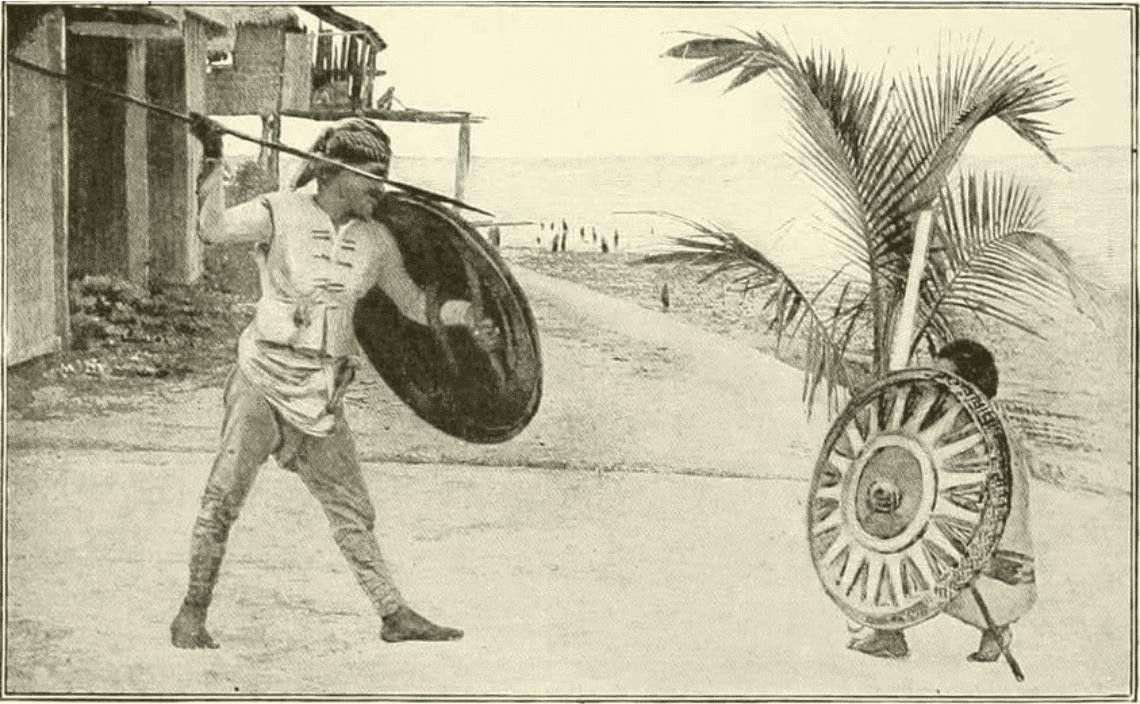
Tausug warriors in full regalia around 1899. Source: Philippine History and Current Events Facebook.
The history becomes particularly relevant when viewed from the southern Philippines, where Tausug communities had their own political traditions and resisted successive attempts by outside powers to impose direct control. After Spain's withdrawal, the United States confronted resistance in Sulu, including the violent Battle of Bud Dajo in 1906, where hundreds of Tausug men, women and children were killed during an American assault. Philippine senators later honored those who died there as martyrs of freedom, while the Bangsamoro government has commemorated Bud Dajo as part of the Tausug resistance to foreign occupation.
"The pattern is worth remembering because sovereignty in Sulu was not simply an empty space waiting to be administered by a colonial government."
The pattern is worth remembering because sovereignty in Sulu was not simply an empty space waiting to be administered by a colonial government. The Sultanate of Sulu had its own political authority, diplomatic relationships and territorial claims, even as those claims and relationships changed over centuries. The later Bates Treaty of 1899, for example, brought the Sulu Sultanate into a new relationship with the United States and illustrates how foreign powers negotiated directly over authority in the region.
The modern Sulu story shows that old questions of sovereignty do not disappear when colonial administrations leave. The recent international arbitration dispute involving the supposed heirs of the Sultanate of Sulu demonstrates how a nineteenth-century agreement can still generate enormous political and legal consequences across borders. In December 2025, the Paris Court of Appeal annulled the $14.92 billion arbitration award against Malaysia, finding that the arbitrator lacked jurisdiction and that no valid arbitration agreement bound Malaysia.
"The broader lesson is that sovereignty, self-government and territorial questions become dangerous when the people most directly connected to a history are repeatedly displaced from decisions made about them by distant powers, whether those decisions occur on a colonial battlefield, in a diplomatic treaty or in a foreign courtroom."
The broader lesson is that sovereignty, self-government and territorial questions become dangerous when the people most directly connected to a history are repeatedly displaced from decisions made about them by distant powers, whether those decisions occur on a colonial battlefield, in a diplomatic treaty or in a foreign courtroom.
REFERENCES
Manila Bulletin. (2020, August 18). Mock battle, real betrayal. Manila Bulletin. https://mb.com.ph
Reuters. (2025, December 11). French court annuls cash bid by late sultan's heirs in Malaysia land dispute. Reuters. https://www.reuters.com
Sulu Online Library. (n/a). US Army and the Moro Wars. Sulu Online Library. https://suluonlinelibrary.wordpress.com

KnowSulu is your trusted source for verified facts, news, and legal insights about the Sulu region. Committed to integrity, our mission is to empower the people of Sulu by providing accurate, transparent, and reliable information that matters.
